THE SHIFT Every Supercar has a Story. Live it with Us.
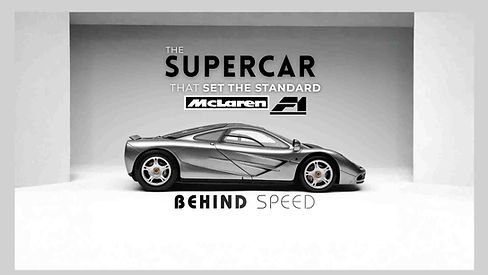
POLE POSITION
Speed is usually measured in numbers.
Horsepower. Top speed. Lap times.
The McLaren F1 was never meant to chase records,
yet it became the fastest road car in the world.
Not by ambition. By clarity.
This is the story of how a single moment, a flight home from Monza, turned an idea into the most uncompromising road car ever built.
THE FLIGHT FROM MONZA
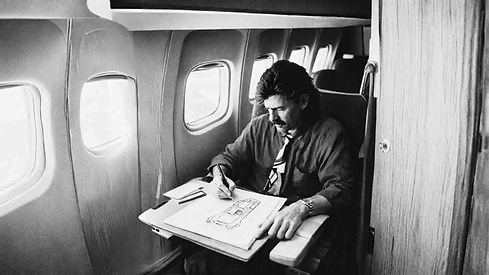
In 1988, after the Italian Grand Prix, Gordon Murray boarded a flight from Monza to London.
McLaren had just won the championship.
Everything was working.
At cruising altitude, Murray began sketching.
Not a race car. A road car.
Light. Pure. Center-driven.
Built without marketing restrictions or regulatory compromise.
By the time the plane landed, the McLaren F1 already existed on paper.
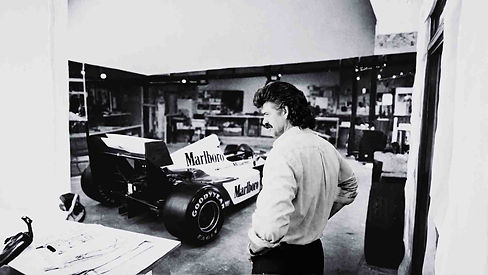
THE QUESTION NO ONE WAS ASKING
The late 1980s were loud.
Supercars were becoming heavier, wider, more theatrical.
Power increased, feedback disappeared.
Murray asked a question no one else dared to ask.
What if lightness mattered more than power?
What if driving feel mattered more than spectacle?
What if the driver was placed at the literal center of the experience?
The F1 was not a response to rivals.
It was a rejection of the direction.
THE PEOPLE BEHIND THE IDEA
This was never a one-man project.
Ron Dennis gave Murray freedom, rare, absolute, and unprotected by market logic.
McLaren engineers followed a vision that refused shortcuts.
Suppliers were chosen not by contracts, but by competence.
Every contributor understood the same rule, nothing enters the car unless it earns its place.
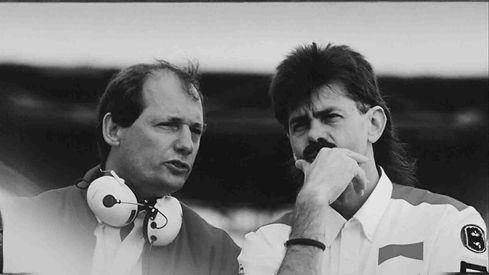
Ron Dennis and Gordon Murray

THE CENTER SEAT WAS INEVITABLE
The most radical decision came first.
The driver would sit in the center.
Not for drama, but for balance, visibility, and symmetry.
Two passenger seats sat slightly behind, angled inward.
This was not innovation for attention.
It was the purest solution.
Once seen, it couldn’t be unseen.

Gordon Murray and Peter Stevens
DESIGN AS CONSEQUENCE
The McLaren F1 was never styled. It was resolved.
Gordon Murray and Designer Peter Stevens didn't make the car dramatic.
Every surface exists because something sits beneath it.
Every intake has a reason.
Every line follows airflow, cooling, or packaging.
There are no visual tricks. No excess gestures.
The F1 looks the way it does because it could not look any other way.
Design, here, is not expression.
It is consequence.
NO FILTERS BETWEEN DRIVER AND MACHINE
Electronics were left out on purpose.
No power steering. No traction control. No ABS.
Not because technology was the enemy, but because it changed the conversation between car and driver.
The McLaren F1 didn’t filter what was happening.
It passed it straight through.
If you made a mistake, you felt it.
If you got it right, you knew why.
Driving it meant taking responsibility for every input.


THE SEARCH FOR AN ENGINE
McLaren did not build engines.
So Murray went shopping, not for power figures, but for philosophy.
Turbocharging was dismissed immediately.
Response mattered more than numbers.
What he wanted was impossible, a naturally aspirated V12, light, compact, bulletproof.
BMW listened.
PAUL ROSCHE’S ANSWER
At BMW Motorsport, one man understood the request.
Paul Rosche had already shaped legendary engines,
including Formula One powerplants.
He didn’t offer a modified unit.
He proposed a clean-sheet engine.
The S70/2, 6.1 liters, naturally aspirated, 627 horsepower.
Instant response.
Mechanical honesty.
An engine worthy of restraint.

Paul Rosche and the McLaren F1 engine

ENGINEERING WITHOUT VANITY
Some of the most important decisions weren’t visible at all.
The engine bay was lined with gold foil, not for luxury, but because gold reflects heat better than any other material.
Cost wasn’t the priority.
Doing the job properly was.
Every choice on the F1 followed the same rule.
If it worked better, it went in.
If it didn’t, it stayed out.
CARBON,
BEFORE IT WAS FASHIONABLE
The F1 became the first road car with a full carbon-fiber monocoque.
At the time, this was racing technology, expensive, risky, and unproven at road-car scale.
But Gordon Murray had spent a career learning the same lesson, lightness is not a tactic, it is a philosophy.
McLaren did it anyway.
Lightness was not a feature.
It was the foundation everything else depended on.

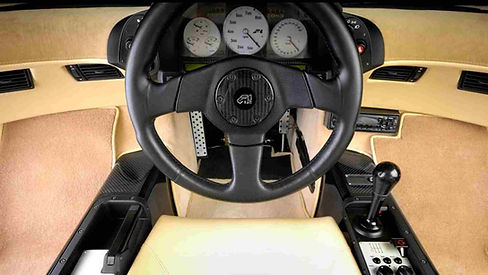
A CABIN DESIGNED,
NOT DECORATED
Inside, everything had a purpose.
Controls were placed where your hands naturally go, not where they looked best.
The pedals were properly aligned.
Visibility was clear in every direction.
Even the luggage was shaped specifically for the car, because balance still mattered when it was loaded.
This wasn’t about luxury.
It was about doing things properly.
A ROAD CAR THAT WON LE MANS
The McLaren F1 was never meant to race.
But customers insisted. And McLaren listened.
In 1995, the F1 GTR won Le Mans outright.
Driven to victory by
Yannick Dalmas, J.J. Lehto, and Masahiko Sekiya.
A road car, barely altered, defeating machines built only to race.
It wasn’t dominance.
It was proof.


RECORDS WITHOUT INTENTION
In 1998, the McLaren F1 set the production car speed record at 386 km/h.
No active aerodynamics.
No hybrid assistance.
No electronic enhancement.
Just power, lightness, and stability.
The record mattered less than the method.
A CAR FROM A CLOSED WINDOW
The McLaren F1 could not be built today.
Not for lack of technology, but because the conditions that allowed it to exist are gone.
Regulations tightened.
Complexity replaced clarity.
The F1 came from a narrow moment, when engineering freedom still existed.
That window closed quietly behind it.


Ron Dennis, Gordon Murray and Paul Roshe with the McLaren F1 XP5 Prototype
BEHIND SPEED
The McLaren F1 was not chasing the future.
It was perfecting a moment.
A machine born on a flight from Monza, shaped by people who said no more than yes, and built with absolute conviction.
Behind the speed, there was clarity.
And that is why it still stands alone.
McLaren F1 Specs & Performance
Engine: 6.1L naturally aspirated V12 (BMW S70/2)
Power: 627 hp @ 7,400 rpm • Torque: 651 Nm
Transmission: 6-speed manual • Drivetrain: Rear-wheel drive
Weight (dry): 1138 kg
0–100 km/h: 3.2 seconds • 0–200 km/h: 11.1 seconds
Top Speed: 386 km/h (production car record, 1998)