THE SHIFT Stories from Car Culture

MOTION IN ART
Motion has always obsessed artists.
Painters chased it with blurred lines.
Sculptors froze it in tension.
Photographers tried to trap it mid-gesture.
BMW did something radical.
They handed motion a steering wheel.
Not to illustrate speed, but to submit art to it.
This is the story of the BMW Art Cars, where motion isn’t depicted, it is experienced at full throttle.
THE ORIGIN 1975
The idea didn’t come from a boardroom.
It came from a racing driver.
French racer and auctioneer Hervé Poulain believed art didn’t belong on walls alone.
In 1975, he invited Alexander Calder to paint his BMW 3.0 CSL, then raced it at Le Mans.
The precedent was set.
These would not be showpieces.
They would be athletes.
Art, exposed to speed, heat, vibration, and risk.


MOTION AS A RULE,
NOT A METAPHOR
From the beginning, one rule mattered:
The cars must move.
They would race. They would age. They would wear scars.
Unlike traditional art, perfection was not preserved.
Motion would finish the work.
Each Art Car became a collaboration between:
-
The artist
-
The engineer
-
Time itself
THE FULL
BMW ART CAR COLLECTION (1–20)
A half-century of art history, in motion:
-
Alexander Calder, BMW 3.0 CSL (1975)
-
Frank Stella, BMW 3.0 CSL (1976)
-
Roy Lichtenstein, BMW 320i Turbo (1977)
-
Andy Warhol, BMW M1 Group 4 (1979)
-
Ernst Fuchs, BMW 635 CSi (1982)
-
Robert Rauschenberg, BMW 635 CSi (1986)
-
Michael Nelson Jagamara, BMW M3 Group A (1989)
-
Ken Done, BMW M3 Group A (1989)
-
Matazo Kayama, BMW 535i (1990)
-
César Manrique, BMW 730i (1990)
-
A. R. Penck, BMW Z1 (1991)
-
Esther Mahlangu, BMW 525i (1991)
-
Sandro Chia, BMW M3 GTR Prototype (1992)
-
David Hockney, BMW 850 CSi (1995)
-
Jenny Holzer, BMW V12 LMR (1999)
-
Olafur Eliasson, BMW H2R (2007)
-
Jeff Koons, BMW M3 GT2 (2010)
-
John Baldessari, BMW M6 GTLM (2016)
-
Cao Fei, BMW M6 GT3 (Digital/AR, 2017)
-
Julie Mehretu, BMW M Hybrid V8 (2024)

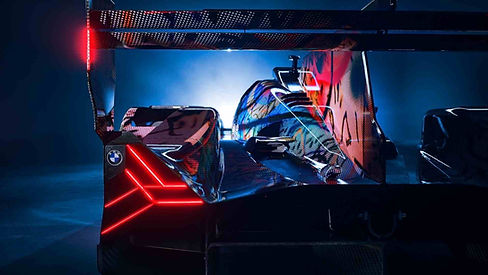
BMW M Hybrid V8
Julie Mheretu 1979
WHY SOME ART CARS MATTER MORE THAN OTHERS
All Art Cars are important.
But not all define motion equally.
Some introduced new ways of seeing speed.
Others redefined how art interacts with engineering, culture, or data.
I selected these not because they are the most famous, but because they reveal something essential.
In them, motion stops being decoration.
It becomes structure. It becomes tension. It becomes language.
.
ANDY WARHOL 1979
MOTION AS SPEED ITSELF
Warhol didn’t delegate.
He didn’t sketch.
He painted the BMW M1 himself, in under an hour.
Brushstrokes were left raw.
Uneven.
Fast.
He wanted the car to look unfinished, because speed never is.
This wasn’t Pop Art.
It was velocity captured in pigment.
Warhol didn’t paint a racing car.
He painted racing.


ROY LICHTENSTEIN 1977
MOTION AS GRAPHIC LANGUAGE
Lichtenstein approached motion analytically.
Lines became airflow.
Dots became vibration.
Color became direction.
His BMW 320i Turbo looks like a technical diagram mid-explosion, a car turned into visual telemetry.
Speed, translated into symbols.
ESTHER MAHLANGU 1991
MOTION AS RHYTHM & HERITAGE
Mahlangu brought something no one else had.
Cultural motion.
Her Ndebele patterns don’t suggest speed, they suggest continuity.
Movement across generations.
Across memory.
On a BMW 525i, ancestral rhythm meets German precision.
Motion here is not acceleration.
It’s belonging.


JEFF KOONS 2010
MOTION AS ENERGY
Koons treated motion like stored electricity.
Explosive color fragments radiate from the BMW M3 GT2 as if the car is permanently mid-impact.
It feels unstable.
Restless.
Alive.
A sculpture that looks like it’s trying to outrun itself.
JENNY HOLZER 1999
MOTION AS LANGUAGE
Holzer didn’t paint color. She painted words.
On the BMW V12 LMR, text runs across the body like a current.
Statements about power, protection, survival.
This car raced at Le Mans. Which means the words weren’t static.
They moved at 300 km/h.
Language, under aerodynamic pressure.
Motion here isn’t visual blur. It’s meaning carried at speed.

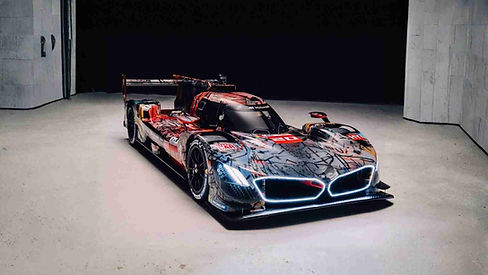
JULIE MEHRETU 2024
MOTION AS DATA AND TIME
The newest Art Car moves in layers.
Mehretu’s BMW M Hybrid V8 uses 3D-mapped abstraction based on her painting Everywhen.
It raced at Le Mans.
Covered in data-like chaos.
A machine wrapped in compressed time.
This is motion in the digital age.
Fragmented.
Overlapping.
Relentless.
ART, ON THE MOVE
Most art resists time.
Museums protect it from light, from dust, from friction.
The BMW Art Cars did the opposite.
They accepted abrasion. Heat cycles. Mechanical stress.
They allowed motion to finish the work.
That is what makes them relevant.
Not celebrity names. Not anniversary exhibitions. Not auction value. Relevance.
Because speed is one of the defining conditions of modern life.
And these cars did not illustrate that condition.
They entered it.
Art, tested at racing velocity. That remains radical.
