THE SHIFT Stories from Car Culture

ENGINEERED, NOT PERFORMED
I didn’t expect to feel emotional watching a car show.
But I did.
There was an episode of Top Gear in 2013, where they closed The Mall and placed Britain’s most extraordinary machines right there, in front of Buckingham Palace.
No noise.
No explanation.
No need to justify anything.
Just machines, quietly standing at the heart of the country that built them.
That moment reminded me that British speed isn’t about theatre.
It’s about identity.
It’s about a nation recognising itself in engineering.
OUR RELATIONSHIP WITH CARS
In Britain, we didn’t grow up worshipping cars.
We grew up testing them.
Ours is an island of narrow roads, unpredictable weather, and hard limits.
Cars had to work everywhere, in the wet, in the cold, on imperfect surfaces.
Speed was never about display.
It was about proof.
“Racing improves the breed.”
Jaguar Motorsport maxim

RACE COMES FIRST
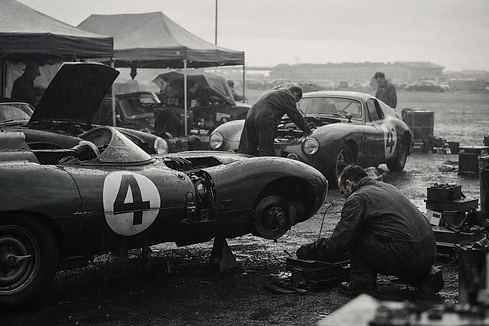
British cars weren’t born in boardrooms.
They were shaped in paddocks, sheds, and airfields.
Built by people who raced on weekends and fixed things at night.
Motorsport wasn’t a distant spectacle.
It was hands-on, local, practical.
If it worked under racing conditions, it earned its place on the road.
If it didn’t, it was rethought.
Comfort was secondary.
Always.
WHY WE BELIEVED IN LIGHTNESS
We learned early that adding power was easy thinking.
Anyone can make something faster in a straight line.
The real challenge is making it faster everywhere else.
Understanding physics, balance, and restraint mattered more than raw output.
Removing weight improved braking, cornering, feedback, and reliability.
Lightness wasn’t a design trend.
It was a belief system.
“Simplify, then add lightness.”
Colin Chapman

JAGUAR & THE LE MANS SCHOOL
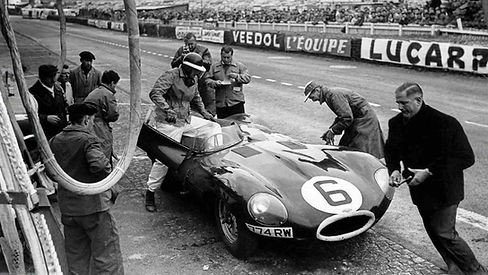
Jaguar didn’t set out to build elegant cars.
It set out to win Le Mans.
Endurance racing demanded efficiency, aerodynamics, and mechanical sympathy.
Every shape, every surface, every decision had a reason.
The beauty people talk about today was never the goal.
It was the consequence of solving the problem correctly.
“A car’s shape should be dictated by physics, not fashion.”
Malcolm Sayer
THE E-TYPE, FROM OUR SIDE
The E-Type shocked the world.
But in Britain, it simply made sense.
Long bonnet for the engine.
Cabin pushed back for balance.
Nothing decorative, nothing wasted.
It wasn’t styled to impress.
It was engineered to go fast, and to keep going fast.

LOTUS & INTELLECTUAL SPEED
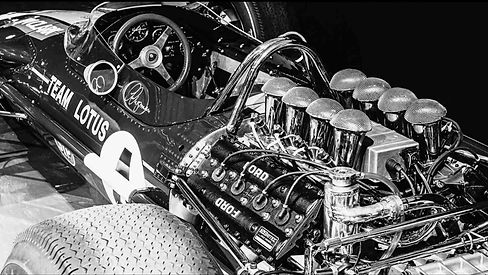
Lotus taught us that speed starts in the mind.
Every component had to justify its existence.
Every gram removed was a competitive gain.
British minimalism was never about purity or aesthetics.
It was about advantage.
Thinking faster than your rival often mattered more than being stronger.
“Adding power makes you faster on the straights. Subtracting weight makes you faster everywhere.”
Colin Chapman
DOING MORE WITH LESS
British engineers rarely had the biggest budgets.
So they learned to question assumptions.
To re-engineer problems rather than outspend them.
This culture produced solutions that were clever, not excessive.
Elegant, not indulgent.
Ingenuity wasn’t ambition.
It was survival.
“When you can’t outspend them, you outthink them.”
Gordon Murray

McLAREN & DOING IT PROPERLY
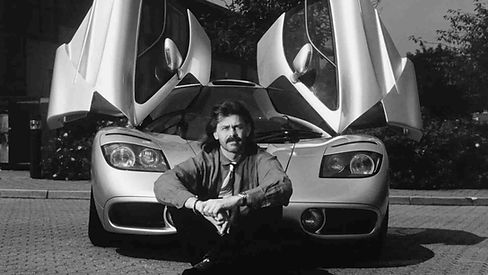
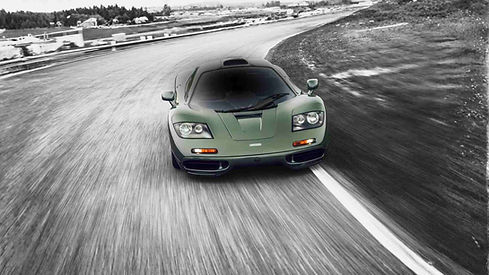
The McLaren F1 was never designed to impress customers.
It was an engineering argument, carefully reasoned and unapologetic.
Central driving position.
No driver aids.
No unnecessary mass.
Every decision answered a single question, does this make it better?
“I never design a car to be beautiful. I design it to work.”
Gordon Murray
WHY IT STILL MATTERS
Decades later, the F1 still feels honest.
Because it ignored trends.
Ignored fashion.
Ignored marketing noise.
British engineering doesn’t chase relevance.
It waits for time to confirm it was right.

BENTLEY BEFORE THE POLISH
Before leather, veneer, and refinement, Bentley was about endurance.
Le Mans wasn’t about elegance.
It was about lasting longer than everyone else.
British speed understands that resilience and character are inseparable.
Behind those early victories were the Bentley Boys, privateers, adventurers, and racers who pushed their own money, their own cars, and themselves to the limit, proving that endurance was as much about character as it was about engineering.
“To build a fast car, a good car, the best in its class.”
W.O. Bentley
SPEED IS NOT DRAMA
British performance doesn’t confuse speed with noise.
Sometimes speed is grip.
Sometimes it’s balance.
Sometimes it’s restraint.
True performance doesn’t need to shout to be understood.
“Speed is nothing without control.”
Jackie Stewart

MINI & QUIET DEFIANCE
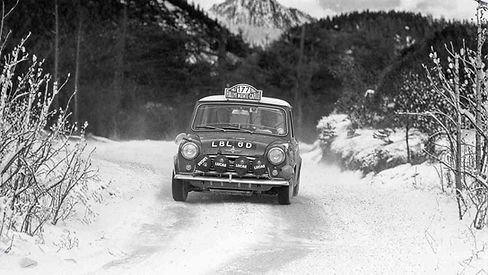
The Mini didn’t overpower its rivals.
It embarrassed them.
Small, light, and cleverly packaged, it proved that intelligence could defeat brute force.
That quiet defiance still feels unmistakably British.
“It wasn’t about power. It was about cleverness.”
Paddy Hopkirk
WHERE WE RACED
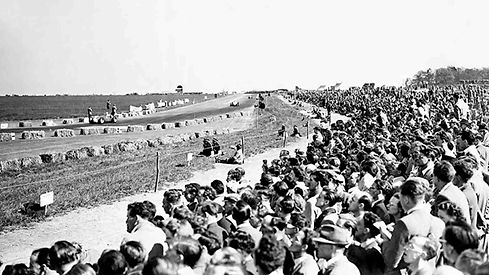
Silverstone was an airfield.
Goodwood was practical land.
Brands Hatch was improvised.
We didn’t wait for perfect conditions or perfect venues.
We raced where we could, with what we had.
That pragmatism shaped British motorsport culture.

THE DRIVER ALWAYS MATTERED
Steering was heavy because it needed to be.
Pedals spoke clearly.
Feedback wasn’t filtered, it was essential.
Driving was never meant to be passive.
It was a dialogue between human and machine.
Driving isn’t consumption. It’s participation.
“The driver must always be the most important component.”
Gordon Murray
NO PRETENSE, NO APOLOGY
British performance never needed to shout at me.
It never tried to convince me it was special.
It simply got on with the job.
Some of the greatest British cars I’ve driven or admired didn’t feel dramatic at first glance.
They revealed themselves slowly, through balance, feedback, and honesty.
There was no posturing. No excess theatre.
No need to explain what they were trying to be.
They trusted the driver to understand.
And if you didn’t, that was fine too.
British cars never asked for validation.
They just worked, and let the results speak.


WHY THIS STILL RESONATES
In a world increasingly filled with screens, artificial sound, and simulated emotion, this way of thinking feels almost rebellious to me.
I miss machines that speak honestly.
That ask something back.
That don’t try to entertain me, but engage me.
Mechanical. Honest. Human.
“Feel is everything.”
Nigel Mansell
SPEED AS A CODE
For us, performance was never marketing.
It was a matter of principle.
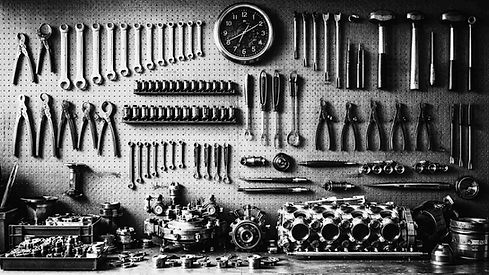
Every decision had to earn its place.
If it didn’t make the car better, it didn’t belong.
That simple rule shaped not just machines, but the engineers and drivers who believed in them.
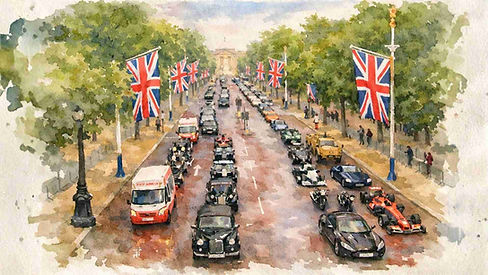
THAT MOMENT ON THE MALL
That’s why that moment on The Mall stayed with me.
Seeing those machines placed quietly at the very heart of London felt deliberate, almost respectful.
No spectacle. No ego.
Just engineering standing on its own, confident enough not to explain itself.
History, restraint, and pride, expressed without a single word being needed.
RACE FIRST. ALWAYS.
Race first. Passengers later.
It sounds simple, almost blunt, but that idea shaped the cars we built, the engineers we trusted, and the victories we remember.
British speed never asked to be admired.
It never needed applause.
But if you’re British, standing in front of it, feeling what it represents, it’s impossible not to feel proud.
