THE SHIFT Stories from Car Culture

THE DECADE OF EXCESS
The 1980s were different.
Louder, sharper, faster.
It was the decade when excess stopped being a flaw and became an identity.
Speed became culture. Design became statement.
The supercar stepped beyond engineering and entered global consciousness, shaped as much by cinema, music, and ambition as by horsepower and performance figures.
A NEW ERA BEGINS
Early 1980s
Before the 1980s, fast cars existed, but the supercar as a complete concept was still forming.
The ’80s changed that forever.
Performance alone was no longer enough.
A supercar had to look radical, feel dangerous, and project confidence even when standing still.
Presence became as important as speed.


THE WORLD IN TRANSITION
1980-1985
The global mood was electric and optimistic.
Silicon Valley accelerated technological ambition.
Tokyo emerged as a design and industrial powerhouse.
Hollywood amplified dreams on a global scale.
In this environment, the supercar evolved into a symbol of progress and aspiration, reflecting a world convinced the future would arrive faster than ever.
THE SHAPES OF SPEED
1980s Design Language
The 1980s introduced a new visual language.
Wedges replaced curves. Flat noses, sharp edges, pop-up headlights, wide intakes, and exaggerated proportions became the norm.
Cars no longer looked organic or romantic.
They looked engineered, intentional, and assertive.
The supercar found a silhouette that communicated speed without movement.

1988
Cizeta-Moroder V16T

LAMBORGHINI COUNTACH
1974-1990
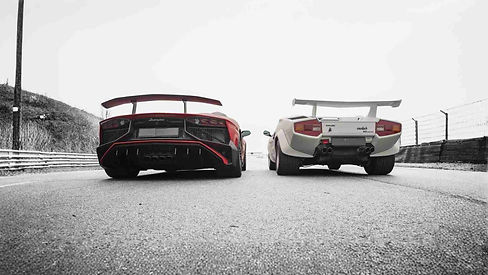
No car shaped the imagination of the 1980s more than the Lamborghini Countach.
Though launched in 1974, it became an icon during the ’80s, especially with the LP5000 QV.
Its V12 wedge rejected moderation entirely.
The Countach wasn’t designed to please everyone.
It was designed to dominate attention and redefine what a supercar could look like.
FERRARI TESTAROSSA
1984
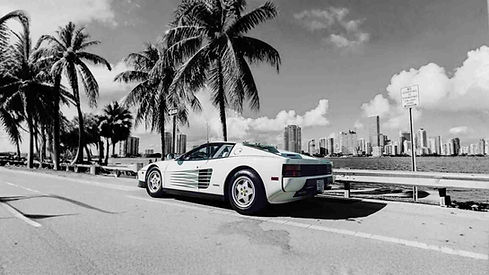
Introduced in 1984, the Ferrari Testarossa marked a turning point for Ferrari design.
Its wide rear track, dramatic side strakes, and flat-12 engine created one of the most recognizable silhouettes in automotive history.
With 390 hp and unmistakable proportions, the Testarossa wasn’t just a Ferrari, it became a visual signature of the decade itself.


MIAMI VICE & POP CULTURE
1984-1989
Before the Testarossa, Miami Vice featured a black Ferrari Daytona replica built on a Corvette chassis.
Ferrari objected. In 1986, the brand supplied the show with two real Testarossas.
Repainted white for television impact, the car became inseparable from the series. Ferrari didn’t just appear on screen, it became part of 1980s visual culture.
PLACE AS IDENTITY
Mid-1980s
Supercars of the 1980s were inseparable from place.
Miami’s neon nights.
Tokyo’s elevated expressways.
Monaco’s marinas.
Desert highways at midnight.
These cars weren’t merely driven, they were staged.
They represented lifestyles as much as performance, becoming visual shorthand for success, rebellion, and modern ambition.

PORSCHE 959
1986
Released in 1986, the Porsche 959 arrived as a technological shockwave.
Twin-turbo power, advanced all-wheel drive, adjustable suspension, and wind-tunnel-developed aerodynamics placed it years ahead of its rivals.
With a top speed of 317 km/h, the 959 wasn’t just fast, it redefined what a road car could be, intellectually and technically.
FERRARI F40
1987
Unveiled in 1987 for Ferrari’s 40th anniversary, the F40 was the last model approved by Enzo Ferrari himself.
Kevlar panels, a twin-turbo V8, minimal insulation, and a ruthless focus on weight defined it.
At just 1100 kg, the F40 wasn’t built to comfort.
It was built to deliver unfiltered speed and emotion.


THE TECHNOLOGY BOOM
1980s
The 1980s transformed how performance cars were built.
Turbocharging became widespread.
Electronics entered the driving experience.
Wind tunnels replaced intuition.
Materials like Kevlar, carbon fiber, and advanced alloys moved from racing into production cars.
Supercars grew more complex, more capable, and increasingly defined by engineering innovation.
THE CULTURE OF SPEED
1980s Media
MTV, VHS, arcade racers, glossy magazines, and prime-time television turned supercars into cultural icons.
Posters filled bedroom walls.
Title sequences and chase scenes made cars into stars.
Even those who would never own a supercar felt emotionally connected to them.
Speed became fantasy, aspiration, and escape.


1989
Nissan Skyline GT-R
JAPAN PREPARES ITS MOVE
1980–1989
While Europe dominated headlines, Japan refined its approach quietly.
Turbo technology matured.
Manufacturing precision improved.
Motorsport programs gained confidence.
The discipline developed during the 1980s laid the foundation for the performance icons of the 1990s.
Cars like the NSX, Supra, and GT-R were made possible by this decade of preparation.
THE AERODYNAMICS SHIFT
Mid-1980s
In the 1980s, aerodynamics stopped being invisible.
Spoilers, diffusers, and ground-effect thinking moved from racetracks to public roads.
Downforce became a design objective rather than a hidden benefit.
The decade didn’t just influence how cars looked, it established aerodynamic principles that still define supercar design today.


THE ENGINEERING ARMS RACE
1980s
Each manufacturer pursued a distinct philosophy.
Ferrari focused on emotion.
Lamborghini embraced shock and drama.
Porsche chased intelligence and efficiency.
Lotus explored lightness.
De Tomaso preserved raw aggression.
There was no single definition of the perfect supercar, and that diversity of thought defined the richness of the decade.
BEHIND THE MACHINES
Behind the cars were visionaries willing to take risks.
Marcello Gandini shaped the wedge era.
Leonardo Fioravanti blended aerodynamics with beauty.
Nicola Materazzi mastered turbocharging for Ferrari.
Helmuth Bott led Porsche’s technological charge.
The 1980s were defined as much by people as by machines.

Helmuth Bott (center)

Porsche team testing the 959
FAILURE & EXPERIMENTATION
Not every experiment succeeded.
Turbo lag could be brutal.
Electronics were immature.
Cooling, handling, and reliability were sometimes compromised.
Some cars were unpredictable, even intimidating.
But failure was accepted as the price of progress.
The 1980s rewarded brands that dared to experiment, even when outcomes were uncertain.
THE DRIVER REQUIRED
1980s Reality
Supercars of the 1980s demanded respect.
No traction control.
No stability systems.
Sometimes no ABS.
Power arrived suddenly, and mistakes were punished.
The driver was not assisted or protected, but exposed.
Speed had to be earned, making the experience visceral, demanding, and deeply engaging.

THE LEGACY OF THE DECADE
Everything that defines the modern supercar traces back to the 1980s.
The stance, the proportions, the obsession with aerodynamics, and the fusion of culture with engineering.
This decade didn’t just refine performance, it established the emotional and visual blueprint that brands continue to follow today.
A DECADE I LIVED
The 1980s proved that a supercar is not defined by numbers, luxury, or logic.
It is defined by emotion, expressed through shape, sound, and presence.
For someone who lived the 1980s intensely, these cars are inseparable from memory.
From posters on bedroom walls to TV screens glowing late at night, they shaped how speed, ambition, and desire first felt.
No decade captured that feeling more honestly, more boldly, or more forever than the 1980s.
And I was lucky enough to live them.
