THE SHIFT Stories from Car Culture

BEFORE DESIGN WAS “DESIGN”
1947 – Early 1950s
In the early years, Ferrari did not “design” cars in the modern sense.
It built machines around engines, suspensions, radiators, and fuel tanks. Bodies were answers to mechanical questions, not expressions of style.
Beauty appeared not because it was pursued, but because function was honest. When nothing is added for effect, form becomes timeless by default.
Ferrari’s earliest shapes were born this way, unselfconscious, raw, and authentic.
Before designers, there were craftsmen.
SCAGLIETTI ENTERS THE STORY
Early 1950s
Sergio Scaglietti was not a designer with sketches and theories.
He was a craftsman who shaped aluminum by hand, adjusting curves by feel, sound, and instinct.
He once summarized his philosophy simply, often paraphrased by those who worked with him:
“I shaped the cars the way they needed to be.”
For Enzo Ferrari, that was enough. Sergio Scaglietti understood speed before it moved.
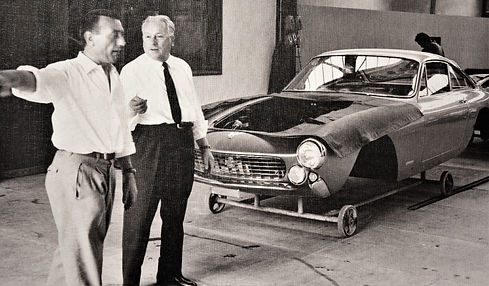
Sergio Scaglietti (left)

THE ART OF INTUITION
1950s – Early 1960s
Every curve Scaglietti formed had a reason.
Long noses for stability at speed.
Bulging fenders to clear wider tracks.
Vents placed exactly where heat demanded escape.
Scaglietti did not decorate Ferraris. He revealed them.
His work proved that instinct, when guided by racing, could produce shapes more powerful than theory.
The car told him what it needed, and he listened.
Function came first. Beauty followed.”
BODIES OF PURE PURPOSE
1957 – 1964
Under Scaglietti’s hammer, legends were born.
The 250 Testa Rossa, dramatic not by choice, but by cooling necessity.
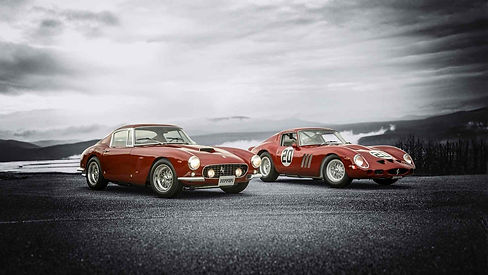
The 250 GT California, relaxed elegance shaped by balance.
The 250 GTO, perfection achieved without drawings, without theory.
These cars were not styled in studios.
They were discovered through iteration, repair, and race weekends. As Scaglietti’s legacy shows, when purpose leads, beauty follows naturally.
Instinct shaped the legends.
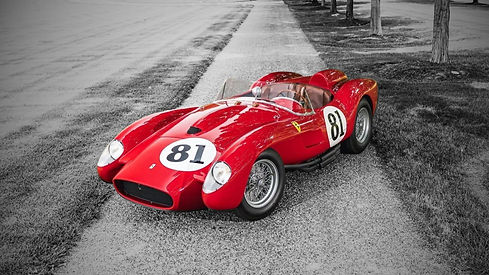
250 TESTAROSSA • 1957

250 GTO • 1962
250 GTO, A PERFECT ACCIDENT
1962 – 1964
The most revered Ferrari ever created was never meant to be art.
The 250 GTO’s long hood, compact cockpit, and muscular tail were dictated by engineering compromise and racing urgency.
Yet the result feels divine.
A reminder that true beauty often comes from instinct, not intention, and that the greatest designs are sometimes accidents of obsession.
A NEW ERA CALLS
Late 1950s
By the late 1950s, Ferrari faced a shift.
Racing success was no longer enough.
Customers wanted refinement, comfort, and visual identity.
The world wanted icons, not just winners.
Ferrari needed elegance without losing aggression.
A new voice was required. That voice came from Turin.
It was time for a new voice.
Enter Pininfarina.
Elegance became intentional.

Battista Pinin Farina and Enzo Ferrari
![3[1].jpg](https://static.wixstatic.com/media/b44a15_f7d8a2fdc4ff46d1802f1ba3415d33f9~mv2.jpg/v1/fill/w_488,h_275,al_c,q_80,usm_0.66_1.00_0.01,enc_avif,quality_auto/b44a15_f7d8a2fdc4ff46d1802f1ba3415d33f9~mv2.jpg)
250 GT Lusso • 1962
THE PININFARINA PHILOSOPHY
From 1952
Pininfarina brought clarity.
Proportion became deliberate.
Surfaces gained intention.
Beauty was no longer incidental.
Ferrari silhouettes became recognizable at a glance.
The balance between violence and grace was now controlled.
For the first time, Ferrari had a visual grammar.
Battista Pininfarina believed deeply in emotional impact, famously stating:
“A car must be beautiful, even when it is standing still.”
With him, Ferrari began to speak fluently in form.
BATTISTA PININ FARINA
1950s – 1966
Battista believed cars should move the soul before they moved the air.
Battista treated automobiles as moving sculpture.
Power and elegance were not opposites, but partners.
Under his guidance, Ferrari transitioned from purely competitive machines to objects of desire.
Ferrari was no longer just something you raced.
It became something you admired, even at rest.

Battista Pinin Farina
and Sergio Pininfarina
TWO VOICES, ONE BRAND
For a brief moment, Ferrari spoke with two voices.
Scaglietti shaped cars for the track, driven by instinct and necessity.
Pininfarina shaped cars for the road, guided by proportion and elegance.
This overlap did not dilute Ferrari. It defined it.
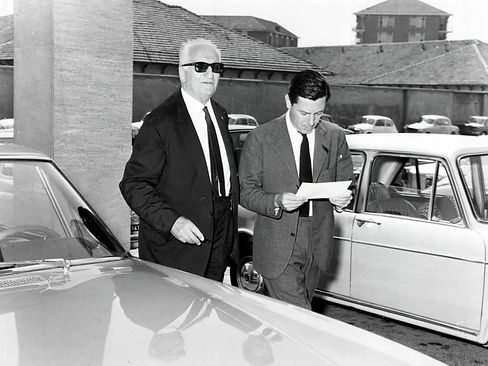
Enzo Ferrari and Sergio Pininfarina
SERGIO PININFARINA’S ERA
1966 – 2001
Sergio refined what his father started.
Lines sharpened.
Volumes became confident.
Curves learned restraint.
Ferrari matured.
The road car was no longer secondary; it became Maranello’s global signature.
He often emphasized that true elegance requires no explanation:
“Elegance does not need to be explained.”
Ferrari’s road cars became its global signature.
ICONS OF A GOLDEN AGE
1960s – 1980s
From Pininfarina’s studio came defining shapes.
250 Lusso (1962), elegance distilled.
275 GTB (1964), muscular yet refined.
Daytona (1968), long, sharp, unforgettable.
308 GTB (1975), wedge purity for a new decade.
512 BB (1976), power without excess.
They did not follow trends.
They set them.
Each model reinforced a growing visual language, unmistakably Ferrari, instantly recognizable.

275 GTB/C Speciale • 1964
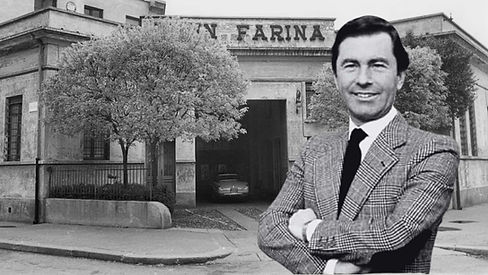
Leonoardo Fioravanti
LEONARDO FIORAVANTI
1964 - 1987
Then came Leonardo Fioravanti.
A designer fluent in aerodynamics, but guided by emotion.
Fioravanti understood that speed did not need to be explained, it needed to be felt. Numbers alone could never define desire.
Working at Pininfarina, he became the bridge between science and passion. His Ferraris were not only efficient, they were expressive. Not only fast, but unforgettable.
To Fioravanti “Aerodynamics is not everything. Emotion matters more.”
In Fioravanti’s hands, Ferrari design learned how to balance science with soul.
THE ICON MAKER
Late 1960s – 1980s
Fioravanti’s work became cultural shorthand.
Daytona, the ultimate GT.
512 BB, Ferrari’s mid-engine revolution.
308, a poster generation icon.
Testarossa (1984), loud, wide, unforgettable.
These were not just cars, they were symbols.
Posters on bedroom walls.
Shapes burned into memory.
Ferrari design had entered popular culture.

TESTAROSSA • 1984

F40 • 1987
THE FERRARI FORMULA
by the 1980s
From this era, Ferrari’s visual DNA crystallized.
Long hood.
Tight cockpit.
Powerful rear stance.
Surfaces that breathe.
Lines that communicate tension.
An anatomy recognizable even in silhouette.
Ferrari became unmistakable.
A WORLD IN TRANSITION
Late 1990s – 2000s
The new millennium changed everything.
Safety, emissions, electronics, aerodynamics.
Design could no longer ignore airflow, sensors, and regulation.
Ferrari needed evolution without erasure.
The answer was not external anymore.
It was internal.

ENZO • 2002
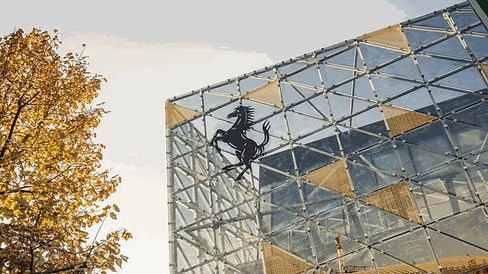
FERRARI CENTRO STILE • MARANELLO
THE BIRTH OF CENTRO STILE
2010
In 2010, the Ferrari Centro Stile in Maranello opened.
For the first time, design moved fully in-house.
Designers, engineers, and aerodynamicists worked together from the first sketch.
The goal was clear, shape the future without losing the soul.
They needed a leader who understood both beauty and data.
They chose Flavio Manzoni.
THE MANZONI PHILOSOPHY
From 2010
When Ferrari brought design in-house in 2010, it wasn’t to control style. It was to protect meaning.
For Flavio Manzoni, design is not surface or nostalgia. It is sculpture shaped by airflow, where emotion must be earned through function.
Influenced by art and architecture, from the organic tension of Anish Kapoor to the structural discipline of Italian industrial design, Manzoni approaches Ferraris as volumes carved, not lines drawn.
As he states clearly, “Aerodynamics is the new design.”
In this era, air becomes structure, surfaces carry tension, and every line has a job. Ferrari enters a phase where instinct, elegance, and technology finally converge into a single language.

FLAVIO MANZONI

F80 • 2025
THE MODERN ICONS
2013 - Present
Manzoni’s Ferraris feel alive.
LaFerrari, organic and aggressive.
812 Superfast, the last great V12 GT.
SF90, precision in motion.
296 GTB, compact and explosive.
Roma, purity revisited.
Daytona SP3, history reimagined.
F80, function stripped to its essence.
Testarossa, an icon reborn with purpose.
Different forms, same bloodline.
Ferrari evolves, but never forgets.
DESIGN IN THE AGE OF TECH
Today
Today, Ferrari blends intuition with computation.
Digital clay.
Simulations.
Virtual reality.
Yet the essence remains unchanged.
The sketch still matters.
Emotion still leads.
Technology refines, it never replaces vision.

SF90 STRADALE • 2019

SP3 DAYTONA • 2021
THE FERRARI DNA
Three eras.
Three masters.
Scaglietti, instinct.
Pininfarina, elegance.
Manzoni, aerodynamics.
Different philosophies, one obsession.
Because a Ferrari is not designed to be beautiful.
A Ferrari is designed to make you feel.