THE SHIFT Stories from Car Culture
"Some cars preserve the past. Others quietly announce the future."
Before hybrid systems.
Before software controlled nearly every aspect of performance.
Before electricity became part of Ferrari's definition.
There was the Enzo.
Not simply Ferrari's fastest road car.
Not merely the successor to the F50.
The Enzo became the bridge between two worlds.
One foot remained firmly planted in the mechanical purity that had defined Ferrari for decades.
The other stepped into an era where technology would increasingly shape the driving experience.
It was Ferrari's ultimate statement at the beginning of the 21st century.
And perhaps the last halo Ferrari where the driver remained unquestionably at the centre of the experience.
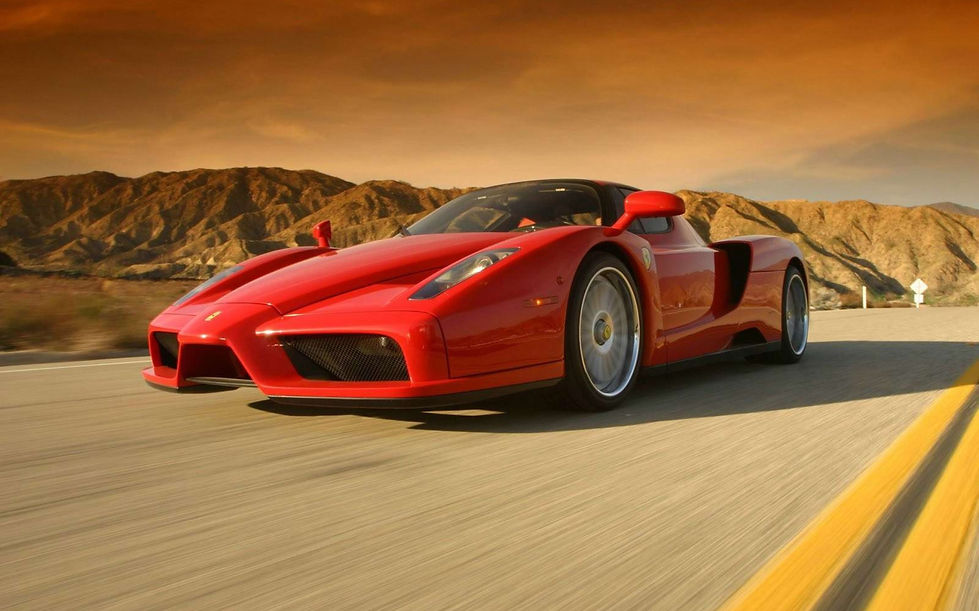
The weight of a name
Naming a Ferrari after its founder is not something Maranello does lightly.
Not after a racing driver.
Not after an engineer.
Not after a world champion.
Only one modern Ferrari carries the name Enzo Ferrari.
That decision alone revealed how important this project was.
Following the F50 was almost impossible.
The 288 GTO had created the blueprint.
The F40 had become an icon.
The F50 had brought Formula One engineering to the road.
The next halo car needed to do something different.
It needed to redefine performance for a new century.

Enzo Ferrari
Schumacher's Ferrari
The timing could not have been better.
By 2002 Ferrari wasn't simply winning Formula One.
It was dominating it.
Michael Schumacher, Ross Brawn, Rory Byrne and Jean Todt had transformed Ferrari into the benchmark of modern motorsport.
Everything learned during that golden era flowed into the Enzo.
Carbon fibre construction.
Advanced aerodynamics.
Electro-hydraulic paddle shifting.
Computational development that previous generations could only imagine.
This wasn't inspired by Formula One.
It was built by a company living Formula One every weekend.
Designed by the wind
Unlike the timeless elegance of earlier Ferraris, the Enzo looked almost unsettling when it debuted.
Sharp.
Angular.
Aggressive.
Its nose deliberately echoed a contemporary Formula One car.
Every surface existed for airflow.
The deep front splitter.
The sculpted side intakes.
The high rear diffuser.
Nothing was decorative.
The Enzo wasn't trying to be beautiful.
It was trying to be fast.
Time would eventually make it both.

Pininfarina's final halo
The Enzo wasn't simply Ferrari's flagship.
It became Pininfarina's final Ferrari halo icon.
Designed under Ken Okuyama, then Design Director at Pininfarina, the Enzo broke away from the flowing curves that had defined Ferrari for decades.
Instead, it embraced sharp surfaces, aggressive proportions and pure aerodynamic function.
Its Formula One-inspired nose divided opinion when it debuted.
Some thought it was too radical.
Others believed Ferrari had abandoned beauty.
Time proved otherwise.
Today, the Enzo stands as one of the defining automotive designs of the early 21st century.
It marked the end of an extraordinary chapter that began decades earlier with masterpieces like the Dino, Testarossa, F40 and F50.
After the Enzo, Ferrari's halo cars would no longer carry the unmistakable signature of Pininfarina.
An era quietly came to an end.

Ken Okuyama
Carbon fibre becomes the standard
Previous halo Ferraris had experimented with lightweight materials.
The Enzo fully embraced them.
Its carbon-fibre monocoque became the structural heart of the car.
The roof, chassis and body worked as a single engineering solution.
Weight dropped.
Rigidity increased dramatically.
Precision improved.
It was no longer exotic technology.
It became Ferrari's new benchmark.
The Enzo wasn't simply lighter than its predecessors.
It changed how Ferrari would build every flagship that followed.
The last great
naturally aspirated V12
At its centre sat one of Ferrari's greatest engines.
A 6.0-litre naturally aspirated V12 producing 660 horsepower.
No turbochargers.
No hybrid assistance.
Just twelve cylinders responding instantly to every movement of the throttle.
Its soundtrack rose from mechanical growl to operatic crescendo beyond 8,000 rpm.
Today, horsepower figures have moved far beyond 660.
Yet very few engines deliver emotion with the same honesty.
Because power can always be increased.
Character cannot.
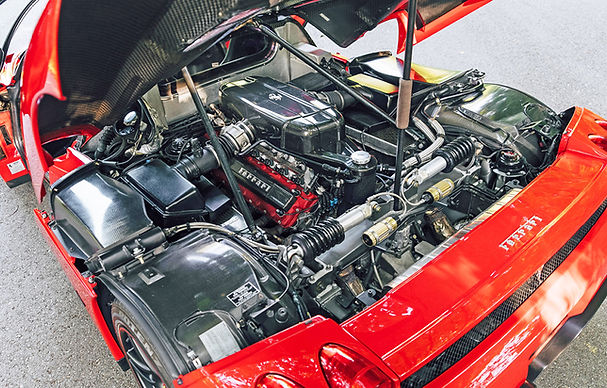
Ferrari Enzo engine bay
Refined by Schumacher
The Enzo wasn't simply developed by Ferrari engineers.
Michael Schumacher played a significant role in refining its dynamics.
Fresh from multiple Formula One World Championships, his feedback influenced steering feel, braking response and overall balance.
The objective wasn't comfort.
It wasn't forgiveness.
It was precision.
Every input.
Every corner.
Every brake application.
The car rewarded commitment rather than confidence.
Exactly as Ferrari intended.

Technology without filters
The Enzo introduced technology that would become standard years later.
Carbon-ceramic brakes.
An electro-hydraulic F1 transmission capable of remarkably fast shifts for its era.
Sophisticated traction control.
Active aerodynamic elements that adjusted automatically depending on speed and load.
Yet despite all this innovation, the Enzo never insulated the driver.
The steering remained alive.
The brakes demanded precision.
The V12 remained the dominant voice.
Technology existed to enhance the experience.
Not replace it.
That philosophy would slowly begin to change.

Enzo's Four-point seatbelts and racing-type seats
The turning point
Looking back today, the Enzo occupies a unique place in Ferrari history.
The F40 celebrated mechanical purity.
The F50 brought Formula One closer to the road than ever before.
The Enzo embraced electronics without allowing them to dominate.
The LaFerrari would introduce hybrid power.
The F80 would take that philosophy even further.
The Enzo wasn't the end of one era.
Nor was it fully part of the next.
It was the bridge between them.
The moment Ferrari crossed from the mechanical age into the digital one.
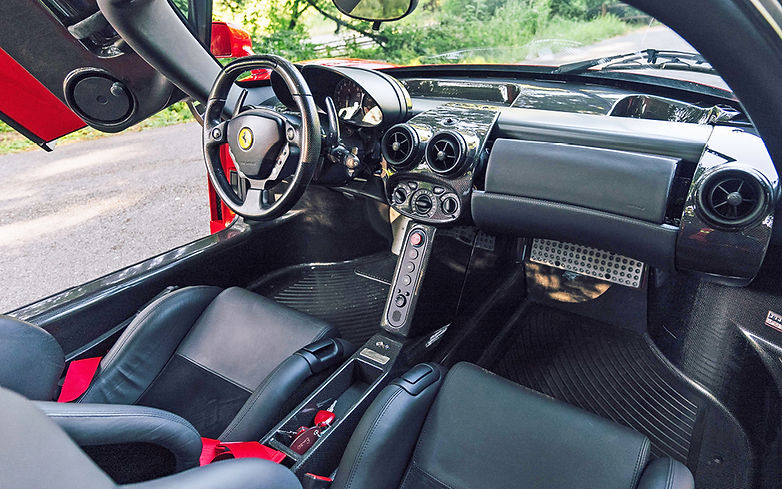
Enzo's interior
A new definition of exclusivity
Ferrari built just 399 examples.
Demand immediately exceeded supply.
So Ferrari built one final car.
Number 400.
Rather than selling it, the company donated it to be auctioned, with proceeds supporting humanitarian relief after the 2004 Indian Ocean tsunami.
Exclusivity wasn't simply about rarity.
It became part of the Enzo's mythology.
Owning one wasn't only about wealth.
It meant being invited into one of Ferrari's most exclusive chapters.

When the Enzo became a legend
History has been kind to the Enzo.
The LaFerrari became faster.
The F80 became more technologically advanced.
Yet enthusiasts continue returning to the Enzo.
Why?
Because it arrived at the perfect moment.
Modern enough to redefine performance.
Analog enough to remain deeply human.
Powerful enough to thrill today.
Simple enough that the driver still mattered most.
It was the final Ferrari halo icon before software began sharing the spotlight with the driver.
Not because technology made Ferraris less exciting.
But because the Enzo reminds us of a fleeting moment when engineering and instinct were still almost inseparable.
The Enzo wasn't the end of an era.
It was the last moment before Ferrari became something different.

