THE SHIFT Every Supercar has a Story. Live it with Us.

“Design should start with instinct, not trends.”
The GP1 is more than a hypercar.
It’s a declaration.
In an era of electrified silence, automated decision-making, and design shaped by algorithms, Angel Guerra, former designer at Rimac and Bugatti, chose another path.
One guided by instinct, emotion, and physical presence.
V12. Manual. Carbon fibre carved with intention.
The GP1 is not about looking back.
It’s about remembering what matters.
This is how a first chapter begins.
THE SPIRIT OF THE GARAGISTI
Garagisti is not just a name. It’s a mindset.
The name itself evokes rebellion.
It recalls a time when privateers, small teams, and independent thinkers challenged giants with conviction rather than resources.
That spirit gave the designer Angel Guerra freedom.
Freedom to reject current design trends, to ignore expectations, and to shape the GP1 exactly as he believed it should be.
The result isn’t nostalgia. It’s resistance.
"I didn't follow any current design trends, which I don’t think are very good. So I took the freedom to interpret the design of the GP1 the way I think it should be".

A CLEAN SLATE
Designing without heritage is both risk and privilege.
No house style.
No visual codes.
No past to protect.
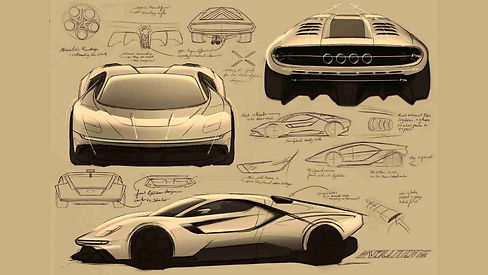
For Guerra, defining a brand’s DNA from scratch was the hardest challenge, but also the most liberating.
Garagisti wasn’t about inventing something loud or shocking. It was about distilling what makes certain cars timeless, and starting there.
"The hardest part of creating a new brand is defining its DNA — establishing a unique design language from scratch. But with Garagisti, it came surprisingly naturally. My idea was to revisit the icons — to return to the essence of what made certain cars timeless".
SCULPTED, NOT STYLED
The GP1 was never built through accumulation.
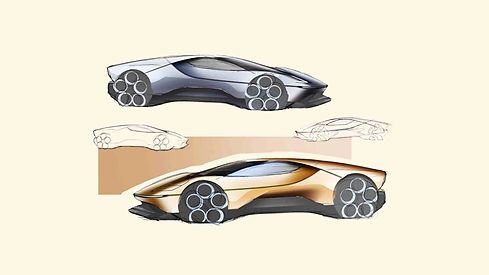
It was conceived as a single, cohesive volume, sculptural, compact, and intentional.
Like a Greek sculptor carving marble, Guerra removed mass rather than adding layers.
Every cut served clarity.
Every subtraction increased tension.
This was not design by decoration.
It was design by reduction.
“I envisioned the car as a single, cohesive volume — homogeneous yet sculptural — and from there, it was about removing mass, almost like a Greek sculptor chiseling away at marble to reveal the form within.”

DESIGN THAT BREATHES TENSION
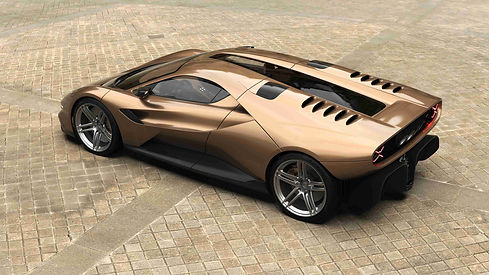
Every line on the GP1 has a job.
Curvatures were studied, tension was deliberate, and nothing was ornamental.
The graphic language is muscular, not expressive for its own sake.
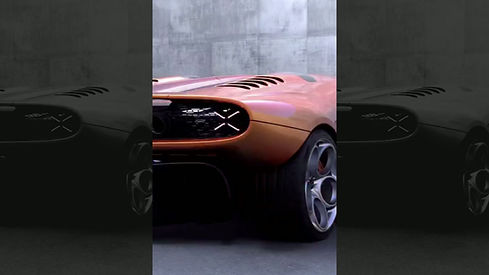
The X motif in the lights.
The line from A-pillar to rear wheel.
The visual energy wrapped tightly around the body.
A design meant to be understood instantly, even in silhouette.
When it came to the graphic design, I focused on creating lines and shapes with carefully studied curvature, introducing elements of high tension to give the car that sense of musculature. I also wanted to define a personal signature, something immediately recognizable — like the X motif in the front and rear lights, or the graphic line that begins at the A-pillar and flows toward the rear wheel, building tension around it".
THE WEDGE AS ORIGIN
What shapes you most is the period you grow up in.
For Angel Guerra, that was the 1980s and 1990s.
But when looking back further, one designer stands apart.
From the ’70s to the late ’90s, Marcello Gandini fundamentally changed automotive design.
The wedge wasn’t a style.
It was a revelation.
"To me, the designer who truly stood out from the ’70s through the late ’90s was Marcello Gandini.
Through his creations — the Lamborghini Countach and Miura, the Lancia Stratos Zero Concept…— he changed the course of automotive design.
When I look back at the style that influenced me the most, it was the wedge design, and it was Gandini who inspired me to start sketching and to fall in love with cars".


PURPOSE IN PROPORTION
The GP1 follows a radical idea, compact is not small. It’s right.
At roughly 1000 kg, with a V12 and a manual gearbox, the car was shaped around balance rather than spectacle.
Inspired by icons like the Ferrari F40 and McLaren F1, the goal was purity of package, where nothing dominates and everything belongs.
Design and engineering moved together.
"Our goal was to create a very light and compact vehicle — at least compact by today’s hypercar standards. Everything has grown so large in recent years, and we wanted to bring back the essence of the classic sports car — let’s call it “compact,” though for us it’s simply perfectly proportioned".
ENGINEERING AS ENABLER
From the start, engineering and design shared the same target.
Ideas moved freely between teams.
Designers proposed solutions.
Engineers answered with possibilities.
With former Formula 1 aerodynamicists involved, airflow became flexible, not restrictive.
The air could be guided anywhere, allowing the design to remain clean and uncompromised.
Having aerodynamic experts on board — including former Formula 1 engineers — meant that their premise was simple: they could make the air go wherever they wanted, to any part of the car. Because of that, the design was never truly compromised.

HUMAN OVER DIGITAL
Modern cars increasingly speak the language of consumer electronics.
Menus. Screens. Interfaces.
Guerra sees this as a mistake, especially in high-performance cars.
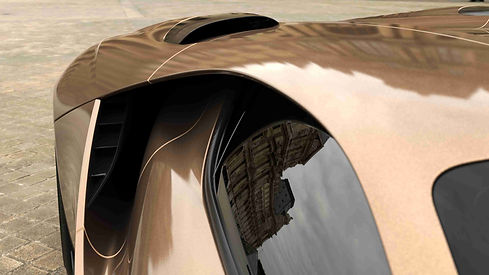
Automotive design once lived in a higher emotional realm, where surfaces felt drawn by hand and shapes carried intent.
The GP1 rejects digital blandness.
It asks to be felt, not navigated.
"My vision was to bring back a truly emotionally analog approach to design — where every volume, every line, every part you touch feels as though it was shaped by a human hand, in form, in gesture, and in volume. That’s what I mean by analog emotion: not only in the mechanical sense, but also in the essence of design itself".
THE RETURN OF ANALOG EMOTION
Analog emotion isn’t nostalgia.
It’s presence.
It’s resistance in the gearshift, weight in the controls, and surfaces that feel shaped rather than generated.
For Guerra, analog emotion must live not only in mechanics, but in design itself. In every line, volume, and gesture.
"For me, analog emotion isn’t just about the psychological aspect or mechanical engineering — it’s also about design. I believe that today there’s been a kind of blending that, in my view, doesn’t feel right within the automotive world".


THE FUTURE IS PERSONAL
As supercar brands scale up, individuality fades.
Buying a high-performance car today can feel generic, visually and emotionally.
Guerra believes this will push enthusiasts toward something else, smaller, more personal, more intentional.
Cars built for people, not markets.
"I believe we may be returning to the era — when a group of passionate individuals would come together to create the car of their dreams, commissioning it from a design houseor a small atelier".
CRAFT, NOT SCALE
Garagisti is small by choice.
Every car is a conversation.
Every surface the result of human decision, not departmental compromise.
This is automotive tailoring, not mass luxury.
A return to craftsmanship where emotion matters as much as precision.
"We’re a small company, but we offer that level of craftsmanship and personalization. I truly believe this will be the direction the supercar and hypercar industry will take in the coming years — a return to independently crafted, bespoke automobiles".

LESSONS FROM RIMAC
Joining Rimac early gave Guerra a front-row seat to growth done properly.
He witnessed how a small team evolves into a global force without losing direction, by prioritizing method over speed.
That discipline shaped his approach at Garagisti.
"From Rimac, I would take the example — the idea — of how to do things the right way. I joined Rimac when we were just fifty people, so I understand, to some extent, what it takes for a small startup to grow into a company as successful as Rimac is today. I was there; I saw the process unfold".
LESSONS FROM BUGATTI
Bugatti reinforced a different truth.
That the automobile, at its highest level, is art.
A fusion of inspiration, emotion, and technical mastery, where nothing is trivial and everything must feel intentional.
That reverence carries directly into the GP1.
"from Bugatti, I would take the love — the relentless pursuit — of expressing that the world of the automobile is, above all, art.
That’s something we must never lose sight of.
When I say art, I mean that delicate fusion of ideas, of inspiration, but also of the ultra-technical mastery that defines a true artist — not only from an artistic perspective, but also from a deeply technical one. It’s about never forgetting emotion, and always striving to be pioneers — to create something truly new".

THE FIRST SPARK
What will stay with Guerra isn’t the name of the project, nor even the design itself.
It’s the first encounter.
Meeting the people who gave life to Garagisti, and instantly feeling the shared passion they carried. That immediate recognition, when you know something meaningful is about to emerge.
Kindred spirits. A shared fire.
And above all, the freedom, the independence of turning an idea into reality, guided only by instinct and passion.
"When that kind of connection happens, you feel it immediately; you know that something extraordinary is destined to emerge from it.
What will truly stay with me is that moment of meeting kindred spirits — people who think, admire, reflect, and love the world of high-performance and automotive design as deeply as I do. That first contact, that shared fire, becomes something unforgettable".
DESIGN AS GESTURE
For Guerra, design is never just geometry or proportion.
It is a language.
A line must communicate intent, direction, and tension.
A surface must hold emotion, weight, and presence.
Digital tools can assist the process, but they cannot decide what matters. They calculate, they optimize, they repeat.
Sensitivity, judgment, and restraint come from elsewhere.
They come from the human hand, guided by experience, instinct, and care.


A NEW LEGACY
The GP1 is not a tribute.
It doesn’t quote the past, nor does it seek validation through borrowed heritage.
It is a beginning, the first expression of a new marque built on clarity, courage, and emotional honesty.
Every decision was made forward-looking, yet rooted in conviction rather than nostalgia.
Legacy is not something you inherit.
It is something you build, deliberately, patiently, and with intent.
FINAL WORD
The Garagisti GP1 exists as proof that another path is still possible.
One where design is led by intent, not market research.
Where engineering serves clarity, not excess.
Where individuality outweighs scale.
In choosing to remain small, focused, and uncompromised, Garagisti does not position itself against the industry.
It simply chooses to stand apart.
That decision, more than any specification, defines what the GP1 represents.
“Designing the GP1 was unique because it came from complete freedom, no trends to follow, no legacy to defend, only passion and instinct guiding every decision.”


GARAGISTI GP1
Key Facts
Naturally Aspirated V12 – 6.6 litres, 800 hp at 9000 rpm, 700+Nm of torque.
Ultra-Lightweight – 1000 kg dry weight target.
Manual Transmission – Longitudinally mounted 6-speed Xtrac gearbox.
Elite Engineering – Italtecnica (engine), DEXET Technologies
(carbon/aero), Brembo and Öhlins (motorsport-grade
components).
Strictly Limited – 25 road cars, each hand-finished through a UK-based bespoke commissioning programme.
Mario Escudero, Co-Founder, Garagisti & Co.:
“We asked ourselves: what if the golden age of analogue
supercars never ended? What if the icons of the past had evolved without losing their soul? The GP1 is our answer — a car with beauty, emotion, and purity at its core.”