THE SHIFT Stories from Car Culture

SENNA
Some drivers are remembered for victories.
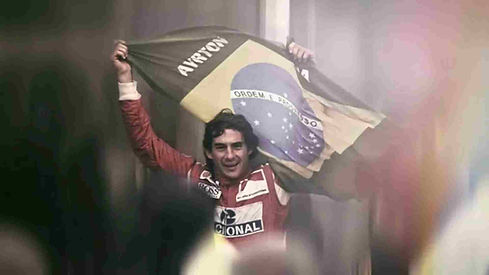
Ayrton Senna is remembered for the silence that fell when he drove.
Those who watched Formula 1 in the 80s and 90s know exactly what I mean.
There was something different about those Sundays.
The room went quiet. Time seemed to slow.
And what unfolded on the screen felt heavier than sport.
For many of us in Brazil, it was never just racing.
It was hope. It was pride.
It was belief moving at 300 kilometres per hour.
This article is my way of saying thank you.
To the man who, in my humble opinion, remains the greatest of all time.
Senna gave me tears of joy. And he gave me tears of sadness.
And even today, when I see those Brazilian colours wrapped around a racing helmet, I still feel both.
THE WEIGHT OF A NATION
Senna never raced alone.
When he drove, Brazil was there, quiet, expectant, sometimes demanding, always hopeful.
We didn’t watch for spectacle. We watched to feel steady again.
To feel proud again.
In those years, effort still meant something.
Discipline still had value.
He carried that weight openly, and somehow, instead of slowing him down, it made him faster.


1984
ARRIVING WITHOUT PERMISSION
In 1984, Senna entered Formula 1 with Toleman.
A modest car. A small team.
A rookie expected to learn quietly.
Then Monaco happened.
Rain erased order.
The barriers felt closer than ever.
Experience was supposed to matter.
But Senna began passing cars where others were simply trying to survive.
It wasn’t just speed. It was certainty.
Second place that day did not feel like a podium.
It felt like a warning.
WHEN RAIN REMOVES PRETENCE
Rain exposed everything.
Skill. Fear. Instinct.
Others adjusted.
Senna transformed.
He seemed to arrive at each corner before it happened.
From that day on, rain stopped being weather.
For him, it became language.
And for us watching, it became expectation.


LOTUS AND THE PURSUIT OF THE PERFECT LAP
At Lotus, from 1985 to 1987, Senna found something close to freedom.
The car was not dominant.
It did not forgive mistakes.
But qualifying became his theatre.
One lap. No margin. No limits.
In those minutes, it felt as if the world narrowed to a single line of asphalt.
Time did not slow down. It seemed to bend around him.
ESTORIL 1985
THE FIRST TRUTH
April 21, 1985 Portuguese Grand Prix. Estoril.
Rain again.
Senna didn’t just win his first race. He dismantled the field.
Almost everyone was lapped.
Some drivers earn victories. Others reveal themselves.
For many of us, this was the moment we understood who Senna really was.
Not just fast. Not just talented. But different.
This was the moment Senna revealed himself.


SPEED AS A
PRIVATE CONVERSATION
Senna never described speed in mechanical terms.
He spoke about limits.
About fear fading. About crossing into a place beyond thought.
He once said that when he reached the limit, he felt closer to something greater than himself.
To him, racing was not chaos. It was clarity.
The closer he moved to the edge, the quieter he seemed inside.
And that calm, at 300 kilometres per hour, is what made him different.
McLAREN AND THE SHARP EDGE OF GREATNESS
In 1988, Senna joined McLaren.
The fastest cars in the field. The brightest spotlight in the sport.
And Alain Prost.
This was not rivalry for drama. It was rivalry of philosophies.
Prost calculated. Senna committed.
Precision versus instinct. Control versus conviction.
They shared the same garage, but not the same understanding of speed.
And in a team built to win everything, only one vision could define it.


MONACO 1988
THE LAP THAT NEVER ENDED
Qualifying. Monaco. 1988.
Senna took pole.
Then he kept going.
Lap after lap, faster than necessary.
Faster than reason.
He wasn’t fighting Prost anymore. He was chasing something internal.
Later, he admitted he felt detached, as if he had stepped outside himself and was watching the car move beneath him.
When he finally slowed, he was shaken.
Not because he was afraid.
But because he had gone somewhere even he did not fully understand.
TITLES WITHOUT COMFORT
World Champion.
1988. 1990. 1991.
Three titles.
Yet Senna never drove like a man who had arrived.
Victory did not relax him. It made him more exacting.
More demanding of the car. More demanding of himself.
Winning didn’t quiet the search. It intensified it.
Because when you touch perfection once, you don’t celebrate it.
You chase it again.


DONINGTON 1993
THE LAP OF THE GODS
From the start, Senna passed nearly the entire field in a single lap.
Prost.
Schumacher.
Everyone.
It wasn’t aggression.
It was inevitability.
That opening lap is still spoken of in whispers, widely regarded as the greatest opening lap Formula 1 has ever seen.
And I was fortunate enough to witness it.
WHAT IT COST HIM
Senna lived at a pace few could tolerate.
The same intensity that made him extraordinary also set him apart.
He demanded everything from the car, from the team, and most of all, from himself.
There was no off switch.
Racing did not leave him when he stepped out of the cockpit.
And I think he knew that.


FAITH, OPENLY CARRIED
Senna never hid his faith. He spoke openly about God.
About guidance. About purpose.
He believed that when you committed fully, when you gave everything without holding back, you were not alone.
For him, racing was not an act of recklessness.
It was an act of honesty.
He drove as if the limit was not something to fear, but something to respect.
1994
A HEAVY BEGINNING
In 1994, Senna joined Williams.
The fastest car on paper. Unsettled in reality.
The season began with tension.
Three races in, the frustration was visible, the confidence not yet settled. Something felt unfinished.
Imola was never meant to be an ending.


WHEN TIME STOPPED
May 1st, 1994.
What was lost cannot be reduced to headlines.
It felt as if everything stopped, not just the race, but the noise around it.
In Brazil, that silence was everywhere.
We did not lose a driver that day.
We lost something harder to define.
A presence. A certainty.
Not just because a champion died, but because a force disappeared from our Sundays.
SENNA'S LEGACY
What followed was not emptiness. It was responsibility.
The Instituto Ayrton Senna.
Millions of children supported. Opportunities created. Futures reshaped.
His name did not remain on trophies.
It moved into classrooms.
Speed gave him a platform.
But purpose is what gave him permanence.


THE REFERENCE POINT
Today, speed is managed. Filtered. Calculated. Measured in data.
Protected by systems.
Senna reminds us of a time when speed came from belief, not permission.
When commitment mattered more than comfort.
He did not wait for conditions to be perfect.
He went.
MORE THAN SPEED
Ayrton Senna was more than an icon of speed.
On every lap, he carried Brazil with him, not as a symbol, but as a responsibility.
He drove knowing that talent creates hope, that discipline earns respect, and that belief, when pushed to its limit, can move people far beyond racing.
And beyond Brazil, he carried all those who recognise true ability when it appears, quiet, uncompromising, impossible to ignore.
Some drivers are remembered.
He is remembered differently.
Written in Portuguese by the author. Presented here in English