THE SHIFT Stories from Car Culture

The Man Who Changed
the Silhouette of Speed
“I never wanted to design beautiful cars.
I wanted to design interesting cars.”
Marcello Gandini
Some designers create beautiful cars.
Marcello Gandini created an entire language.
A language of wedges, sharp lines, dramatic proportions, and fearless experimentation that would redefine what a supercar looked like.
Before Gandini, sports cars were elegant and curvaceous.
After Gandini, they became aggressive, architectural, and futuristic.
He did not simply design cars.
He changed the way speed was drawn.
Bertone’s Young Visionary
Marcello Gandini joined Bertone in 1965, replacing another rising genius: Giorgetto Giugiaro.
He was only 27 years old.
Unlike many designers who refined existing ideas, Gandini arrived with something radically different.
He believed cars should not simply move through space.
They should cut through it.
Within months, he would create one of the most influential cars ever built.

Marcello Ganini (left) and Nuccio Bertone (right)

The Miura
The Birth of the Supercar
In 1966 the Lamborghini Miura appeared at the Geneva Motor Show.
Low. Wide. Exotic.
Its transverse mid-engine layout changed performance engineering.
But its design changed something even bigger.
The Miura introduced the supercar silhouette:
• Extremely low nose
• Wide rear hips
• Cockpit pushed forward
• Engine behind the driver
The famous eyelashes around the headlights, the flowing bodywork, and the dramatic proportions made the Miura feel alive even when standing still.
The modern supercar had arrived.
Design as Emotion
What made Gandini different from many designers was his philosophy.
He did not design for harmony.
He designed for impact.
Where others smoothed surfaces, Gandini introduced tension.
Where others pursued elegance, he pursued drama.
His cars were meant to provoke emotion.
They were sculptures of speed.


The Montreal
Elegance with an Edge
While Gandini is often associated with radical wedge shapes, he was also capable of extraordinary refinement.
The Alfa Romeo Montreal, first revealed as a concept at Expo 67, demonstrated that balance.
Its distinctive slatted headlight covers, sculpted hood vents, and muscular proportions created a car that was both elegant and experimental.
Under the body sat a racing-derived V8 inspired by Alfa Romeo’s Tipo 33.
The Montreal proved that Gandini could combine beauty with technical drama.
The Birth of the Wedge
By the late 1960s Gandini began exploring a radical idea.
The wedge. Sharp angles. Flat surfaces. A rising profile.
Concept cars allowed him to push this idea further than production vehicles would allow.
And in 1968 he revealed a design that looked like it had arrived from decades in the future.


Alfa Romeo Carabo
A Design Manifesto
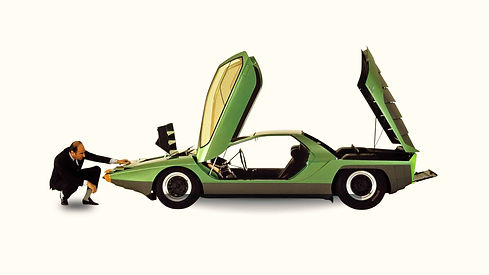
The Alfa Romeo Carabo, introduced in 1968 at the Paris Motor Show, was not simply a concept car.
It was a declaration.
Its metallic green body and orange accents highlighted an extreme wedge shape that seemed almost impossible for a road car.
But the Carabo also introduced something that would become legendary.
Scissor doors.
A theatrical gesture that would soon become inseparable from Lamborghini.
The future of supercar design had been sketched.
The Countach Shockwave
In 1971 Gandini revealed the Lamborghini Countach LP500 prototype.
The reaction was immediate. Shock. Disbelief.
A sense that the future had suddenly arrived.
The Countach looked less like a car and more like a spacecraft.
And once people saw it, nothing else looked modern anymore.

Lancia Stratos Zero
The Extreme of the Wedge
If the Carabo introduced the wedge, the Lancia Stratos Zero pushed it to its absolute limit.
Designed in 1970, the Zero looked less like a car and more like a piece of science fiction.
At just 84 cm tall, it forced the driver to enter through the windshield, reinforcing the idea that this was not conventional transportation.
It was a concept taken to its most radical conclusion.
The Zero was not designed to be practical.
It was designed to explore the boundaries of form.
Every line, every angle, every surface reduced the car to a single idea: Speed as geometry.
Few cars have ever captured Gandini’s vision so purely.


The Poster
That Defined a Generation
When the production Countach arrived in 1974, it retained the drama of the concept.
Extreme wedge proportions. Scissor doors. Wide stance.
For an entire generation, the Countach became the ultimate bedroom wall poster.
It wasn’t just a car.
It was the embodiment of the supercar dream.
Radical Thinking
Marcello Gandini never repeated himself.
He constantly explored new ideas.
Angular surfaces. Hidden headlights. Experimental interiors.
He treated car design almost like architecture.
Every surface had purpose.
Every line created tension.


The Stratos
A Rally Weapon
In 1973 Gandini designed another icon: the Lancia Stratos.
Short, wide, and aggressively compact, the Stratos looked unlike any rally car before it.
Powered by a Ferrari Dino V6 engine, it would dominate rally racing, winning three consecutive World Rally Championships.
Few racing cars have ever looked so radical.
The Stratos proved Gandini’s ideas worked not only in showrooms, but also on the world’s toughest roads.
Maserati Khamsin
Geometry Meets Elegance
With the Maserati Khamsin, in 1973, Gandini explored a different expression of his philosophy.
Still angular and modern, the Khamsin introduced a remarkable feature:
A glass rear panel revealing the car’s structure beneath.
It was both design statement and engineering showcase.
Even here, Gandini experimented with light, transparency, and architecture.


A Different Path
BMW Garmisch
Gandini’s relationship with BMW was not defined by the Turbo concept and its radical wedge design of 1972, but by a different vision altogether, the car itself designed under the direction of Paul Bracq.
The BMW Garmisch, unveiled in 1970, was Gandini’s interpretation of a modern BMW. Clean, architectural, and deliberate, it introduced a design language that would later echo through the brand’s identity, particularly in the first generation of the 5 Series.
It wasn’t about radical expression.
It was about direction.
The Philosophy of Tension
Gandini once explained that he disliked perfect symmetry.
He preferred tension.
Unexpected surfaces.
Conflict between lines.
This philosophy gave his cars energy.
They felt alive even when standing still.


The Supercar as Theatre
Perhaps Gandini’s greatest insight was understanding that supercars were not only machines.
They were theatre.
Scissor doors opening upward.
Extreme proportions.
Futuristic silhouettes.
A Gandini car never quietly arrived.
It made an entrance.
The Early Diablo
Return to Lamborghini
In the mid-1980s, Gandini returned, Gandini returned to Lamborghini to design the successor to the Countach.
His original concept for the Diablo was sharper and more radical.
While later softened before production, Gandini’s DNA remained visible in the car’s proportions and stance.
Even diluted, the Diablo carried the echoes of his vision.


A Designer
Who Challenged Rules
Gandini often resisted corporate constraints.
He believed designers should challenge engineers, not simply follow them.
Sometimes manufacturers hesitated.
But history repeatedly proved his instincts correct.
The Wedge Legacy
From the Miura to the Countach, from the Carabo to the Stratos, Gandini shaped an era of automotive design.
He proved that cars could be bold experiments rather than cautious evolutions.
He made the automobile an expression of imagination.

When Design Becomes History
Few designers change the trajectory of an entire industry.
Marcello Gandini did it multiple times.
The Miura defined the supercar.
The Countach defined the future.
The wedge defined an era.
The Architect of the Supercar
Today, when people imagine a supercar, they picture something low, dramatic, and futuristic.
Without realizing it, they are imagining a Gandini idea.
And that may be his greatest achievement.
He didn’t just design cars.
He designed the shape of speed itself.


.jpg)
%20(1).jpg)
