THE SHIFT Stories from Car Culture

The Most Beautiful Race
in the World
Some races test machines.
Others test drivers.
But a few transcend motorsport and become legend.
For three decades, the Mille Miglia transformed the public roads of Italy into the fastest stage on earth.
From Brescia to Rome and back, across mountains, villages, and endless crowds, drivers chased speed for a thousand miles.
It was not a circuit.
It was a nation watching.
And for many, it remains the greatest road race ever held.
Born From Pride
The race was born in 1927, in the northern Italian city of Brescia.
A group of local aristocrats, Aymo Maggi and Franco Mazzotti, the director of the Automobile Club of Brescia, Renzo Castagneto, and the prominent motoring journalist Giovanni Canestrini, decided their city deserved a race that could rival the great European competitions.
The idea was simple.
A brutal endurance race on open roads, stretching roughly 1,000 miles (about 1600 km) from Brescia to Rome and back again.
The name came naturally:
Mille Miglia.
One thousand miles.

Maggi, Mazzotti, Castagneto and Canestrini

Italy as a Racetrack
The route cut through the heart of Italy.
Brescia.
Verona.
Florence.
Rome.
Then back north again.
Drivers crossed mountain passes, narrow medieval streets, and long stretches of countryside.
There were no run-off areas.
No barriers.
Just roads, trees, spectators, and speed.
And millions came to watch.
A Race Like No Other
Unlike modern motorsport, the Mille Miglia was run on public roads.
Cars started one minute apart, often with the smallest engines leaving first and the fastest machines chasing them through the Italian countryside.
The race lasted close to 20 hours of relentless driving.
Drivers navigated by instinct, maps, and handwritten notes.
In an era before telemetry and GPS, victory depended on memory, courage, and endurance.


The Rise of the Manufacturers
The Mille Miglia quickly became the ultimate proving ground for European manufacturers.
Brands like:
Alfa Romeo
Ferrari
Maserati
Mercedes-Benz
Porsche
BMW
All saw the race as an opportunity to prove their machines on the most demanding road in the world.
Winning the Mille Miglia meant more than victory.
It meant prestige.
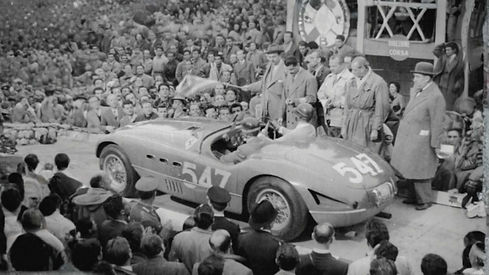
Ferrari and the Italian Era
In the early post-war years, Ferrari dominated the race.
Between 1948 and 1957, Ferrari secured multiple victories, turning the Mille Miglia into a stage for the brand’s rising legend.
Cars like the Ferrari 166 MM, 340 MM, and 375 Plus became synonymous with Italian speed.
The roads of Italy had become Ferrari territory.

The 1955 Masterpiece
Then came 1955.
One of the most legendary performances in motorsport history.
A young British driver named Stirling Moss, alongside journalist Denis Jenkinson, entered the race in a Mercedes-Benz 300 SLR.
Jenkinson used a remarkable innovation: a scroll of pace notes, read during the race like a primitive rally system.
The result was extraordinary.
Moss completed the 1,000-mile course in 10 hours, 7 minutes, and 48 seconds.
A record that would never be beaten.
Speed Beyond Imagination
Average speeds during the Mille Miglia became astonishing.
Drivers raced through villages at over 250 km/h.
Spectators stood only meters away from the road.
At night.
In the rain.
Across mountains.
The Mille Miglia was both breathtaking and terrifying.


The Dark Side of Speed
But the danger was always present.
Open roads meant unpredictable conditions, mechanical failures, and crowds standing dangerously close to the cars.
The risks were immense.
And in 1957, tragedy struck during the race, leading to fatalities among drivers and spectators.
The event was immediately cancelled.
The golden era of the Mille Miglia had come to an end.
Thirty Years of Legend
Between 1927 and 1957, the race ran 24 times, interrupted only by World War II.
During those years, it became the ultimate test for endurance road racing.
A race where:
drivers became heroes,
cars became icons,
and speed became myth.

Stirling Moss and Denis Jenkinson. 1955

Mille Miglia 1977
The Return
Two decades later, the legend returned.
In 1977, the Mille Miglia was revived as a historic regularity rally.
But with one crucial rule.
Only cars that participated in the original races, or models produced before 1957, were allowed to enter.
The goal was not speed.
It was memory.
A Rolling Museum
Today, the Mille Miglia is often described as:
“the most beautiful race in the world.”
Hundreds of historic machines retrace the original route across Italy.
Alfa Romeos.
Ferraris.
Mercedes.
Porsches.
Cars that once raced flat-out now glide through the same roads, carrying the stories of another era.


Wolfgang Seideland Helm Glöckler in Porsche 550 | 1955
The Cultural Impact
Few races influenced automotive culture like the Mille Miglia.
It helped define the Grand Touring philosophy:
Fast cars.
Long distances.
Real roads.
The idea that a car should be able to travel across a country at speed became part of the DNA of brands like Ferrari and Porsche.
The Race That Built Legends
The Mille Miglia created some of the greatest stories in motorsport.
Nuvolari.
Fangio.
Moss.
Drivers who risked everything across a thousand miles of Italian roads.
And machines that proved their greatness far from racetracks.

Collins, Fangio, Moss and Haworth

A Thousand Miles of Myth
The Mille Miglia no longer belongs to the world of racing.
It belongs to history.
A time when drivers crossed a country at full speed.
When crowds lined the roads.
And when the line between bravery and madness was almost invisible.
One thousand miles.
One nation.
One legend.
%20(5).jpg)
.jpg)

