Along an ancient Roman road, among fields, vineyards and workshops,
lies a place unlike anywhere else in the automotive world.
Ferrari. Lamborghini. Maserati. Ducati. Pagani. Dallara.
They did not simply happen to emerge from the same region. They are products of it.
The Road
In 187 BC, the Roman consul Marcus Aemilius Lepidus ordered the construction of the Via Emilia.
More than two thousand years later, follow that same road, and you will find the Motor Valley:
an industrial district bringing together some of the most important and prestigious automobile and motorcycle manufacturers in the world.
Its beating heart stretches between Modena, Bologna, Parma and Reggio Emilia.
Within just a few kilometres are Ferrari, Lamborghini, Maserati, Ducati, Pagani and Dallara. There are corporate and specialist museums, private collections, international racing circuits including Imola and Misano, more than 180 sporting teams, and universities and specialist institutes dedicated to engineering and automotive mechanics.
But numbers alone cannot explain this place. To understand Motor Valley, you have to look beyond the factories.
The Via Emilia crosses the Po Valley for around 250 kilometres. Drive along it, through countryside, small towns and villages, past farmhouses and churches, and you will find the workshops where some of the world's fastest machines are built.
And then you notice something extraordinary.
Beside the workshops producing racing cars are fields of grass for the cows whose milk becomes Parmigiano Reggiano. There are Lambrusco vineyards.
There are farms raising the pigs that will become culatello.
Supercars and agriculture. Carbon fibre and vineyards. Racing engines and Parmigiano.
They coexist almost side by side.
This special region is called the Motor Valley, largely for reasons connected with international marketing.
Yet despite the name, it has very little in common with the Silicon Valley that inspired it.
There, the foundations are finance, digital scalability and the mobility of workers.
Here, in Emilia-Romagna, the industrial, cultural and social reality is profoundly different.
The Italian Motor Valley has its roots in tradition, craftsmanship, territorial stability and a passion for mechanics.
Innovation here does not come from an isolated laboratory. It comes from collaboration and rivalry between workshops that are neighbours.
If Maranello needs a special component, there is probably an artisan only a few kilometres away capable of making it.
That proximity has shaped everything.
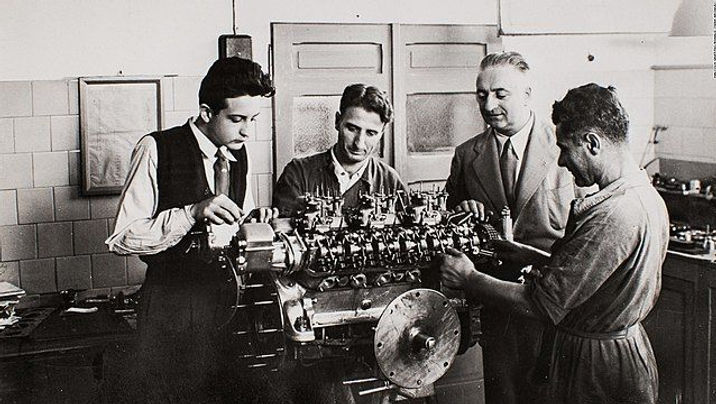
Enzo Ferrari and engineers (his son Alfredo to the left), Maranello, 1947
From the Land to the Machine
Enzo Ferrari once described Emilia as a land rich in enterprising, hard-working people driven by a burning desire for redemption.
There is something important in those words.
This was an agricultural region. Its people went from being farmers to becoming highly skilled mechanics.
With agricultural reform and the arrival of the first tractors and machines, farmers learned to understand engines quickly, almost instinctively.
After the First and Second World Wars, people found ways of transforming military and wartime remains into tractors for agriculture or vehicles for transportation.
Machines were not abstract objects. They were things you opened, repaired, modified and made work again.
Then came the sound. The roar of engines and the intoxication of speed only strengthened the growing love for racing cars.
When pioneers such as Enzo Ferrari or the Maserati brothers began producing automobiles, they did not do everything themselves. They didn't need to.
Walk a few metres — perhaps travel as far as the next village — and you could find master craftsmen, coachbuilders who were artists, mechanics capable of making an engine sing, precision foundries, carburettor magicians, geniuses of wire wheels, gasket manufacturers and practically everything required to build a racing car.
Motor Valley was never just a group of manufacturers. It was an ecosystem before anyone thought to call it one.

Mario Maserati, Ernesto, Ettore and leftmost is Bindo outside their first workshop in Bologna, in 1934
When Craft Becomes Art
In 2019, during the ModenArt exhibition held in the Church of San Carlo in Modena, Italian-French art critic
Philippe Daverio looked at the work of Modenese master coachbuilders and declared: “Cars are works of art.”
He was referring to craftsmen such as Giancarlo Guerra, Afro Gibellini and Oriello Leonardi, whose work contributed to legendary Ferrari forms including the GTO, California and Testarossa.
Their bodies were shaped completely by hand.
Like Renaissance sculptors, these craftsmen worked with remarkably simple tools: a collection of hammers, a piece of tree trunk, a bag of sand, a pair of shears and an iron workbench.
Particularly during the 1950s and 1960s, creating an automobile body was an authentic artistic process. Pure manual skill. Metal becoming form beneath the hands of a craftsman.
The old battilastra did not simply manufacture panels. They sculpted cars.

Giancarlo Guerra working on the Ferrari 250 GTO
The People
Then there is the character of the people themselves. Passion. Hard work. Tenacity. Pride.
Essential qualities when you want to transform an idea inside your head into something real.
The founders of Ferrari, Maserati, Lamborghini, Pagani, Ducati and Dallara demonstrate it in very different ways.
Enzo Ferrari did not simply want to sell road cars. He created a myth.
His philosophy connected competition directly with desire: build machines capable of winning on Sunday and people will want them on Monday. For Ferrari, racing was not marketing added to the automobile. Racing was the reason for the automobile.
The Maserati brothers were less interested in corporate fame or wealth than in engineering perfection. They represented an almost heroic form of craftsmanship, driven by a visceral love of fine mechanics.
Ferruccio Lamborghini was practical, passionate and stubborn, guided by a distinctly Emilian pride.
He wanted perfect Gran Turismo cars: comfortable, mechanically accomplished and uncompromising.
A Lamborghini should dominate the road through elegance, raw power and visual excess.
Horacio Pagani began at Lamborghini as a third-level worker. At the foundation of his vision is Leonardo da Vinci's philosophy of art and science. His hypercars are not merely extremely high-performance mechanical objects. They are tailored works of art — sculptures in carbon fibre and titanium where even a single screw should be a masterpiece of design.
The Cavalieri Ducati brothers founded their company in Bologna in 1926, originally producing components for radio communications and inspired by the discoveries of Guglielmo Marconi.
They entered the world of two wheels through necessity, patenting the small Cucciolo auxiliary engine for bicycles.
But they transmitted something into Ducati's DNA that remains fundamental: scientific rigour, a fascination with electronics and a passion for technical miniaturisation.
And Giampaolo Dallara, after working at the highest levels for Ferrari, Maserati and Lamborghini, founded his own company in 1972. Dallara became the invisible but indispensable partner of motorsport around the world, with an obsessive focus on chassis, aerodynamics and driver safety.
Different people. Different companies. But all connected by the same land.

The Ducati brothers. Adriano, Bruno and Marcello, 1935

Ferruccio Lamborghini, 1970
The Visible Soul of Engineering
Design here has never been merely an aesthetic exercise applied after the engineering is finished.
It is the symbiotic interaction between formal beauty and the laws of physics — aerodynamics, fluid dynamics, proportion and performance.
From the old battilastra, shaping aluminium by eye and hammer, to the modern designers at Pagani and the historic coachbuilders of the region, the automobile has always been treated as a sculpture in motion.
Here, design is the visible soul of engineering.
And that may be one of the most important ideas for understanding Motor Valley.
Beauty and performance were never supposed to live separately.
One gives form to the other.

Giampaollo Dallara at Lamborghini, 1964

Horacio Pagani when working at Lamborghini, 1980
An Ecosystem of Knowledge
The proximity between universities, major manufacturers and highly specialised suppliers allows knowledge to travel remarkably quickly. Over time, the region has institutionalised this relationship.
Universities across Emilia-Romagna, working alongside the leading brands of Motor Valley, have created an international centre for training the engineers of the future — integrating academic theory directly with experience inside factories and on racetracks.
International groups look at the many companies and specialists within Motor Valley as reservoirs of artisanal knowledge worth acquiring.
Because this knowledge cannot simply be replicated on a drawing board.
Small scale. Extreme specialisation. A short supply chain.
This is not the classic Fordist model of one enormous factory producing everything. It is a network. And the network itself is part of the intellectual capital of Motor Valley.
The Next Generation
Which raises perhaps the most important question.
What does Motor Valley mean today, and how do we preserve its legacy for future generations?
Andrea Pontremoli, CEO of Dallara Automobili, has repeatedly argued that Italy must decide what kind of automobiles it wants to produce.
Should it chase enormous production volumes? Or should it concentrate on excellence?
His vision points towards three strategic pillars: technological innovation, education and tourism.
Italy does not lack capability or expertise. The challenge is creating the conditions in which those qualities can continue to flourish.
Today, Motor Valley represents an ecosystem of thousands of businesses and tens of thousands of workers, generating billions of euros in exports. People arrive from across the world to study and work here. International students attend specialist programmes designed to educate the next generation of automotive professionals.
Motor Valley has also entered popular culture.
Films, television and events increasingly carry the image of Emilia-Romagna's automotive world beyond Italy, while gatherings such as Motor Valley Fest bring industry, culture, tourism and spectacle together in Modena.
The world comes here because this is presented as the place where some of the most beautiful and fastest cars on Earth are born.
But perhaps the real legacy of Motor Valley is not the cars. It is the knowledge behind them.
The hands that know how to shape metal. The engineer searching for another tenth of a second. The artisan in the next village who knows how to make the component nobody else can make. The farmer who learned to repair a tractor. The mechanic who learned to make an engine sing. The designer who understands that beauty must obey physics — but can still provoke emotion.
And a road built more than two thousand years ago that still connects all of them.
Motor Valley is not simply where machines are made.
It is where a culture learned how to turn ideas into machines.

Maserati factory, Modena, 2021

