THE SHIFT Every Supercar has a Story. Live it with Us.

MISALIGNED
Not every radical idea becomes a legend.
Some arrive too early.
Some aim too high.
Some collide with a world that has no space for them.
They don’t fail because they lack intelligence or ambition.
They fail because vision alone is never enough.
OUTLAWS is not about bad cars.
It is about misalignment, between idea and market, engineering and reality, courage and timing.
And behind every one of these cars stood a mind willing to risk reputation, capital, and credibility to move the conversation forward.
WHAT MAKES AN OUTLAW
I’ve learned that an outlaw is not defined by speed, power, or spectacle.
It’s defined by distance, the gap between what a car truly is and what the world is ready to accept at that moment.
Most of these machines didn’t fail because a competitor built something better.
They failed because the ecosystem around them wasn’t ready, regulation, capital, culture, even belief.
Outlaws don’t get safety nets.
They don’t evolve gently through facelifts or second chances.
They either survive intact, or they disappear entirely.
And when they disappear, I’ve noticed something curious.
Their ideas don’t.
They resurface quietly, years later, inside cars that are finally ready to be understood.


DOME ZERO
Too futuristic to survive
In 1978, Japan unveiled a car that looked as if it had escaped from the future.
The Dome Zero, conceived under the vision of Minoru Hayashi, wore a canopy cockpit, brutal wedge geometry, and showed almost no interest in comfort or regulation.
It shocked audiences and unsettled regulators alike.
The future didn’t reject it.
The present did.
Specs & performance
Inline-6, 2.8L (Nissan L28)
≈145 hp
0–100 km/h ≈7.5 s (est.)
Top speed ≈220 km/h (est.)
ITALDESIGN AZTEC
A brilliant idea with no audience
When 1988 arrived, Giorgetto Giugiaro had nothing left to prove.
The Italdesign Aztec was not an act of ego, but of exploration.
Twin cockpits separated driver and navigator like an aircraft.
Information, ergonomics, and systems took priority over emotion.
The market, however, was still looking for romance.
Specs & performance
V6 twin-turbo, 3.0L (Audi)
≈250 hp
0–100 km/h ≈5.8 s
Top speed ≈250 km/h


YAMAHA OX99-11
When engineering forgot the road
In 1992, Yamaha believed Formula 1 logic could be translated directly to the road.
The Yamaha OX99-11 used a carbon tub and a V12 derived from its F1 programme.
Engineers saw purity. Customers saw inconvenience.
Brilliant in theory. Impossible in reality.
Engineering won.
Reality didn’t.
Specs & performance
V12, 3.5L (F1-derived)
≈400 hp
0–100 km/h ≈3.5 s
Top speed ≈350 km/h
SBARRO CHALLENGE III
Too radical to mature
In 1991, Franco Sbarro did what he had always done best, he ignored convention and built anyway.
The Sbarro Challenge III was not a finished product in the traditional sense. It was an experimental platform, built to explore lightweight construction, unconventional packaging, and radical mechanical solutions in full view of the public.
It wasn’t designed to seduce buyers or reassure investors.
It was designed to provoke discussion.
Bold, inventive, and unapologetically unfinished, the Challenge III asked questions about structure, weight, and purpose that the market, and the industry, had no interest in answering at the time.
Specs & performance
Flat-4, 2.0L
≈200 hp
0–100 km/h ≈4.5 s
Top speed ≈250 km/h

CIZETA-MORODER V16T
Obsession without restraint
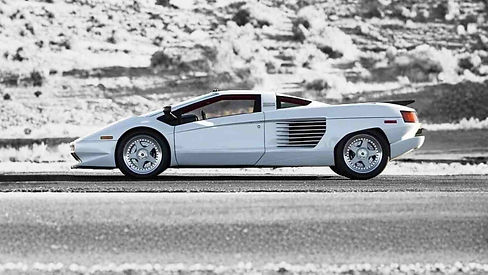
In 1991, the Cizeta arrived with a transverse V16 engine that emerged from the obsession of Claudio Zampolli.
Built not because it made sense, but because it could be done.
A transverse V16 was not necessary.
It was deliberate.
The result was dramatic, complex, and unsustainable.
Engineering ambition without limits sealed its fate.
Specs & performance
V16, 6.0L
≈540 hp
0–100 km/h ≈4.0 s
Top speed ≈328 km/h
COVINI C6W
Right idea, wrong moment
First revealed in 2004, the Covini challenged a century of convention.
Six wheels. Four at the front. Logic over tradition.
Conceived by Ferruccio Covini, the C6W wasn’t an exercise in shock, but in reasoning, grip, stability, braking.
The engineering was sound.
Belief never followed.
Specs & performance
V8, 4.2L (Audi)
≈434 hp
0–100 km/h ≈4.5 s
Top speed ≈300 km/h


PANTHER SIX
Excess without direction
In 1977, the Panther Six made subtlety irrelevant.
Six wheels, twin-turbo V8, unapologetic extravagance.
It captured attention instantly. It couldn’t hold it.
It succeeded in shocking the world.
It failed in giving that shock meaning.
Specs & performance
V8 twin-turbo, 8.2L (Cadillac)
≈600 hp
0–100 km/h ≈5.0 s
Top speed ≈322 km/h
DEVEL SIXTEEN
Ambition without containment
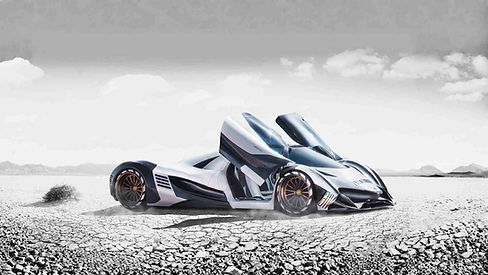
When the Devel Sixteen appeared in 2013, it didn’t just promise performance, it promised a rupture.
5,000 horsepower. 500+ km/h.
A quad-turbo V16 future that ignored every known boundary.
For a moment, it felt as if physics had been renegotiated.
But the Devel Sixteen emerged from an era where attention moved faster than validation, and numbers traveled the world long before proof arrived.
Claims shifted. Timelines stretched.
What remained was not a finished machine, but a symbol of ambition outrunning the structures meant to sustain it.
The Devel Sixteen didn’t fail for lack of vision.
It failed because vision alone could no longer carry belief.
Specs & performance
V16 quad-turbo (proposed)
Up to 5,000 hp (claimed)
0–100 km/h <2.0 s (claimed)
Top speed >500 km/h (claimed)

THE IMPORTANCE OF THE OUTLAWS
These cars did not shape markets.
They shaped questions.
They asked how far ambition could stretch before reality pushed back.
They exposed the fragile line between courage and overreach, between imagination and execution.
In their failure, they revealed what success often hides, that progress is rarely linear, rarely clean, and almost never polite.
It advances through missteps, through ideas released too early, through risks taken without guarantees.
Behind every outlaw stood a mind willing to challenge consensus, invest belief where certainty did not yet exist, and accept the possibility of being wrong in full view of the world.
Most of these machines disappeared quietly.
Their ideas did not.
That is how progress actually moves, not by perfect answers, but by imperfect attempts that expand the boundaries of what can be imagined, engineered, and eventually accepted.