THE SHIFT Stories from Car Culture
Art DNA
Bugatti did not begin in a factory.
It began in an atelier.
Ettore Bugatti grew up in an environment where creation was not driven by function, but by expression.
His father, Carlo Bugatti, designed furniture and interiors that blurred the line between utility and sculpture, often using unusual materials and intricate detailing.
His brother, Rembrandt Bugatti, approached animals with the eye of a structural artist, studying their balance and movement before translating them into bronze.
That context matters.
Because before Bugatti became about performance,
it was already about proportion, tension, and form.

Throne chair designed by Carlo Bugatti
Engineering By Instinct
Ettore Bugatti never followed a conventional engineering path.
He learned by doing, building, dismantling, and refining what didn’t feel right.
There was method in his work,
but it wasn’t academic.
It was intuitive.
The phrase often associated with him,
“Nothing is too beautiful. Nothing is too expensive,”
is frequently misunderstood.
It wasn’t about excess.
It was about refusing to compromise when something mattered.

Ettore Bugatti
The Dancing Elephant | 1926
The Bugatti Type 41 Royale was one of the most ambitious cars ever created in its time.
Large, complex, and designed without concern for limitation.
At its front sits the Dancing Elephant,
a sculpture originally created by Rembrandt Bugatti.
It wasn’t designed as a brand symbol.
It existed before the car.
What Bugatti did was integrate it,
bringing its artistic world directly into the machine.
Heavy, yet balanced.
Powerful, yet composed.
The Dancing Elephant
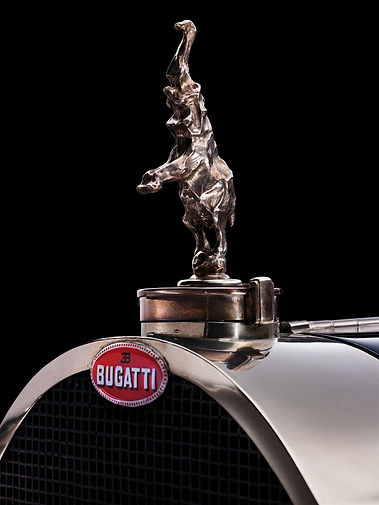
The Logo, Explained
The Bugatti oval follows the same logic.
It wasn’t designed as a marketing tool.
A red field.
White lettering.
And sixty small pearls surrounding the edge.
Red for intensity and craftsmanship.
White for clarity.
Not decoration, but detail.
A visual expression of precision and completeness.

Bugatti Logo
Naming As Memory
Bugatti has always treated naming differently.
Rather than inventing new identities,
it preserved existing ones.
The Bugatti Veyron takes its name from Pierre Veyron,
linked to the brand’s history, including victory at Le Mans in 1939.
The Bugatti Chiron follows the same principle,
honoring Louis Chiron,
one of the defining drivers of Bugatti’s Grand Prix era.
Early Bugatti names were not created for impact.
They were chosen to remain connected.

Berlin, 1933, Pierre Veyron conquers the AVUS track in his Bugatti T51A
Bugatti Blue
Before it became a signature,
blue was simply France’s racing color.
Bugatti adopted it as part of that identity, not as a design choice.
The Bugatti Type 35 carried that blue across Europe,
driven by names like Louis Chiron and Albert Divo,
becoming one of the most successful racing cars ever built.
Over time, the color became inseparable from the brand.
Not through strategy.
Through repetition and success.
.jpg)
Bugatti Type 35 that debuted at the legendary Grand Prix de Lyon in 1924.
The Golden Years 1924–1939
Between the mid-1920s and the late 1930s,
Bugatti established one of the most successful periods in motorsport history.
More than 2,000 race victories.
Dominance in events like the Targa Florio.
A defining presence in European Grand Prix racing.
And overall victory at Le Mans in 1939.
What defined this era wasn’t brute force.
It was approach.
Lightness, balance, and control,
applied with consistency.
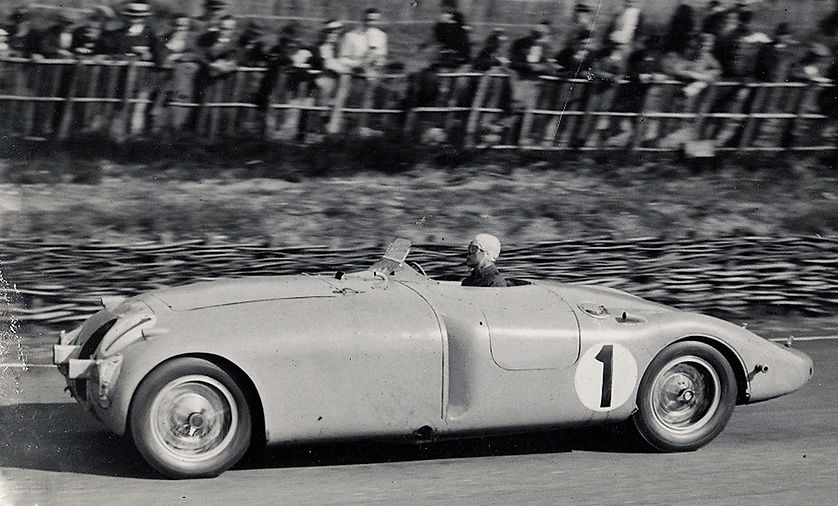
Wimille and Pierre Veyron took the victory with a Type 57C at Le Mans in 1939
Jean Bugatti 1909–1939
Jean Bugatti played a crucial role in shaping the visual identity of the brand.
While Ettore established the philosophy,
Jean translated it into form.
Cars like the Bugatti Type 57 Atlantic, often regarded as one of the most beautiful cars ever created, reflect that shift.
More fluid.
More resolved.
His death in 1939 had a lasting impact.
Jean Bugatti had been defining the next chapter of the brand.
After that, Bugatti continued,
but without the same clarity of direction.

The Bugatti Type 41 Royale Esders was one of Jean Bugatti's inspiring designs. Only 6 of them were ever made.
Between The Lines
The more time you spend understanding Bugatti,
the less it feels like a brand built around extremes.
And the more it reveals itself as continuity.
Art,
engineering,
and memory,
existing together.
Layered, not linear.
Once you see that,
modern Bugatti stops feeling excessive.
It feels inevitable.
Some stories are not louder.
They are deeper.