THE SHIFT Stories from Car Culture
There are circuits where speed defines greatness.
Monaco is not one of them.
Here, the margins are too small, the barriers too close, the consequences too immediate.
What matters is not how fast you are in a straight line, but how precisely you can place a car millimetre by millimetre, lap after lap, under pressure that never fades.
Monaco is not built for Formula 1.
Formula 1 was forced to adapt to Monaco.

First edition of the Monaco Grand Prix, won by William Grover-Williams in a Bugatti Type 35
The Birth of a Legend
The story begins in 1929, when Antony Noghès convinced the Automobile Club de Monaco to create a race through the streets of the principality.
It was an unusual idea.
Street circuits were unpredictable, narrow, and unforgiving. But Monaco offered something no permanent track could replicate, elevation changes, tight corners, and a setting that turned a race into a spectacle.
From the very beginning, Monaco was different.
Not just a race, but a stage.

Antony Noghès, founder of the Monaco Grand Prix.
The Theatre of Precision
There is no margin for error in Monaco.
At Sainte Dévote, hesitation costs time.
At Massenet, commitment defines rhythm.
Through Casino Square, the car feels momentarily weightless.
At the Grand Hotel Hairpin, speed disappears entirely, replaced by mechanical patience.
And then comes the tunnel.
A sudden shift from shadow to light, from confinement to acceleration, before the braking zone at the Nouvelle Chicane reminds the driver how quickly control can be lost.
Monaco is not a sequence of corners.
It is a continuous test of concentration.

Monaco Grand Prix track map
The Drivers Who Mastered It
Some drivers win races.
Others define circuits.
No name is more closely tied to Monaco than Ayrton Senna.
Six victories. Five in a row.
But numbers alone do not explain his dominance.
In 1988, he outpaced his teammate by over a second in qualifying, a gap so large it felt unnatural. Senna later described that lap as something beyond conscious control, a moment where precision became instinct.
Monaco rewards that state.
Few ever reach it.
Monaco Grand Prix qualifying lap with Senna | 1988
The Illusion of Control
At Monaco, the driver appears in control.
The reality is more fragile.
The barriers are not just close, they are constant. There is no runoff, no forgiveness. Every mistake has a consequence, and every lap is driven with that knowledge.
It creates a paradox.
Drivers must push to the limit, but the limit is defined by survival.
That tension is what makes Monaco unique.
When the Race Slows Down
Modern Formula 1 is built on overtaking, strategy, and tyre management.
Monaco resists all of it.
Overtaking is rare. Strategy becomes compressed. Track position is everything.
Critics often point to this as a weakness.
But they misunderstand the nature of the challenge.
Monaco is not about racing wheel-to-wheel.
It is about qualifying on Saturday, and executing perfectly on Sunday.
One mistake, one misjudged braking point, and everything is lost.

Fernando Alonso at the 2005 Monaco Grand Prix
The Hidden Workload
What Monaco lacks in overtaking, it compensates in intensity.
A single lap of the circuit demands around 50 to 55 gear shifts.
Over a full race distance, that translates to more than 3,800 gear changes.
There is no rest.
No long straights to reset, no moment to breathe.
The driver is constantly working, adjusting, reacting, managing the car through an endless sequence of low-speed corners and short bursts of acceleration.
It is one of the highest workloads in Formula 1.
Not physically alone, but mentally.
Moments That Defined It
Monaco is remembered through moments.
Graham Hill earning the title “Mr. Monaco” in the 1960s.
Alain Prost mastering consistency in changing conditions.
Senna’s near-mythical laps in the late 80s.
Michael Schumacher redefining precision in the 90s and early 2000s.
And then, the unexpected.
Crashes in the tunnel.
Rain turning certainty into chaos.
Leaders falling within sight of victory.
Monaco does not follow logic.
It creates its own.

"Mr. Monaco" Graham Hill
The Weight of Saturday
At most circuits, qualifying sets the stage.
At Monaco, it defines the outcome.
A perfect lap here is not just about speed, it is about proximity.
Brushing the barriers without touching them, carrying momentum where others hesitate.
The difference between pole position and second place can be measured in centimetres.
And yet, it determines everything.

Schumacher won the 2001 Monaco Grand Prix en route to the fourth of his seven world titles
Beyond Racing
Monaco exists beyond Formula 1.
The harbour, the yachts, the balconies overlooking the circuit, all of it contributes to an atmosphere that transcends sport.
It is often described as glamorous.
But that is only part of the story.
Because behind that image is one of the most demanding challenges a driver can face.
A contradiction that defines Monaco itself.
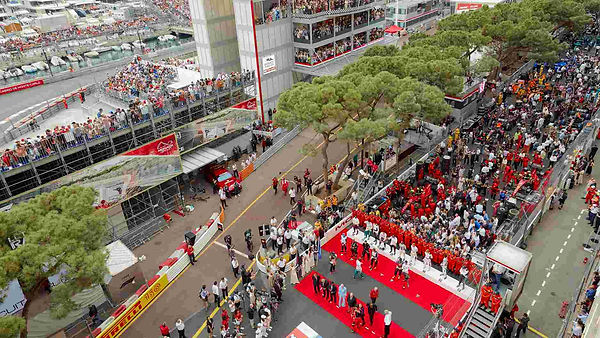
Panoramic view of the Grid from Heracles Roof Terrace
Monaco's Essence
In an era of advanced simulations, wide runoffs, and evolving circuits, Monaco remains unchanged.
It is imperfect.
It is restrictive.
And yet, it is essential.
Because it asks a question that modern Formula 1 rarely does.
Not how fast the car is.
But how precise the driver can be.
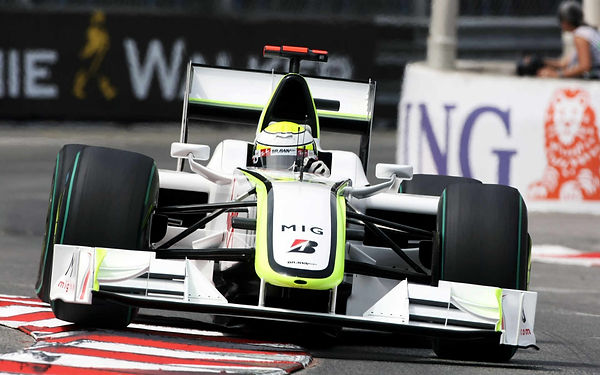
Jenson Button winner in 2009 with a Brawn GP BGP 001
Nothing is Like Monaco
There are faster races.
There are more dramatic races.
But there is nothing like Monaco.
Because here, victory is not just earned through performance.
It is earned through control, discipline, and the ability to exist on the edge, without ever crossing it.
Masters of Monaco
Winning here once is an achievement.
Winning here repeatedly is something else entirely.
Top 10 drivers by Monaco Grand Prix victories:
Ayrton Senna — 6 wins
Graham Hill — 5 wins
Michael Schumacher — 5 wins
Alain Prost — 4 wins
Stirling Moss — 3 wins
Jackie Stewart — 3 wins
Niki Lauda — 2 wins
Fernando Alonso — 2 wins
Mark Webber — 2 wins
David Coulthard — 2 wins
Different eras. Different machines.
The same demand, absolute precision.
Because Monaco does not evolve around the car.
The driver must evolve around Monaco.

Stirling Moss drives to Victory in 1961 with his Lotus 18
The Numbers Behind the Illusion
Monaco feels chaotic.
But its challenge is defined by numbers.
Circuit length: 3.337 km
Total corners: 19
Race distance: 78 laps
Average speed: ~150 km/h
Lap record: 1:12.909 — Lewis Hamilton (2021)
Gear shifts per lap: ~50–55
Total gear shifts (race): 3,800+
On paper, it is one of the slowest tracks in Formula 1.
In reality, it is one of the most demanding.
Because every number hides something more difficult to measure.
Risk. Precision. Consequence.