Dominique Leroy spent decades behind the lens during Formula 1’s most human era. He photographed the heroes, the gladiators and the pioneers, but always saw the human being before the driver.
There was photography first. And then there was speed.
For Dominique Leroy, the two arrived separately before becoming inseparable.
His fascination with photography came through his two grandfathers, both serious amateur photographers.
But there was another influence, perhaps less predictable: Tintin.
“I wanted to become exactly like Tintin,”
Leroy remembers.
“A reporter who travelled the world.”
Then, at nine years old, another obsession arrived.
Motorsport.
His father passed on his own enthusiasm for racing, and suddenly the path seemed obvious. Leroy would combine the two things that fascinated him most. He would become a motorsport photographer.
There was only one problem. His parents said no. So Leroy waited, and resisted.
“I had to wait another ten years to get the message through to my parents,” he says, with characteristic humour,
“by sabotaging my studies.”
Eventually, the boy who wanted to travel like Tintin found his passport.
It was a camera.
And Formula 1 would take him around the world.

The beautiful Ayrton era, in McLaren colours. His first victory on Brazilian soil…

The Hôtel de Paris, in the Principality of Monaco.
An extraordinary setting and an unbeatable view.
Ayrton Senna would go on to claim another pole position.
Fighting the Light
There is a temptation to describe great motorsport photography as a matter of reflexes.
Dominique Leroy sees it differently.
“I think, at the beginning, it is a gift that we cultivate throughout our lives.”
Then comes the work.
“You have to fight the light constantly, observe the drivers’ trajectories and recognise the circuits. Then everyone has their own eye.”
Leroy certainly has his.
“I love slow shutter speeds, backlighting and graphics. That is something you cultivate.”
It is an important distinction. The camera records what happens while the photographer decides what matters.
A Formula 1 car may pass a particular point for only a fraction of a second.
The photographer cannot wait for the image to appear and then react. By then, it is already gone.
Experience changes the relationship with time. Leroy describes something approaching a sixth sense.
“Yes, of course, the sixth sense exists. It comes with experience.”
And then he quantifies something that feels impossible to quantify.
“You press the shutter with a quarter of a second of anticipation.”
A quarter of a second.
Before the moment.
Before the photograph exists.
Before everyone else sees it.

Paul Ricard. The crash at the start.
The Driver and the Light
Ask Leroy what he searches for before taking a photograph and his answer is remarkably simple.
“The story, we don't know before taking the picture. Instinctively, I look for the light and the driver.”
Not the car. The driver.
It is a distinction that runs through almost everything Dominique Leroy says about his career.
Formula 1 may be constructed around machines, engineering, speed and competition, but Leroy's lens repeatedly returned to the person inside the machine. And he photographed extraordinary people.
“Ayrton Senna — how could you forget him? His charisma, his eyes and, of course, his enormous talent behind the wheel.”
Then Stefan Bellof.
“Gone far too soon. I discovered him at Monaco in 1984, in the rain. Exceptional, just like Ayrton.”
Then comes Gilles Villeneuve.
“The Little Prince.”
And Ronnie Peterson.
“Super Swede.”
Leroy was still near the beginning of his career when Peterson was racing, which resulted in what he affectionately describes as many images “stolen” from him.
These were drivers from an era in which danger remained visible. The cars were becoming more sophisticated, but the mythology of Formula 1 still belonged as much to courage as technology.
And if Leroy could point his camera at one of today's generation?
“I would like to make images of the new prodigy, Kimi Antonelli.”
Different generation.
Different Formula 1.
Same search.
The driver.
And the light.

The Little Prince, Gilles Villeneuve. The balancing act, the acrobat…

Nigel Mansell. Focus.
You Don't Know When History is Happening
Today, we look at certain photographs and immediately recognise history.
But history rarely announces itself when the shutter is pressed.
Leroy is unequivocal about that.
“No. Absolutely not.”
Only afterwards does the photographer discover that an image has become iconic.
Sometimes much later.
And sometimes for reasons he would rather never have experienced.
“Unfortunately, like Imola '94.”
There are moments in motorsport that belong to statistics while others belong to memory, and then there are moments that divide time into before and after.
For Formula 1, Imola 1994 is one of them. For Dominique Leroy, it became something else as well.
A confrontation between the photographer and the human being holding the camera.
Disbelief… Jean Alesi has just retired while leading the race.
He drops to his knees on the tarmac, screaming out his despair and rage

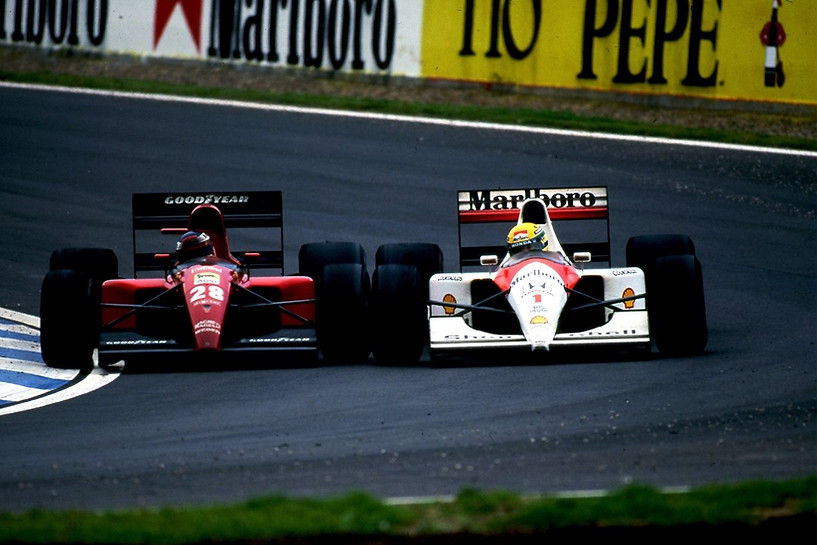
Jean Alesi and Ayrton Senna. An image I owe to my laziness…
I simply couldn’t be bothered to move anymore. Pure luck.
Imola 1994
The first images appeared on the giant screen. Something had happened.
“The big screen gave me the first images of the tragedy.”
In front of Leroy, red flags began to move.
“And in front of me, the red flags were waving and immediately stopped Schumacher, who was leading.”
Leroy understood where it had happened.
Tamburello. Close. Very close.
“I realised it was at Tamburello, just a few steps away.”
Instinct took over.
“I ran.”
Three other photographers arrived almost as quickly.
Then decades of professional conditioning did what they had been trained to do.
“I started shooting again.”
Another frame.
“And again I pressed the button on my camera.”
Another. Another. Another.
“The camera had turned me into a robot.”
It is perhaps the most revealing sentence in Leroy's account.
A photographer working at this level is trained not to miss the moment. Whatever happens in front of him, his responsibility is to record it. But there is a point at which professional instinct collides with something stronger.
“And suddenly my brain took over again.”
One message. Nothing else.
“Stop.”
Leroy could not continue.
“I can't. It's horrible. I can't photograph this.”
The man defeated the photographer, and perhaps that tells us more about Dominique Leroy than any photograph ever could.

Flat-out attack in torrential rain.
Stefan Bellof in action at the Monaco GP

Mika Häkkinen, his blue eyes fixed on the screens above,
studying his rivals’ times.
The Human Before the Driver
There is a question hanging over modern Formula 1 photography.
With enormous hospitality structures, restricted areas, security barriers, digital workflows and increasingly controlled access, can a photographer still get close enough to reveal the humanity of the sport?
Leroy hesitates.
“I don't know if, on today's circuits, we can still talk about humanity.”
Then he returns to the principle that has guided his work.
“For me, it was always the human being before the driver.”
The human being first. Then the driver.
“Then everything else, of course.”
That philosophy explains much of Leroy's photography.
The helmet matters. The car matters. The corner matters.
But so does a glance. A gesture. A face before the visor comes down.
A fraction of vulnerability before the violence of speed.
This was the Formula 1 Leroy photographed.
Not simply cars moving quickly. People preparing to do extraordinary things.

A reflection in a firefighter’s helmet, capturing Rubens Barrichello’s Ferrari.

1993. The vertigo of a racing line stretched from one apex to the next. Robert Kubica at Circuit Paul Ricard.
Ten Thousand Photographs
Photography has changed. So has Formula 1.
Digital cameras transformed the economics of taking a picture.
Artificial intelligence is beginning to transform the image itself.
For someone who came from film, the difference is profound.
“Yes, digital and AI change many things. It isn't the same vision anymore.”
Today, a photographer can return from a Grand Prix with an almost unimaginable number of frames.
“You can take 10,000 images during a Grand Prix.”
In Leroy's era, every press of the shutter carried a cost.
“I was shooting slide film, and the film and development were very expensive.”
That limitation forced a different discipline.
“It allowed us to think much more about what we were going to do.”
Perhaps that is the great paradox of technological progress.
We have never been able to produce so many images.
But having fewer opportunities to make them may once have forced photographers to see more carefully.
A roll of film demanded decisions.
Where do I stand?
Where will the driver be?
Where will the light fall?
What am I waiting for?
And then:
one quarter of a second.
Press.

The era of the 1,200-horsepower turbos, with those incredible sparks…

Winter testing — fantastic for the light.
One Photograph
Ask a photographer who has spent a career around Formula 1 to select a single image and you are asking something close to impossible.
Leroy struggles.
“Only one? That's difficult.”
There are decades to choose from.
Drivers.
Victories.
Defeats.
Circuits.
Faces.
But eventually one image comes back.
“Perhaps that famous look from Ayrton at Imola '94, on the grid.”
The look.
Senna.
Imola.
1994.
“But frankly, it's complicated.”
Of course it is.
Because a photographic archive is not simply a collection of images. It is a collection of places where the photographer once stood.
Looking back at those photographs can therefore feel less like viewing history and more like returning to it.
Leroy describes the sensation simply.
“You dive back into the past and everything comes back.”
And with the passing of time comes another realisation.
“You say to yourself: Ah yes… of course. I was there.”
Iconic F1
Leroy's archive is now becoming part of another project. Iconic F1.
He describes it as something very different from the conventional chronological Formula 1 book.
“In my opinion, it is going to be the rare pearl.”
The structure will not simply move from one season to another.
“No succession of years.”
Instead, drivers, images, graphic design, memories and poetry will interact.
There will be poems about the drivers by Charles Cluny, writing by Daniel Ortelli and anecdotes drawn from Leroy's interviews, some deliberately humorous. The design will have considerable freedom, with Leroy's photographs placed in dialogue with the words.
“It comes through the drivers, the graphics and the poems.”
It sounds appropriate. Because Leroy's own career has never really been about chronology either.
It has been about moments.

That cursed first of May, 1994, at Imola…

The Archive Continues
Another project is also developing around one of Formula 1's defining modern figures: Michael Schumacher.
For the planned Schumacher book, Leroy is careful to explain his role.
“I only provide the images.”
He credits his collaborator Thomas Wolloch as the driving force behind the project, which has been in development for two years and is planned for 2027.
Again, the photographs return.
Images made in fractions of seconds decades ago find another life.
A different page.
A different generation.
A new audience.
The moment passes.
The photograph doesn't.

Monaco is paradise for photographers. The single-seaters pass just centimetres away. For action photography, for the beauty of the setting,
there is simply no other circuit like it. Charles Leclerc.
The Man Who Photographed F1
What would Dominique Leroy say today to the young man who first arrived at a circuit carrying a camera and a dream?
His answer does not involve equipment.
It does not involve technique.
It does not involve shutter speed, lenses, access or accreditation.
Instead, he looks back at the world that young photographer was about to enter.
“Ahhhh…”
You can almost hear the smile.
“He lived through that great era.”
Then come three descriptions.
“Gladiators.”
“Pioneers.”
“Tamers of fear.”
And finally:
“How lucky he was.”
Perhaps he was.
Lucky to photograph Senna.
Lucky to discover Bellof in the rain at Monaco.
Lucky to see Villeneuve and Peterson.
Lucky to stand beside circuits when Formula 1 felt closer, less controlled and unmistakably human.
But luck alone does not create an archive.
Someone still has to recognise the light.
Someone still has to understand the trajectory.
Someone still has to anticipate the moment by a quarter of a second.
And someone has to remember, even when history is unfolding directly in front of the lens, that there is a human being on both sides of the camera.
Dominique Leroy photographed Formula 1.
But what he was really photographing was the people who made us care about it.
The human before the driver.
Always.
All photographs and accompanying descriptions by Dominique Leroy.
Discover more of Dominique Leroy’s work at dominiqueleroy.art

My first stolen photo — James Hunt… No accreditation, just a fake press card.

Dominique Leroy

