THE SHIFT Stories from Car Culture
First Impressions
Not all Ferraris seduce you immediately.
Some require distance.
Others require understanding.
The Ferrari F50 was never built to impress.
It was built to eliminate the distance between driver, machine, and intent.
First Impressions, Revisited
I’ll admit something that, today, sounds almost misplaced.
I didn’t fall in love with the F50 at first sight.
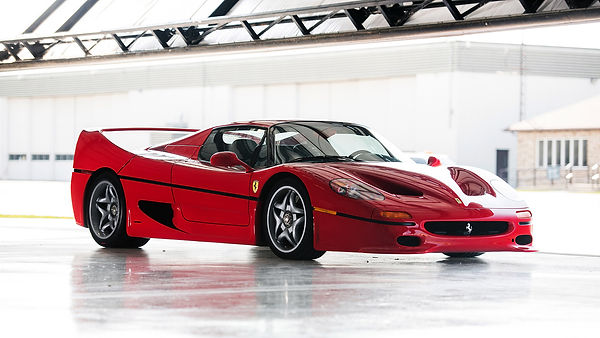
Coming after the F40, it felt less dramatic, less aggressive, almost restrained in its presence.
Where the F40 overwhelmed you instantly, the F50 seemed to hold something back.
For years, I interpreted that as a limitation.
In reality, it was a different kind of confidence.
The Moment
Ferrari Chose Direction
In 1995, Ferrari stood at a crossroads disguised as a celebration.
Fifty years of history forced a decision, not a continuation.
Under Luca di Montezemolo, Ferrari made a move that, at the time, felt almost provocative:
They refused to build a successor to the F40 in spirit.
Instead, they redefined the objective.
Not more power.
Not more spectacle.
But more authenticity.

The Man Behind the Concept
That philosophy didn’t emerge in isolation.
It was shaped early on by Nicola Materazzi, the engineer often associated with the F40, and one of the key figures behind the initial concept of the F50.
Materazzi understood turbocharged performance better than almost anyone.
And yet, for the F50, he moved in the opposite direction.
He pushed for a race-derived naturally aspirated V12, not because it was easier, but because it was purer.
That decision alone defines the car.

F50 V12 Engine
From Concept to Reality
Translating that philosophy into a road car required a different kind of discipline.
By the time the F50 reached its final stages, oversight fell under Amedeo Felisa, who ensured that what began as an ambitious concept could actually function, reliably, in the real world.
Between Materazzi’s vision and Felisa’s execution, the F50 became something rare:
A car that did not dilute its original idea during development.
It refined it.
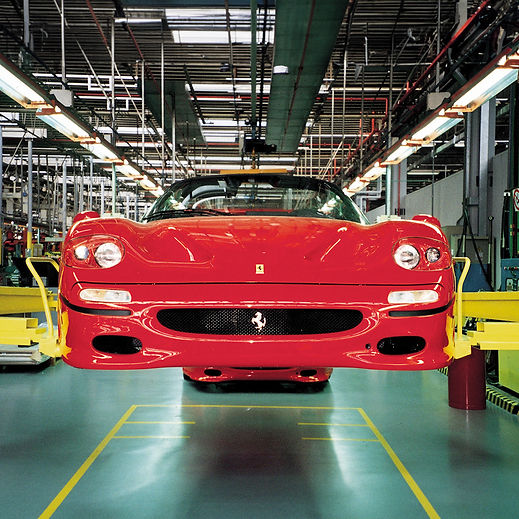
F50 production line
A Formula 1 Architecture
The 4.7-liter V12 is derived from Ferrari’s 1990 Formula 1 engine.
Not a symbolic connection.
A structural one.
But this is where the real engineering challenge begins.
A Formula 1 engine is designed for maximum output over minimal lifespan.
The F50 required durability, thermal stability, drivability.
What Ferrari achieved was not replication.
It was translation.

Ferrari F93A with 745 bhp V12 | 1993
The Structural Philosophy
The more you look at the F50, the clearer its intention becomes.
The engine is not just placed inside the car. It is part of the car.
Mounted directly to the carbon fiber monocoque, acting as a stressed member, the V12 becomes a structural element of the chassis itself.
The gearbox bolts directly to the engine.
The suspension, pushrod, Formula 1-style, connects without isolation.
This eliminates layers.
And with them, it eliminates comfort.
What remains is connection.

F50 engine bay
Design as a Consequence,
Not a Statement
At first, I thought the F50 lacked visual drama.
Now I understand that it avoids it intentionally.
The car was designed by Pietro Camardella at Pininfarina, under the direction of Lorenzo Ramaciotti.
This is not a car styled to impress.
It is a car shaped by airflow, cooling, and structural necessity.
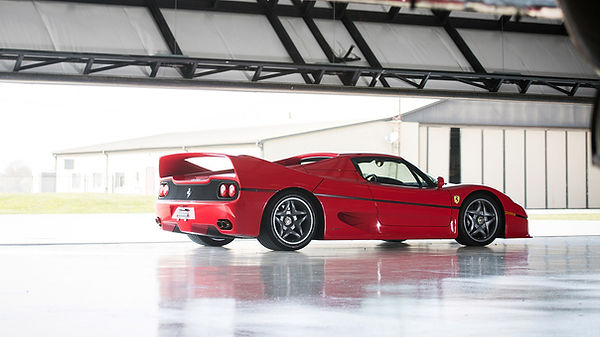
The integrated rear wing, the open rear section, the softened surfaces…
they are not aesthetic compromises.
They are engineering decisions made visible.
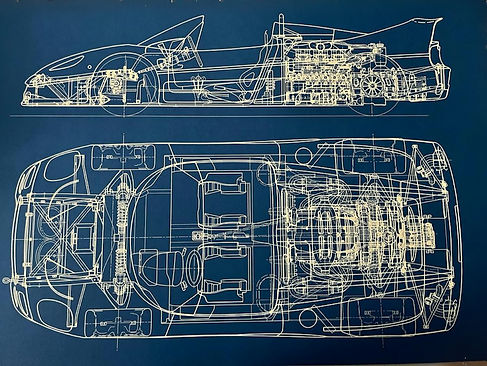
F50 blueprint
Removing the Final Barrier
Then Ferrari removed the last layer of separation.
The roof.
At the time, I questioned it.
Today, it feels inevitable.
Because once you commit to mechanical purity, enclosing the experience becomes a contradiction.
The sound of the V12, the air, the mechanical vibration…
they are not side effects.
They are the point.

F50 overhead perpective
Performance, Reframed
Yes, the numbers exist.
0–100 km/h in 3.8 seconds.
Around 325 km/h top speed.
But reducing the F50 to performance metrics misses its purpose entirely.
This is not a car built to dominate numbers.
It is built to deliver something far more difficult:
Consistency between what the machine does and what the driver feels.

Why It Was Misunderstood
Looking back, I understand my initial reaction.
The F50 arrived at the wrong time for its philosophy.
The industry was moving toward usability.
Toward refinement.
Toward making speed accessible.
The F50 rejected all of it.
It demanded skill.
It required patience.
It offered no shortcuts.
And because of that, it was never immediately embraced.
What Time Revealed
Time, however, has a way of removing noise.
349 units.
Naturally aspirated V12.
Manual gearbox.
Carbon monocoque.
Today, these are not limitations.
They are the definition of purity.
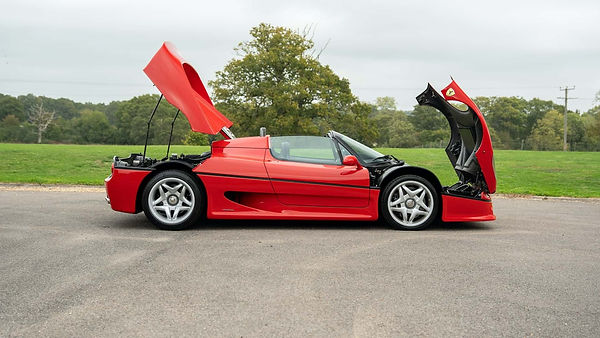
Personal Resolution
I didn’t fall in love with the F50 at first sight.
But I’ve come to see it differently.
Not as a successor to the F40.
But as something far more uncompromising.
A car that doesn’t try to impress you.
It forces you to understand it.
And once you do…
there is very little else like it.
Next Chapter
From mechanical truth…
to technological control.
The story that began with the 288 GTO,
continued through the F40 and the F50,
now evolves into something else.
The Ferrari Enzo.