THE SHIFT Stories from Car Culture
Opening Perspective
I never saw Michael Schumacher as the fastest driver of his generation.
That was never the point, and I think reducing him to speed alone misses what actually made him so disruptive.
What I saw, and what I still believe today, is that he was the first driver to fully understand that Formula 1 could be controlled. Not just influenced, not just mastered in moments, but systematically shaped over time.
That realization, more than any victory or title, is where his story truly begins.

Michael Schumacher
Before Schumacher
Before Schumacher, performance in Formula One existed in a space that was still partially unpredictable.
Drivers relied on instinct, on feel, on their ability to react to changing conditions in real time. The great ones stood out because they could operate closer to the edge, more consistently than others, but the edge itself was still unstable.
In my opinion, Formula 1 was still a sport of interpretation.
Schumacher didn’t want to interpret it.
He wanted to define it.

Michael Schumacher talks with Engineer Trevor Foster at Jordan | 1991
The Hidden Difference
What always stood out to me was not what happened during the race, but everything that led up to it.
The unseen hours. The repetition. The willingness to go deeper into details that most drivers were content to leave to engineers.
He treated preparation as part of performance, not something separate from it.
In many ways, the race weekend was simply the visible expression of a process already defined in advance.
That, more than anything, is where I believe the shift began.

Michael Schumacher in his Ferrari F300 | Fiorano testing pre-launch 1998
From Driver to Operator
At some point, and it’s difficult to define exactly when, Schumacher stopped behaving like a traditional driver.
He became something else.
Someone who didn’t just extract performance from the car, but actively shaped the environment around it, influencing how the team worked, how feedback was processed, how decisions were made.
In my opinion, this is where the term “driver” begins to feel insufficient.
He wasn’t just responding to the system.
He was building it.
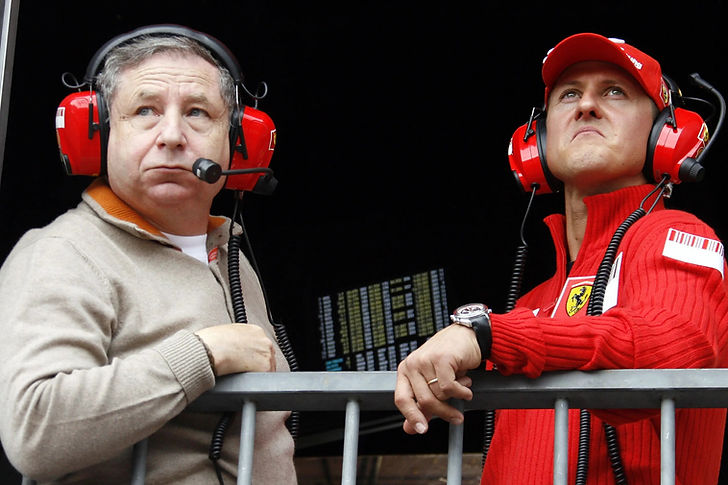
jean Todt and Michael Schumacher
Ferrari Rebuilt
When Schumacher arrived at Scuderia Ferrari in 1996, the narrative that followed would later be described as a return to glory.
I never saw it that way.
Ferrari, at the time, felt less like a team on the verge of success and more like an institution that had lost its internal coherence.
What changed was not immediate performance, but method.
At Fiorano, Ferrari’s private test track, Schumacher pushed for relentless, structured testing. He would repeat the same runs under controlled conditions, sometimes focusing on a single phase of a corner or a specific setup variation, not to go faster in that moment, but to understand why the car behaved the way it did.
He extended debriefs, questioned assumptions, and demanded clarity in how information moved across the team.
It wasn’t visible.
But it was decisive.
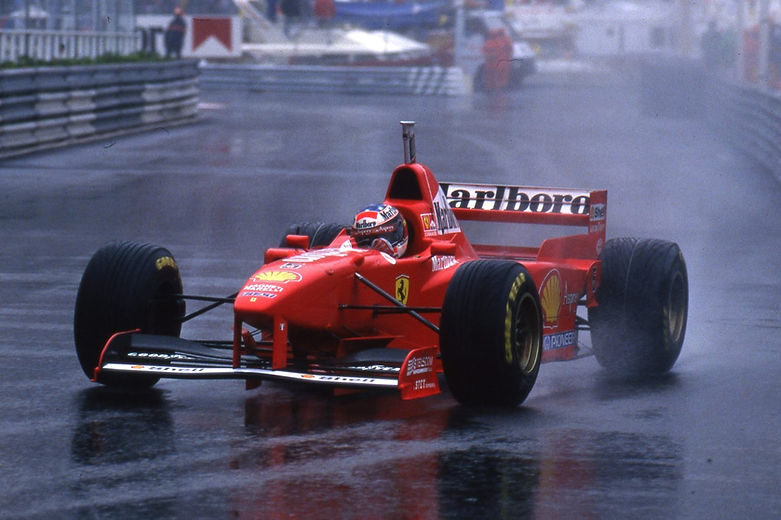
Schumacher Monaco Grand Prix | 1997
Building the System
What he built, alongside Jean Todt, Ross Brawn, and Rory Byrne, was not a comeback story.
It was the continuation of that method, now applied to the entire team.
A system where every detail had intention, where preparation extended far beyond the car, and where performance became something that could be engineered and repeated.
When Ferrari began to dominate, it didn’t feel like a surge.
It felt like the natural outcome of something that had already been built.
Control, Not Magic
There are still races people reference when trying to explain Schumacher, particularly in the rain, where his performances seemed almost unreal.
But I never believed those moments were driven purely by instinct or some innate sensitivity that others lacked.
What I saw was understanding.
A driver who processed grip, balance, and risk with a level of clarity that allowed him to act with precision, even in conditions that appeared chaotic to everyone else.
He wasn’t reacting faster.
He was operating differently.

Michael Schumacher
The Moment That Didn’t Fit
And yet, for all this control, there is a moment that never quite aligns with that image.
After equaling Ayrton Senna’s 41 victories, Schumacher was asked whether he understood the significance of what he had just achieved.
It was a simple question, the kind he had answered countless times before.
I remember expecting the usual composure, the measured tone, the sense that everything was exactly where it should be.
But something shifted.
He paused.
Human
And then he couldn’t continue. He cried.
Not as a gesture, not as a performance, but as the release of something that had been building long before that question was asked.
It had been a difficult stretch of the season, with retirements, pressure, and the growing weight of expectation from Scuderia Ferrari. He would later describe feeling exhausted, not physically, but mentally, carrying the responsibility of delivering a title that had eluded Ferrari for so long.
But that alone doesn’t explain it.
When the comparison to Ayrton Senna was made, something deeper surfaced. Not just respect, but memory.
I always believed that moment reached further back, to Imola in 1994, when Schumacher was driving just behind Senna before the crash. A moment that, for an entire generation of drivers, never fully disappeared.
And then there was Monza itself.
The intensity of the crowd. The emotional charge of the weekend. Even the shadow of the marshal who had lost his life during the race.
All of it, contained until that point.
And then, suddenly, not contained at all.
Monza Grand Prix Press Conference | 2000
The Legacy We Live In
When we look at modern Formula 1, it is easy to assume that its current level of structure and professionalism was a natural evolution.
I don’t believe it was.
I think it was accelerated, and in many ways shaped, by Schumacher’s approach.
Drivers like Lewis Hamilton and Fernando Alonso operate in an environment where total preparation is no longer exceptional, it is expected.
That expectation had to be established.
And once it was, there was no going back.

Schumacher and his Ferrari in action
At The Limit
Seven world titles will always define how Schumacher is remembered.
But in my opinion, they are not what defines his importance.
Most drivers speak about the limit as something they approach, a boundary they feel, a moment they reach.
Schumacher seemed to understand it differently.
Not as something to chase, but as something to construct, piece by piece, detail by detail, until the margin for uncertainty became almost nonexistent.
And once you see his career through that lens, the results no longer feel extraordinary.
They feel inevitable.

Michael Schumacher