THE SHIFT Stories from Car Culture
GORDON
MURRAY
The Engineer Who
Outsmarted Formula One
By Frank Saint-James
Automotive Historian
Contributor, THE SHIFT
The Man Behind the Champions
Formula One celebrates its champions.
Its greatest engineers often remain hidden in the background.
Yet every so often, one individual changes the sport so profoundly that his influence becomes impossible to ignore.
Gordon Murray was one of those rare engineers.
For more than two decades, he challenged convention, exploited regulations and forced rivals to rethink what was possible.
His greatest weapon was never horsepower.
It was imagination.
Long before data simulation became the norm, Murray was solving problems that nobody else had even identified.
The result was not just faster racing cars.
It was a completely different way of thinking.

Gordon Murray and the Brabham BT44B
A Different Way of Thinking
Born in Durban, South Africa, in 1946, Murray developed an obsession with mechanics at an early age.
While others admired racing cars, he wanted to understand why they worked.
He built, modified and raced his own machines before earning a degree in mechanical engineering.
In 1969, carrying little more than a portfolio of sketches and relentless determination, he moved to Britain.
Formula One was entering one of its most creative periods.
It proved to be the perfect environment for a young engineer who believed every problem had a solution.
Even if nobody else could see it yet.

Gordon Murray and Niki Lauda, BT48 racing car at Brabham factory
Brabham's New Brain
Murray joined Brabham in 1969 as a designer.
Within only a few years, he had become Technical Director.
Unlike many of his contemporaries, he never began with the engine.
He began with the question.
How could the entire car become faster?
Less weight.
Smaller dimensions.
Better visibility.
Improved balance.
Lower drag.
Every gram mattered.
Every millimetre mattered.
His philosophy was simple.
Performance was created through efficiency.
Not excess.
The Fan Car
No Gordon Murray creation has achieved greater mythical status than the Brabham BT46B.
Better known simply as the Fan Car.
Introduced at the 1978 Swedish Grand Prix, the BT46B featured a large fan mounted behind the car.
Officially, it cooled the engine.
In reality, it extracted air from beneath the chassis, creating extraordinary ground effect and dramatically increasing grip.
The concept was entirely legal.
It simply exploited an area of the regulations nobody else had considered.
Niki Lauda won the race comfortably.
The car never raced again.
Political pressure forced Brabham to withdraw it voluntarily before the FIA had the opportunity to ban the concept.
One race.
One victory.
An immortal legend.

Mastering Ground Effect
If the Fan Car demonstrated Murray's creativity, the following years proved his consistency.
Ground effect became Formula One's greatest technological revolution.
Rather than copying rivals, Murray refined the concept through packaging, aerodynamics and chassis design.
His objective was never simply to generate more downforce.
It was to create the most efficient car possible.
Every surface had a purpose.
Every component worked together.
The stopwatch rewarded intelligence.
Not complexity.

Gordon Murray talking to Nelson Piquet
The Champion's Formula
That philosophy reached maturity with the Brabham BT49.
Powered by the legendary Cosworth DFV V8, the BT49 relied on balance rather than brute force.
Driven by Nelson Piquet, it secured the 1981 Formula One World Championship.
The title was more than a sporting achievement.
It validated Murray's belief that intelligent engineering could defeat larger budgets and greater horsepower.
Efficiency had once again beaten excess.
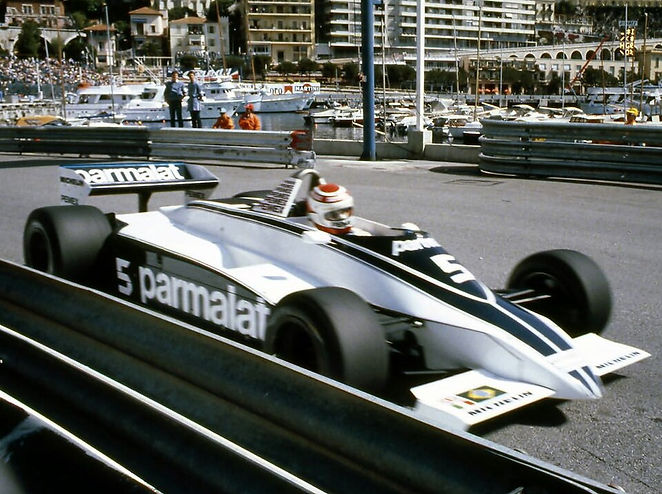
Nelson Piquet in Monaco
Winning by Adapting
Then Formula One changed the rules.
Ground effect tunnels were restricted.
Fuel became a decisive factor.
Most engineers complained.
Gordon Murray saw opportunity.
The Brabham BT52 looked unlike anything else on the grid.
Its sharply pointed profile and dramatically rearward weight distribution reflected a completely new approach to the regulations.
Every design decision revolved around fuel efficiency without sacrificing outright speed.
With Nelson Piquet once again behind the wheel, Murray delivered another World Championship in 1983.
The regulations had changed.
His ability to outthink them had not.
Innovation Without Limits
Throughout the 1980s, Murray became known as Formula One's ultimate innovator.
Not because every idea succeeded.
But because he was willing to ask questions others never considered.
Compact packaging.
Rapid refuelling concepts.
Advanced cooling layouts.
Driver positioning.
Weight distribution.
Every season brought another solution that challenged accepted wisdom.
Some disappeared.
Others became standard practice.
That is often how true innovation works.
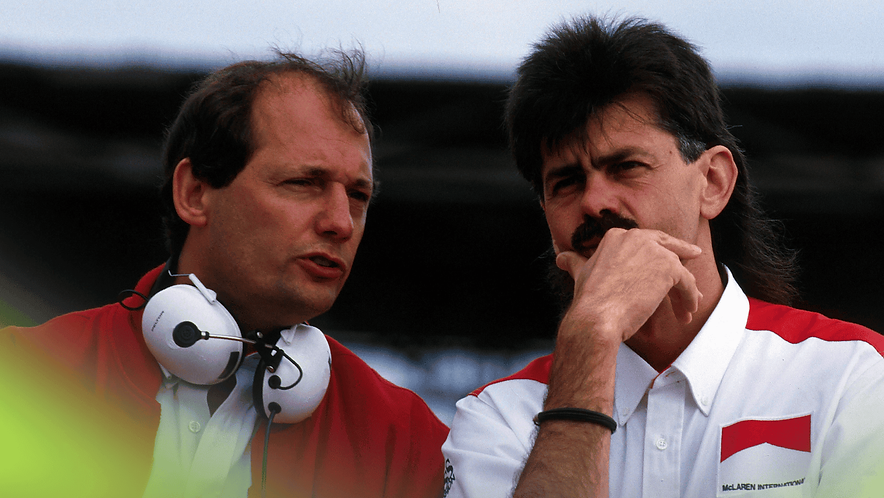
Ron Dennis and Gordon Murray, 1987
McLaren's Next Leap
By 1987, Ron Dennis wanted Gordon Murray at McLaren.
The team already possessed one of Formula One's strongest organisations.
What it wanted was another leap forward.
Murray brought exactly that.
Working alongside Steve Nichols and Honda's engineers, he helped create one of the greatest racing cars ever built.
Its name would become part of Formula One folklore.
The MP4/4.

Senna, Prost and the MP4/4
The Perfect Formula
The numbers remain astonishing.
Sixteen Grands Prix.
Fifteen victories.
Fifteen pole positions.
Ten fastest laps.
A World Championship for Ayrton Senna.
A Constructors' Championship for McLaren.
Driven by Senna and Alain Prost, the MP4/4 dominated the 1988 season with a level of superiority rarely seen before or since.
Its success came from remarkable packaging, aerodynamic efficiency and exceptionally low centre of gravity.
Nothing about the car was excessive.
Everything about it was optimised.

Ayrton Senna and the MP4/4
The Men Who Drove His Ideas
Statistics tell only part of Gordon Murray's story.
His cars carried some of Formula One's greatest names.
Niki Lauda.
Nelson Piquet.
Alain Prost.
Ayrton Senna.
Together they won races, championships and secured places among the sport's immortals.
Yet every one of those victories began long before the lights went out.
They began on Murray's drawing board.

A Philosophy That Endured
Perhaps Gordon Murray's greatest contribution to Formula One was not a single car.
It was a way of thinking.
He never chased power for its own sake.
He chased efficiency.
Reduce weight.
Simplify solutions.
Improve airflow.
Optimise the driver's environment.
Extract every possible advantage from the regulations.
Walk through a modern Formula One paddock and traces of Murray are everywhere.
Extreme packaging.
Obsessive weight reduction.
Aerodynamic integration.
Cooling efficiency.
The relentless search for performance through intelligent engineering.
Technology has evolved beyond recognition.
His philosophy has not.
The Relentless Problem Solver
Those who worked alongside Murray often describe the same qualities.
Curiosity.
Humility.
Relentless attention to detail.
He rarely accepted conventional answers.
Instead, he filled notebooks with sketches, questioned assumptions and searched endlessly for simpler solutions to increasingly complex problems.
For Murray, engineering was never about showing how clever you were.
It was about making the impossible appear obvious.
The Lasting Legacy
Formula One history remembers its champions through trophies.
It remembers its engineers through ideas.
Few minds have left deeper fingerprints on the sport than Gordon Murray.
His cars won championships.
His innovations rewrote regulations.
His philosophy transformed engineering.
Decades later, Formula One is still chasing the same ideal that guided every one of his designs.
Do more. With less.

