THE SHIFT Stories from Car Culture
Heuer / TAG Heuer
Measured in Seconds,
Remebered in Time Forever
By Glenn Allan
Avid Collector and Enthusiast
of TAG Heuer and Ayrton Senna
Contributor, THE SHIFT
The Beginning Of Precision
There are moments in motorsport that last forever.
The sight of a Porsche 917 disappearing into the distance at Le Mans.
Steve McQueen adjusting the cuff of his racing suit.
Ayrton Senna standing silently on the top step of the podium.
Max Verstappen crossing the finish line with his fist raised in the air.
What connects them all is something we rarely notice.
Time.
Not simply the passing of it, but the ability to measure it with absolute precision.
Long before Formula 1 became a global spectacle, and before endurance racing evolved into the technological masterpiece it is today, motorsport faced a surprisingly fundamental problem.
How do you decide a winner when the difference is measured in fractions of a second?
How do you make speed credible?
For more than a century, one name has helped answer that question.
Heuer.
Later, TAG Heuer.
Their story is not simply the story of a watchmaker.
It is the story of motorsport itself.
"Racing needed an instrument nobody could dispute."

Michelle Dubosc, first ever professional timekeeper in Grand Prix Racing and at Le Mans
The Instrument Of Trust
Picture a racetrack in the early 1900s.
There were no electronic sensors.
No transponders.
No digital timing systems.
No photo finishes.
Just officials with mechanical stopwatches and a tremendous amount of trust placed in their thumbs.
When prestige, prize money and reputation depended on who crossed the line first, the smallest mistake could change history.
Motorsport needed more than speed.
It needed credibility.
In 1911, Heuer answered that challenge with a revolutionary invention: the first dashboard-mounted chronograph.
Mounted directly inside the racing car, it allowed drivers and teams to record both the current time and the duration of the race with unprecedented precision.
It wasn't designed as a luxury object. It was a tool.
One built for competition.
Heuer didn't simply manufacture timepieces.
It brought accuracy, confidence and credibility to the racetrack.

Heuer "Time of Trip,” the first dashboard timer for automobiles and aircraft, 1911
Heuer Autavia, 1933
The Birth Of Autavia
Precision had found its place.
Now it needed to evolve.
In 1933, Charles-Edouard Heuer introduced another milestone: the Autavia.
Its name combined two worlds that demanded absolute precision, AUTomobile and AVIAtion.
Originally designed as an onboard timer for both racing cars and aircraft, the Autavia could measure time to one-fifth of a second, becoming an indispensable instrument wherever precision mattered most.
Whether flying through the skies or charging down the Mulsanne Straight, the mission remained exactly the same.
Measure every second.
Because every second mattered.
Quietly, almost unnoticed by the public, Heuer was becoming the instrument trusted by teams, organisers and professionals alike.
Its reputation wasn't built through advertising.
It was built through performance.
"Precision entered a whole new dimension."
The First Ambassador
Technology alone, however, doesn't create legends.
People do.
As motorsport entered the late 1960s, Formula One was transforming into a global spectacle.
Drivers were becoming international stars.
For Jack Heuer, this represented an opportunity unlike any before.
If precision had earned the respect of the paddock, now it needed faces that people could believe in.
Heroes.
The first was Jo Siffert.
Known affectionately as "Seppi," the Swiss driver became Heuer's very first brand ambassador in 1969.
It proved to be one of the smartest decisions Jack Heuer ever made.
Siffert didn't simply wear a Heuer chronograph.
He believed in it.
And wherever he raced, he convinced fellow drivers to do the same.

Jo Siffert
More Than a Sponsor
The relationship quickly became something motorsport had never quite seen before.
Siffert wore the Heuer logo on his racing overalls.
His Lotus-Ford 49B became the first Formula One car to carry the Heuer name, although the sponsorship was directly with the driver himself rather than the team.
Today, that might seem commonplace. In 1969, it was revolutionary.
For the first time, a watchmaker wasn't simply measuring motorsport.
It was becoming part of its identity.
That partnership laid the foundation for everything that followed.
Within just a few years, Heuer's presence would spread through Formula One and endurance racing, attaching itself to some of the greatest names the sport has ever known.
The stopwatch had become something much bigger.
It had become part of racing's culture.
"Heuer wasn't just keeping time anymore. It was becoming part of motorsport's identity."
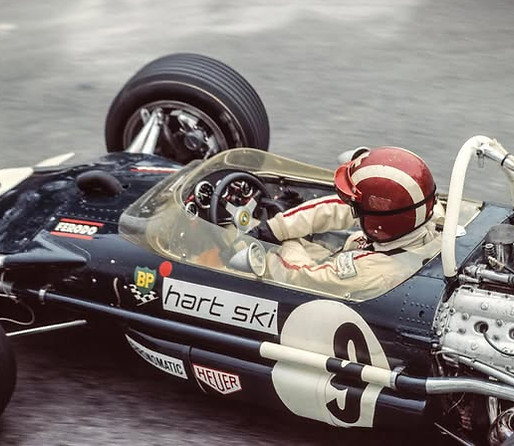
Jo Siffert's Lotus 49B at 1969 Monaco Grand Prix
The Prancing Horse
If Jo Siffert opened the door, Ferrari threw it wide open.
In 1971, Jack Heuer secured one of the most significant partnerships in the company's history.
Scuderia Ferrari appointed Heuer as its Official Timekeeper and one of the team's principal sponsors.
It was a defining moment.
The world's most famous racing team had placed its trust in a company whose reputation had been built not on marketing slogans, but on precision.
Along with Ferrari came some of the greatest names ever to grace a racing circuit.
Mario Andretti.
Niki Lauda.
Jochen Rindt.
Ronnie Peterson.
Mike Hailwood.
Emerson Fittipaldi.
Jacky Ickx.
Jody Scheckter.
Gilles Villeneuve.
These weren't simply ambassadors.
They were competitors who understood that, in motorsport, precision isn't a luxury. It's everything.
Heuer had earned its place among legends.
"The world's greatest drivers didn't simply wear Heuer. They trusted it."

Niki Lauda and Clay Regazzoni
The Watch That
Changed Everything
Then came the watch that changed everything.
The Monaco.
By the late 1960s, almost every chronograph looked the same.
Round cases.
Conservative dials.
Traditional designs.
Jack Heuer wanted something different.
Something bold enough to challenge convention.
Introduced in 1969, the Monaco was unlike anything the watch world had seen.
Its square case immediately stood apart.
A metallic blue dial.
Bright red chronograph hand.
Domed crystal.
Even the crown was positioned on the left, proudly announcing that this automatic chronograph didn't need to be wound every morning.
Named after the Monaco Grand Prix, it wasn't designed to follow trends.
It was designed to create them.
At the time, many questioned whether such a radical design would succeed.
History would answer that question.

Heuer Monaco, 1969
The King Of Cool
Sometimes a product becomes iconic because of engineering.
Sometimes because of design.
Occasionally because of timing.
The Monaco had all three.
But it still needed one final ingredient.
Someone capable of giving it a personality.
Someone who could transform it from a watch into a symbol.
That person was Steve McQueen.
The King of Cool.
"A watch had become more than a tool. It had become a character."

The King of Cool, Steve McQueen
Authenticity Above All
When filming began on Le Mans in 1970, Steve McQueen wanted authenticity above everything else.
This wasn't simply another Hollywood production.
He wanted audiences to feel what endurance racing truly looked like.
The danger.
The speed.
The atmosphere.
To prepare himself, McQueen turned to one of the finest drivers of the era.
Jo Siffert.
The Swiss driver helped McQueen understand both the Porsche 917K and the mindset required to race it.
The two quickly developed enormous mutual respect.
McQueen admired Siffert's professionalism.
His calmness.
His effortless confidence.
It wasn't long before the actor made a decision that would change watch history forever.
If his character was inspired by Siffert...
Then he would dress like him too.

Steve McQueen and Jo Siffert, Le Mans, 1970
The Watch That
Became A Legend
McQueen wore the same Gulf racing suit.
The same Heuer patch.
And naturally, he wanted a Heuer on his wrist.
His choice was the Monaco.
For most films, wardrobe choices disappear once the credits roll.
This one never did.
Millions watched Le Mans.
Millions saw the square blue chronograph on McQueen's wrist.
Without advertising.
Without product placement as we know it today.
Simply through authenticity.
The Monaco became inseparable from Steve McQueen.
And Steve McQueen became inseparable from the Monaco.
More than fifty years later, it remains one of the most recognisable chronographs ever created.
Loved by collectors.
Admired by enthusiasts.
Still instantly associated with one of cinema's greatest automotive films.
One that has always remained a personal favourite of mine.
"The Monaco was already revolutionary. Steve McQueen made it legendary."

Steve McQueen, Le Mans movie, 1971
The Greatest
and The Greatest Legacy
Few relationships between a brand and an athlete have stood the test of time quite like the one between TAG Heuer and the great Ayrton Senna.
It wasn't built overnight.
It grew alongside one of the greatest careers motorsport has ever witnessed.
The story began in 1988, the year Senna joined McLaren-Honda and claimed his first Formula One World Championship.
At the time, TAG Heuer's relationship was primarily with McLaren itself.
The famous logo appeared proudly on the MP4/4, one of the most dominant Formula One cars ever built.
But it didn't take long for the focus to shift.
It shifted towards the man behind the wheel.
By 1989, Senna could be seen wearing the TAG Heuer logo on the sleeve of his race suit, along with the first TAG Heuer watch on his wrist, the Super 2000 Chronograph.
It was the beginning of one of motorsport's most enduring partnerships.
"Some ambassadors promote a brand. Others become part of its history."

Ayrton Senna, 1989
Designed To Win
As Senna's legend grew, so too did his relationship with TAG Heuer.
The partnership extended beyond the circuit into advertising campaigns and public appearances, but what made it special was its authenticity.
Senna never represented perfection.
He represented commitment.
Discipline.
An uncompromising pursuit of excellence.
Those same values naturally aligned with a company whose identity had always revolved around precision.
Perhaps no sentence captures both better than the words Senna spoke during one of his most memorable interviews.
"I am not designed to come second or third. I am designed to win."
Decades later, those words continue to inspire TAG Heuer's philosophy.
Designed to Win.
They are more than a slogan.
They are a mindset.

Ayrton Senna and the McLaren MP4/4, 1988
A Legacy Beyond Time
In 1994, the relationship reached its highest point.
Together, Senna and TAG Heuer were preparing the first watch personally designed by the three-time World Champion.
It was scheduled for release later that year.
History, however, had other plans.
On 1 May 1994, during the San Marino Grand Prix at Imola, Ayrton Senna lost his life.
The world of motorsport stood still.
For millions, it wasn't simply the loss of a racing driver.
It was the loss of a hero.
TAG Heuer honoured the project by releasing the watch in 1995, with part of the proceeds supporting the newly created Instituto Ayrton Senna, helping generations of children in Brazil.
More than thirty years later, Senna's name continues to appear on TAG Heuer timepieces.
Few ambassador relationships in any industry have endured for so long.
Fewer still continue to carry such meaning.
For many collectors, including myself, they represent far more than a watch.
They represent a legacy.
"Some moments stop time. Others live beyond it."

TAG Heuer 6000 Senna, Limited edition, launched in 1995
We Are Back
Motorsport never stands still.
Neither does TAG Heuer.
Today, the company once again occupies one of the sport's biggest stages.
As Official Partner and Timekeeper of Oracle Red Bull Racing, TAG Heuer continues a journey that began over half a century ago.
The names have changed.
The technology has evolved.
The stopwatch has become digital.
But the mission remains exactly the same.
Measure every fraction.
Ensure every result is beyond dispute.
From Jo Siffert to Max Verstappen.
From the Ferrari pit wall to the modern Formula One grid.
The thread has never been broken.
Today, Monaco chronographs can once again be seen on the wrists of Formula One drivers, including four-time World Champion Max Verstappen and rising star Isack Hadjar.
TAG Heuer has also returned as the Official Timekeeper of Formula One.
The campaign says it simply.
We Are Back.
For those who know the brand's history, it feels less like a return...
...and more like a homecoming.

TAG Heuer back as the Official Timekeeper of Formula 1, 2025
Passion Measured In Seconds
None of this history would matter if people had stopped caring.
The remarkable thing is...
They never did.
Speak to TAG Heuer collectors today and you'll hear countless different stories, but one theme appears time and time again.
For many, it was their first serious Swiss watch.
The piece that opened the door to mechanical watchmaking.
The watch that started a lifelong passion.
That is certainly something I have witnessed myself.
Whether speaking with boutique staff, fellow collectors or enthusiasts from completely different walks of life, one thing becomes obvious.
The timepieces may be different.
The stories may be different.
But the passion is exactly the same.
Along the way, those shared passions create friendships, unforgettable experiences and memories that extend far beyond the timepieces themselves.
That, perhaps, is the greatest achievement of all.
"The timepieces tell time. The people give them meaning."

Anthony Ranalli's TAG Heuer tattoo and Carrera chronograph.
A lifelong passion worn both on the wrist and in the skin.
Measured In Seconds.
Remembered Forever.
Since its founding in 1860, Heuer, and later TAG Heuer, has measured far more than races.
It has measured ambition.
Innovation.
Risk.
Victory.
Heartbreak.
History.
From the first dashboard chronograph in 1911 to today's Formula One grid, one constant has remained.
The pursuit of precision.
Legends such as Jo Siffert, Steve McQueen and Ayrton Senna didn't simply wear the name.
They gave it meaning.
And every new generation of drivers, collectors and enthusiasts continues to add another chapter to that story.
Because time can measure a lap.
It can measure a race.
It can even measure a lifetime.
But it can never measure what motorsport makes us feel.
Some stories are counted in trophies.
Some in championships.
The very best...
Are measured in seconds.
And remembered forever.
"Time measures races. Passion makes them timeless."

Jo Siffert, Steve McQueen and Ayrton Senna