Beginning With A Memory
The first time I stood in front of an Ferrari F40, it didn’t feel like meeting a car.
It felt like stepping into a moment that had already happened.
You don’t approach it the way you approach something new.
There’s a sense that this is something already decided, already fixed in history, and you are just arriving late to it.
1987, But Not a Celebration
Ferrari turned 40 in 1987.
Anniversaries usually bring reflection, sometimes indulgence.
A softer tone, a sense of looking back.
The F40 didn’t look back.
It felt like a car built with urgency, not nostalgia.
As if time wasn’t something to celebrate, but something to respond to.


Enzo Ferrari
Enzo’s Presence
By then, Enzo Ferrari was already a distant figure to the outside world.
Inside Ferrari, he was still very much present.
The F40 carries that presence in a way that’s difficult to explain but easy to feel.
Not through symbolism, but through decisions.
There is very little in this car that feels negotiated.
The Project That Didn’t End
The story doesn’t really begin with the F40.
It begins with the Ferrari 288 GTO, and more specifically, with what it was supposed to become.
The Evoluzione program pushed that car far beyond its original intent.
Lighter, more aggressive, closer to something that belonged on a circuit.
The project never found its official purpose.
But internally, it left something behind.
A direction that was too clear to ignore.

288 GTO Evoluzione

Nicola Materazzi (first on the right) and the 288 GTO Evoluzione
Materazzi’s Approach
At the center of that direction was Nicola Materazzi.
He wasn’t working towards refinement.
That was never the objective.
His work on turbocharged engines had already shaped Ferrari’s approach to performance in that era, but with the F40, the intention feels different.
Less about improving a system, more about removing anything that diluted it.
How Power is Delivered
The numbers are well documented.
A 2.9-liter V8, twin turbocharged, producing 478 horsepower.
But the character of the engine is not defined by those figures.
It’s defined by how it responds.
There is a delay, noticeable and deliberate.
Then the car gathers itself and delivers everything in a single, uninterrupted surge.
It doesn’t build progressively.
It arrives.
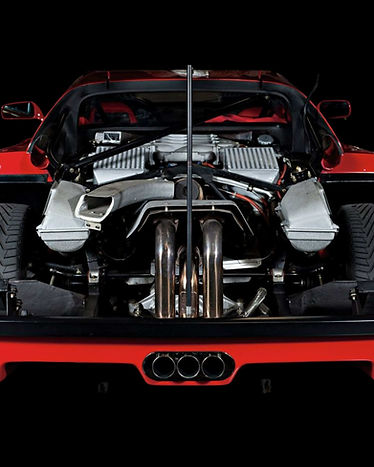
F40 Engine Bay

The Role of Delay
Most engineers would treat that delay as something to eliminate.
Materazzi didn’t.
He understood that it shaped the experience as much as the power itself.
That brief pause before the turbos engage changes the way you interact with the car.
It asks you to anticipate rather than react.
Over time, it becomes part of the rhythm.
Removing What Doesn’t Matter
Inside the F40, there is very little to distract you.
The absence is immediate.
No carpeting, minimal trim, exposed materials.
Even basic elements like door handles are reduced to simple mechanisms.
This wasn’t done to create a statement.
It was the natural result of a process that kept asking the same question: Is this necessary?
If the answer was no, it disappeared.


Shaped By Necessity
At Pininfarina, under the direction of Leonardo Fioravanti, with the lines shaped by Pietro Camardella, the F40 took form in a way that feels almost inevitable.
There’s no sense of decoration.
The rear wing, the vents, the proportions, they all exist because they have to.
Nothing feels added afterwards.
The car looks the way it does because it couldn’t look any other way.
The Way It Treats The Driver
Driving the F40 is not about being assisted.
There are no systems working in the background to correct mistakes or soften reactions.
The relationship is direct.
Every input produces a response that feels mechanical, immediate, and sometimes unforgiving.
Over time, you understand that the car isn’t trying to challenge you.
It’s simply not trying to protect you.


Before “Analog” Had A Name
Looking back, it’s easy to describe the F40 as analog.
At the time, it was simply contemporary.
The absence of electronic mediation wasn’t a philosophy.
It was the reality of how cars were built.
What makes the F40 stand out is how fully it embraces that reality.
There’s nothing between the driver and the machine that doesn’t need to be there.
Performance In Context
On paper, its performance remains impressive.
0 to 100 km/h in just over four seconds.
A top speed exceeding 320 km/h.
In 1987, these figures placed it at the very edge of what was possible for a road car.
But the experience of the F40 has never been defined by numbers alone.
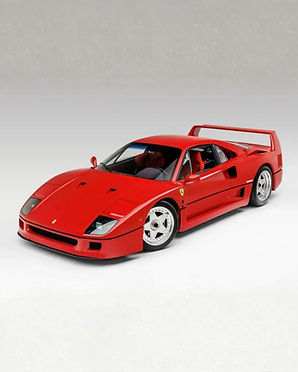

Image and Reality
For many, the F40 was first encountered as an image.
A poster, a magazine cover, a photograph that seemed almost too perfect.
In reality, the car is less composed.
It moves, it vibrates, it communicates constantly.
That contrast between expectation and experience is part of what makes it memorable.
Its Place In The Lineage
The F40 sits within a clear progression.
From the 288 GTO to what followed, the F50, the Enzo, LaFerrari, and later the F80.
Yet it feels distinct within that sequence.
Less resolved, perhaps.
Closer to the edge of what was acceptable at the time.


Production, And Perception
Although production eventually exceeded initial expectations, with over 1,300 units built, the F40 never became commonplace.
Its reputation was shaped less by numbers and more by the nature of the experience it offered.
It wasn’t a car that adapted to its owner.
It required adjustment in the opposite direction.
Learning The Car
Understanding an F40 takes time.
Not because it is complex in a technical sense, but because it communicates in a way that is unfamiliar today.
The feedback is constant, sometimes subtle, sometimes abrupt.
There is a process of learning how to interpret it.
And even then, it retains an element of unpredictability.

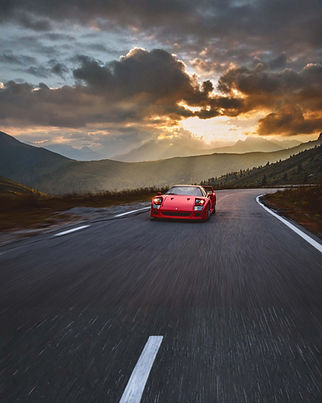
What It Leaves Behind
What defines the F40 isn’t just what it does, but what it refuses to do.
It doesn’t isolate you from speed.
It doesn’t simplify the experience.
It keeps everything intact, the delay, the noise, the movement, the effort.
And in doing so, it represents a moment in automotive history where nothing stood between the driver and the machine.
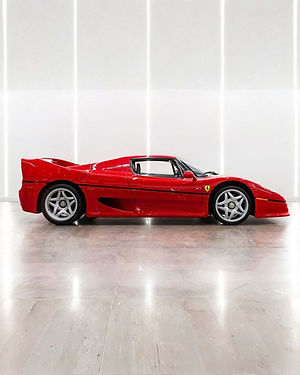
Ferrari Halo Icons
Episode III
If the F40 was the rawest expression of Ferrari’s philosophy, what happens when that philosophy meets Formula 1 thinking?
The answer comes next.
The Ferrari F50.
Ferrari Halo Icons | Episode III.
Coming in the next issue of THE SHIFT.
Specifications
Engine: 2.9L Twin-Turbo V8
Power: 478 hp
Torque: 577 Nm
0–100 km/h: ~4.1 seconds
Top Speed: 324 km/h
Weight: ~1,100 kg
Production: 1,311 units
Layout: RWD, 5-speed manual

.jpg)