Memory, Engineered
Ferrari does not just build cars. It builds memory.
And the more time I spend around these machines, the more I realize that Ferrari’s true material is not carbon fiber or aluminum.
It is memory.
The Icona Series is Ferrari’s way of reconnecting with the moments that defined its legend.
The open-top racers that conquered the 1950s.
The endurance prototypes that dominated the 1960s.
Machines that shaped the identity of the Cavallino.
With the SP1, SP2, and Daytona SP3, Ferrari revisits those victories and transforms them into modern sculptures of speed, blending heritage with contemporary engineering and pure V12 emotion.
These are not simply limited editions.
They feel closer to something else.
Chapters of Ferrari history rewritten for a new generation of collectors.
Inspiration
Ferrari has always looked forward.
Innovation, performance, the constant pursuit of speed.
But the Icona Series does something different.
It looks back, not with nostalgia, but with intent.
And that distinction matters.
It selects precise moments in Ferrari’s history, not entire eras, not vague inspiration, but specific machines, specific victories, specific emotions, and brings them into the present.
Not as replicas. As reinterpretations.
To me, that’s where Icona becomes interesting.
It’s not about remembering.
It’s about choosing what is worth remembering.
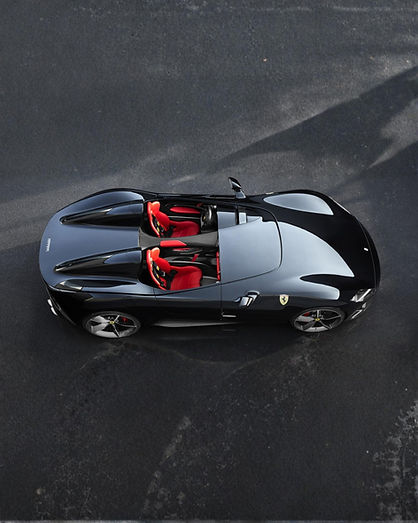
Ferrari SP2

Flavio Manzoni
Design as a Time Bridge
At the center of this philosophy is Flavio Manzoni.
Under his direction, Ferrari’s design language evolves without breaking its lineage.
The Icona cars are not retro.
They are distilled.
And that’s much harder to achieve than it sounds.
Proportions, surfaces, and details are reduced to their essence, removing excess until only identity remains.
A line becomes a reference. A curve becomes memory.
The result is something rare.
A car that feels both familiar and entirely new.
You recognize it instantly, even if you’ve never seen it before.
Distilling Identity
Proportions, surfaces, and details are reduced to their essence, removing excess until only identity remains.
A line becomes a reference. A curve becomes memory.
The result is something rare.
A car that feels both familiar and entirely new.
You recognize it instantly, even if you’ve never seen it before.

Ferrari SP1

Ferrari SP2 and Ferrari 166MM
Monza Sp1 & Sp2:
The Origin
The first chapter.
The Monza SP1 and SP2 draw directly from Ferrari’s barchettas of the 1950s.
Not as a general reference, but as a precise lineage.
The Barchetta Legacy
The Ferrari 166 MM, winner of the Mille Miglia, where lightness and agility defined performance.
The Ferrari 250 Testa Rossa, a machine shaped by endurance, where form followed airflow and necessity.
The Ferrari 750 Monza, raw, elemental, built around the idea that less weight meant more speed.
These were not designed to impress.
They were designed to win.

Ferrari 166MM, Ferrari 250 Testa Rossa and Ferrari 750 Monza

Ferrari 166MM | Mille Miglia 1951 | Castellotti and Rota
Function Before Form
Open cockpits.
Minimal bodywork.
Nothing beyond what speed required.
Cars built for pure driving.
No roof. No concessions. No distractions.
And that changes how you look at the Monza.
Modern Interpretation
The SP1 takes that idea to its extreme, a single-seat experience, almost like a modern racing prototype for the road.
The SP2 introduces a second seat, but keeps the philosophy intact.
They are not trying to be practical.
They are trying to be honest.

Ferrari SP1 and Ferrari SP2

Ferrari SP1 and Ferrari SP2
Sensation Over Comfort
Minimalism becomes the luxury.
Even the absence of a windshield becomes a statement.
Instead, Ferrari developed a “Virtual Wind Shield”, an invisible barrier of air that allows speed without interruption.
It is not about comfort.
It was never about comfort.
It is about sensation.
Form Follows Emotion
On the Monza, surfaces are sculptural.
Clean, uninterrupted volumes.
No aggressive wings. No visual noise.
The car does not shout.
It flows.

Ferrari SP2

Echoes Of The Past
Every surface carries echoes of those early barchettas, where airflow shaped form and necessity defined beauty.
Every line recalls a time when speed was raw, exposed, and deeply human.
This is not performance defined by numbers.
It is performance defined by feeling.
And that, in today’s world, feels almost radical.
Daytona Sp3: The Next Chapter
If the Monza looks to the 1950s, the Daytona SP3 moves into the 1960s.
An era of endurance racing dominance.
1967 Daytona.
Ferrari finishes 1-2-3.

Daytona 1967

Ferrari Daytona SP3
Capturing A Victory
The SP3 captures that moment, not literally, but emotionally.
The low, wide stance.
The sculpted fenders.
The dramatic rear with its horizontal blades.
It is a car shaped by speed over distance.
By endurance, not just acceleration.
And somehow, you can feel that just by looking at it.
A V12, Uncompromised
In an age of electrification, the Daytona SP3 remains defiantly pure.
A naturally aspirated V12, mounted in the middle.
No hybrid assistance.
No artificial enhancement.
Just mechanical response.

Ferrari Daytona SP3
Memory As Performance
In the end, the Icona Series reveals something deeper about Ferrari.
Performance is not only speed.
It is memory.
The SP1, SP2, and Daytona SP3 are not just cars.
They are reminders.
Of what Ferrari was.
And of what it refuses to forget.
And maybe that’s what makes them so compelling.
Not what they are.
But what they carry with them.
Specifications
Ferrari Monza SP1 / SP2
-
6.5L naturally aspirated V12
-
810 hp
-
0–100 km/h: 2.9 s
-
Top speed: 300+ km/h
-
Production: 500 units
Ferrari Daytona SP3
-
6.5L naturally aspirated V12
-
840 hp
-
0–100 km/h: 2.85 s
-
Top speed: 340 km/h
-
Production: 599 units

.jpg)