THE SHIFT Stories from Car Culture
ITC 1996
Too Fast to Survive
By David Keller
Fourth-Generation Petrolhead
Defender of Combustion
Contributor, THE SHIFT
Formula One in Disguise
There was a brief moment when touring cars stopped behaving like touring cars.
Manufacturers no longer competed to build the fastest sedan.
They competed to build the closest thing possible to a Formula One car, disguised as one.
It was magnificent.
It was unsustainable.
And it would only last a single season.
The International Touring Car Championship of 1996 remains one of motorsport's most ambitious and expensive experiments.
Many believe it was also its greatest.

FIA International Touring Car Championship ITC Silverstone 1996
From DTM to the World
The story actually began years earlier.
The Deutsche Tourenwagen Meisterschaft, better known as DTM, had become Germany's premier touring car championship during the late 1980s and early 1990s.
Manufacturers loved it.
Fans packed the grandstands.
The racing was spectacular.
By the mid-1990s, DTM had grown beyond Germany.
The FIA saw an opportunity.
In 1996, the championship became the International Touring Car Championship.
The world stage awaited.

DTM Champion Klaus Ludwig, Mercedes-Benz C Class AMG DTM (W202), 1994
The Class One Revolution
The regulations created something extraordinary.
Known as Class One, they gave manufacturers remarkable technical freedom while still requiring the cars to resemble production saloons.
What emerged were machines unlike anything seen before or since.
Carbon fibre construction.
Sequential gearboxes.
Electronically controlled differentials.
Sophisticated suspension systems.
Wind-tunnel-developed aerodynamics.
Nearly 500 horsepower from screaming naturally aspirated V6 engines.
These were touring cars only in appearance.
Everything underneath belonged to another world.
Three Manufacturers.
One Arms Race.
Only three manufacturers accepted the challenge.
Mercedes-Benz.
Alfa Romeo.
Opel.
Each arrived with an entirely different philosophy.
Each believed it had found the winning solution.
Each spent extraordinary amounts of money proving it.
The result was one of the greatest engineering rivalries touring car racing has ever witnessed.

Alfa Romeo: The Benchmark
Alfa Romeo entered with the already legendary 155 V6 TI.
Aggressive.
Light.
Exceptionally agile.
Its naturally aspirated V6 became one of the defining sounds of the era.
Having dominated earlier seasons, Alfa understood that standing still meant falling behind.
Every race became another opportunity to evolve.

Nicola Larini ,Hockenheim, 1996
Mercedes: Precision Perfected
Mercedes responded with ruthless precision.
Its C-Class represented engineering discipline at its finest.
Nothing appeared exaggerated.
Nothing was left to chance.
Driven by Bernd Schneider, Klaus Ludwig and an exceptional line-up of factory drivers, Mercedes continuously refined every detail.
Reliability became just as important as outright speed.
Sometimes, perfection wins races.

Bernd Schneider, Hockenheim, 1996
Opel: Innovation Without Fear
Then there was Opel.
The Calibra V6 looked almost futuristic before it even entered the circuit.
Beneath its elegant bodywork hid one of the most technically sophisticated racing cars ever built.
Advanced aerodynamics.
An immensely complex four-wheel-drive system.
Constant development.
Opel was determined not merely to compete.
It intended to beat two of Europe's biggest manufacturers.

Manuel Reuter, Hockenheim, 1996
When Engineers Became the Heroes
The drivers were exceptional.
Former Formula One racers.
Le Mans winners.
Touring car specialists.
Bernd Schneider.
Nicola Larini.
Alessandro Nannini.
Klaus Ludwig.
Hans-Joachim Stuck.
Manuel Reuter.
Johnny Cecotto.
The grid was filled with talent.
Yet, strangely, this became a championship remembered more for its machines than for its heroes.
The engineers had stolen the spotlight.
Alessandro Nannini, Estoril, 1996

Speed Beyond Reason
Watching these cars was unforgettable.
The V6 engines screamed beyond 11,000 rpm.
Gear changes happened almost instantly.
The aerodynamics generated astonishing grip.
They attacked kerbs with the aggression of single-seaters while carrying the silhouette of family cars.
No touring championship had ever looked this fast.
Perhaps none ever will again.
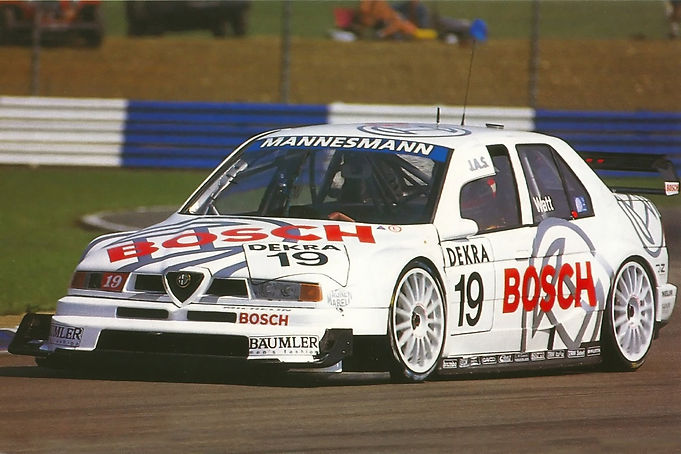
Jason Watt, Alfa Romeo 155 V6 TI, Silverstone, 1996
The Cost of Perfection
There was only one problem.
The technology worked.
Too well.
Budgets spiralled into Formula One territory.
Every tiny performance gain required millions.
Development never stopped.
Private teams disappeared.
Even manufacturers began questioning whether the investment made sense.
The championship had become a victim of its own brilliance.

Dario Franchitti, Suzuka, 1996
The Fall
At the end of 1996, it was over.
Mercedes walked away.
Alfa Romeo left.
Opel followed.
Without manufacturers, there was no championship.
The most technologically advanced touring cars ever created had survived only a single international season.
They had evolved beyond what the sport could sustain.

Too Fast to Survive
Today, Class One cars occupy a unique place in motorsport history.
They were faster than many prototypes.
More sophisticated than anyone expected.
And almost impossible to justify economically.
They represented engineering freedom at its absolute peak.
A reminder that innovation sometimes moves faster than reality can afford.
Perhaps that is why they remain so captivating.
Not because they changed touring car racing forever.
But because they proved just how extraordinary it could become when ambition had no limits.

