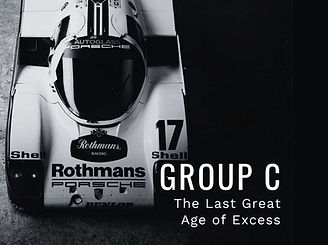
THE SHIFT Stories from Car Culture
Yannick Dalmas
MORE THAN FOUR VICTORIES AT LE MANS
Four Manufacturers. One Mindset.
By Nuno Di Franco
Founder, KINGSHIFT
The Smile Before the Storm
"You never lose or you never win alone." — Yannick Dalmas
Thirty minutes before the start of the 1995 24 Hours of Le Mans, Yannick Dalmas smiled. Not because he expected to win. Quite the opposite.
He was sitting with his teammates inside the team's small caravan when he heard the rain beginning to fall.
"It was the first time I smiled," he remembers.
The McLaren F1 was never supposed to beat the prototypes. On a dry circuit, Dalmas admits it would have been impossible.
"If the race had been dry, we never would have won."
But endurance racing has always rewarded those who adapt faster than everyone else.
That rainy afternoon would become one of the most unforgettable victories in Le Mans history.
And perhaps the perfect summary of Yannick Dalmas himself.

Yannick Dalmas, Le Mans, 1995
More Than Statistics
Looking at his career today, it would be easy to define Yannick Dalmas by statistics.
Four victories at the 24 Hours of Le Mans.
Four different manufacturers.
Peugeot.
Porsche.
McLaren.
BMW.
A World Sportscar Championship.
Formula One.
Yet speaking with him, something quickly becomes obvious.
He rarely talks about winning.
Instead, he talks about people.
Strategy.
Preparation.
Respect.
And above all...
adaptation.
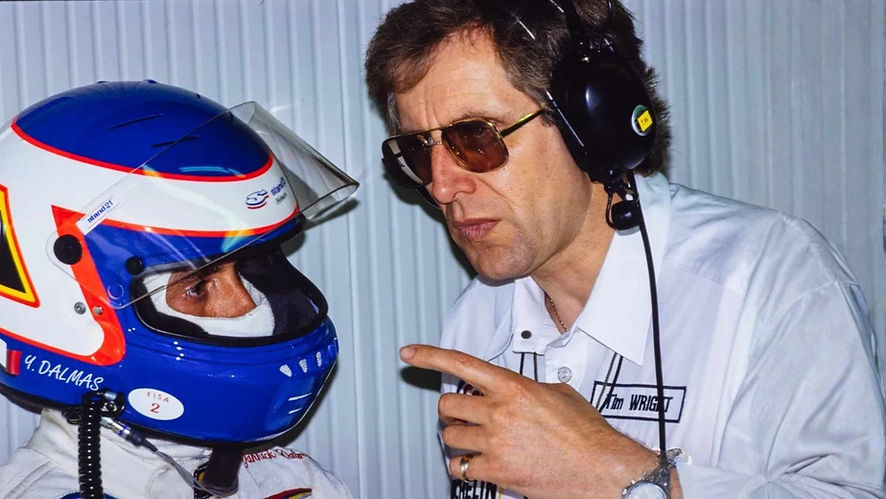
Yannick Dalmas and Tim Wright, Race Engineer
Finding His True Discipline
Dalmas never describes himself as the fastest driver. Nor the bravest. Nor the most naturally gifted.
Instead, he believes endurance racing suited something deeper in his personality.
"Maybe my profile was much better for endurance than Formula One."
Formula One taught him invaluable lessons, even if the opportunities never fully matched his ambitions.
"Experience is something you cannot buy."
Endurance, however, allowed him to become something different.
Not simply a driver.
But part of a team.
Nobody Wins Alone
Throughout the interview, one sentence returns again and again.
"You never lose or you never win alone."
It isn't a slogan.
It's the philosophy that shaped his entire career.
For Dalmas, victories begin months before the green flag.
The engineers.
The mechanics.
The race engineers.
The strategy meetings.
The discussions between teammates.
Everyone contributes.
At Le Mans, three drivers share one car.
But one objective.

Porsche 962 Dauer Le Mans, 1994
Four Teams.
Four Cultures.
One Driver.
"You prepare for Le Mans two or three months before the race. It's a lot of work."
"You never lose or you never win alone."
Perhaps that explains how Dalmas achieved something no other driver has.
Winning Le Mans with four completely different manufacturers wasn't about adapting to different cars.
It was about adapting to different people.
Different cultures.
Different engineering philosophies.
French.
German.
British.
Every manufacturer approached racing differently.
Every team had its own identity.
Dalmas embraced all of them.
"I had the opportunity to work with French, German and English teams...
different drivers, different factories."

BMW V12 LMR, drove by Yannick Dalmas, Pierluigi Martini and Joachim Winkelhock crossing the finish line, Le Mans, 1999
Four Victories, Four Lessons
When asked what each victory taught him, his answers reveal four different lessons.
With Peugeot came the overwhelming realization of what Le Mans truly meant.
"When we stood on the podium... I had never seen so many people."
With Porsche, patience.
Mechanical problems early in the race didn't end their chances.
The car recovered. Others failed.
Victory arrived through persistence.
With BMW, strategy.
The team deliberately refused to join the early sprint.
"If we had changed our strategy, we never would have won."
And then there was McLaren.
The impossible victory.

McLaren F1 GTR, Le Mans, 1995
When Slowing Down Wins The Race
Twenty-one hours of relentless rain.
Aquaplaning.
Changing conditions.
A race where survival became just as important as speed.
"The rain was good for us."
"Sometimes it's necessary to lose some seconds to be better in the end."
Ask Dalmas what separates a good endurance driver from a great one, and he never mentions outright speed.
Instead, he talks about precision.
About protecting the car.
About accepting that lifting the throttle can sometimes be the fastest decision.
"Sometimes you have to release the throttle to stay safe."
Modern racing often rewards aggression.
Dalmas believes experience teaches restraint.
"You have to adapt to the race conditions."
Because endurance isn't won by driving every lap at the limit.
It's won by knowing exactly when not to.

Original onboard footage from Yannick Dalmas' opening lap at Le Mans, 1995
The Leader Without an Ego
Leadership, for Dalmas, also looks different.
The best teammate isn't necessarily the quickest.
Nor the loudest.
Nor the most famous.
"You need a leader. But the leader isn't a boss."
Instead, the leader understands everyone's strengths.
One driver prefers qualifying.
Another enjoys the night.
Someone else thrives in changing weather.
The greatest endurance teams don't ask every driver to do everything.
They ask every driver to do what they do best.

Yannick Dalmas, Pierluigi Martini and Joachim Winkelhosk, Le Mans, 1999
Endurance's New Golden Age
Today's World Endurance Championship fascinates him.
Not simply because of the Hypercars.
Or the technology.
But because an entirely new generation has finally discovered endurance racing.
"Twenty or thirty years ago, endurance drivers were seen like taxi drivers."
Today, things have changed.
Ferrari's return.
The arrival of Porsche, Toyota, BMW, Cadillac, Alpine and soon McLaren.
Millions watching online.
Young fans filling grandstands.
"Communication changed everything."
For Dalmas, social media didn't just transform motorsport.
It transformed careers.
Yet despite all the technology...
all the data...
all the artificial intelligence...
his advice remains surprisingly simple.

AF Corse Ferrari 499P, Le Mans, 2026
The Fundamentals Never Change
"Be mentally strong."
"Be physically strong."
"Concentrate."
"Adapt."
"Learn from your mistakes."
The fundamentals never change.
"High level is not enough. You have to be more than high level."
Near the end of our conversation, the discussion moves away from racing.
Towards childhood.
His father. His values.
As a young boy living near Paul Ricard, Dalmas dreamed of Formula One.
His parents never taught him how to become famous.
They taught him something far more valuable.
Focus.
Respect.
Discipline.
"Those values stayed with me throughout my career."
Perhaps that explains why, despite one of the most remarkable résumés in endurance racing,
humility remains one of his defining characteristics.

Yannick Dalmas, focus before the race
Lessons From His Father
For the first time during our conversation, Yannick Dalmas pauses for longer than usual.
Asked what he would tell the ten-year-old boy who dreamed of becoming a racing driver,
he doesn't speak about Le Mans.
He doesn't mention Formula One.
He doesn't talk about victories.
Instead, he thinks back to the values his father passed on to him.
"I was very timid... maybe too timid."
Then he smiles.
"Maybe... less modest."
Friends have often told him the same thing throughout his career.
"Yannick, you're too modest about what you've achieved."
He never argues.
Instead, he quietly explains why.
"It's my education."

Yannick Dalmas on the podium with Pierluigi Martini, and Joachim Winkelhock, Le Mans 1999
The Character Behind The Champion
Respect came before recognition. Humility before ego.
Whether speaking to a mechanic, an engineer, a team manager or another driver, everyone deserved the same respect.
Perhaps that is what his parents gave him long before racing ever did.
Not the ambition to become a champion.
But the character to become one.
"Respect is the most important."
Four Le Mans victories.
Four manufacturers.
Countless races.
Yet perhaps Yannick Dalmas' greatest achievement isn't adapting to different cars.
It's never abandoning the values that made adaptation possible in the first place.

Yannick Dalmas kissing one of his four Le Mans trophies
The Greatest Victory
Respect.
Humility.
Preparation.
Teamwork.
In an era increasingly obsessed with individual heroes, Dalmas reminds us that endurance has always been something else.
It is a sport where success belongs to everyone.
Where patience often defeats speed.
Where losing a second can sometimes win a race.
And where, long after the trophies have been lifted, character remains the greatest victory of all.

Yannick Dalmas. A gentleman. A champion. A legend.