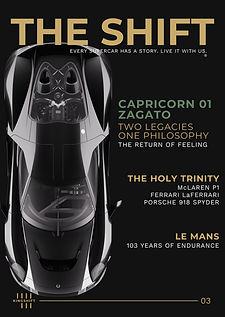
Time as the Ultimate Opponent
There are races I admire.
There are races I respect.
And then there is the 24 Hours of Le Mans.
I attended Le Mans several times growing up, and it became one of those defining moments of my childhood.
The one I never quite manage to fully understand.
Not because it is complex.
But because it asks a question I’m not sure any race should ask:
How long can you hold on before something breaks?
Origins
It began in 1923, organized by the Automobile Club de l'Ouest.
The idea came from Georges Durand, together with Charles Faroux and Émile Coquille, who wanted to create something fundamentally different from the sprint races of the time.
Not another test of speed. But a test of durability.
At the time, no race had ever been structured quite like this.
Running for 24 continuous hours, on public roads closed for the occasion, was a radical concept.
In many ways, it didn’t just introduce a new race.
It helped define endurance racing as we understand it today.
Le Mans has been held almost every year since, interrupted only because of World War II, between 1940 and 1948.
Which, in itself, says something about its importance.
Because once it started, it never really stopped.
And the idea behind it remains unchanged.
Let the cars run. Long enough for the truth to appear.
Not the fastest.
The one that refuses to stop.

24 Hours of Le Mans | 1923

A Different Kind of Race
Held on the Circuit de la Sarthe, Le Mans never behaved like a normal race.
And I think that’s what makes it difficult to grasp.
There is no rhythm you can follow.
No clean narrative.
Just time, stretching everything until it reveals what it really is.
The Human Limit
I’ve always believed that Le Mans is less about driving and more about resisting.
Resisting fatigue.
Resisting mistakes.
Resisting the instinct to push when you shouldn’t.
Because the race punishes impatience.
And it does so slowly.

Tom Kristensen "Mr. Le Mans" | Nine Times Le Mans Winner

Regulating brake cooling airflow is critical
Machines Built for Time
There is something almost philosophical about the way cars are built for Le Mans.
They are not designed to impress.
They are designed to endure.
Which, in a way, feels more honest.
Because anyone can be fast for a moment.
Very few can remain fast when everything starts to wear down.
1955
It would be impossible to speak about the 24 Hours of Le Mans without acknowledging 1955.
A year that forced the race, and the entire sport, to confront its own limits.
During that edition, a catastrophic accident claimed more than 80 lives, marking one of the darkest moments in motorsport history.
Its impact went far beyond the circuit, reshaping safety standards and altering the course of racing forever.
Even today, it changes the way I look at Le Mans.
Not just as a test of performance, but as a discipline that demands respect, awareness, and responsibility at every level.

Le Mans' 1955 accident

24 Hours of Le Mans 1966 | Race Start
Moments that Define It
Le Mans is not built on statistics.
It is built on moments.
Fragments of time that stay long after the race ends.
And one of them, for me, always returns.
1966
The duel between Ferrari and Ford Motor Company is often told as a story of revenge.
But I’ve always seen it differently.
As obsession.
The kind that builds something like the Ford GT40 just to prove a point.
And when it finally won in 1966, it didn’t feel like victory.
It felt like release.

24 Hours of Le Mans 1966 | Ford Victory

Porsche's 19 wins with six legendary cars
Porsche
If one brand truly understands Le Mans, it is Porsche.
Not just because of victories, but because of how those victories were built.
With 19 overall wins, more than any other manufacturer,
Porsche didn’t dominate a single era.
It kept returning. Adapting. Finding new ways to win.
From the raw, almost uncontrollable Porsche 917 in the early 1970s, to the efficiency of the Group C era, and later to the precision of modern hybrid prototypes.
Different rules. Different technologies. Same result.
And that, to me, is what Le Mans truly rewards.
Not brilliance for a moment.
But the ability to evolve, and remain at the front, decade after decade.
The Night
Night changes everything.
I remember staying at the circuit as a kid, refusing to leave when the sun went down.
Le Mans felt different at night.
Slower, almost quieter, but at the same time more intense.
You don’t see the cars the same way anymore.
You hear them before you see them.
Headlights appear in the distance, then disappear just as quickly.
There’s a sense of isolation that settles in.
Reduced visibility. Longer reactions.
And the constant awareness that you are never alone on the track.
It’s in those hours that Le Mans stops feeling mechanical.
And becomes something else entirely.
Something psychological.

24 Hours of Le Mans by night

LMP and GT3 in action at Le Mans
Many Races, One Track
Another thing I’ve always found fascinating is how Le Mans is never just one race.
Different classes. Different speeds. Different ambitions.
And yet, they all share the same space.
It creates a kind of constant negotiation.
One that never really stops.
Innovation
Le Mans has always pushed things forward.
Not in dramatic leaps, but in necessary ones.
Because when something has to survive 24 hours,
it forces clarity.
You don’t innovate to impress.
You innovate because you must.

Ferrari 499P Hypercar | 2023

Ken Miles | Le Mans 1966
The Driver
Le Mans doesn’t reward the fastest driver.
It rewards the most complete one.
Over 24 hours, outright pace is only one part of the equation.
Drivers have to manage traffic across multiple classes,
adapt to changing track conditions, and preserve the car while still maintaining competitive lap times.
They also have to work as a unit.
Three drivers, sometimes more, sharing the same car,
adjusting to each other’s rhythm, feedback, and mistakes.
Winning here isn’t about domination.
It’s about making fewer mistakes than everyone else.
Sunrise
Sunrise is one of the most decisive moments of the race.
By that point, the field has spread out, fatigue has fully set in, and mechanical issues begin to surface more frequently.
This is when teams reassess.
Gaps are calculated. Risks are reduced.
Strategies shift from chasing to securing.
Many races are not won at sunrise.
But they are often lost there.

Le Mans at sunrise

Ferrari Box
The Final Hours
The final hours at Le Mans are rarely about pushing harder.
They are about managing what remains.
Drivers are instructed to protect the car, short-shift the engine, avoid unnecessary risks in traffic.
Every noise is monitored. Every vibration is questioned.
Because after 20+ hours, the smallest issue can end everything.
At this stage, finishing becomes the priority.
Winning becomes a consequence of doing that better than the others.
Legacy
Le Mans has always been more than a race result.
For manufacturers, it’s a benchmark.
Winning here validates engineering decisions, technology, and long-term development.
That’s why brands keep returning, even after success.
Because one victory proves capability.
Consistency over decades builds legacy.

A 103 years legacy

Between the Lines
What has always stayed with me about Le Mans is not a single winner or moment.
It’s the scale of the effort.
A full day of racing.
Thousands of kilometers.
Dozens of variables that can’t be controlled.
And yet, at the end of it, one car crosses the line.
Not because it was perfect.
But because it held together longer than the rest.