TAME OR BE TAMED
Mount Panorama, Bathurst
Featuring Daniel Bilski
By Glenn Allan
Motorsport & Timepieces, KINGSHIFT
There's a saying that gets thrown around the paddock every year:
You don't drive Mount Panorama.
You negotiate with it.
If the negotiation goes badly, the mountain doesn't just beat you. It embarrasses you, in front of a hundred thousand people and a television audience that's watched this fight play out for over sixty years.
It began in 1963 with the Armstrong 500, won by Bob Jane and Harry Firth in a Cortina GT, first across the line in a field of 57 starters of every make and model, divided into four classes.
In 1973, the race distance became 1,000 kilometres and the Bathurst 1000 era began.
Most racetracks are purpose-built. Mount Panorama feels like it was discovered, some ancient, half-buried thing in the Australian bush that someone decided, against all sense, to drive cars around at 300 kilometres an hour.
For most days of the year, it's a public road that wraps itself around an actual mountain in Bathurst, New South Wales, climbing 174 metres from the valley floor to the top and back.
Then, for a small number of days each year, it becomes one of the most feared 6.2 kilometres in motorsport.
What makes Mount Panorama different from almost every other circuit is that nobody flattened it out to make it fair.
The elevation change is savage. Cars claw their way up through Griffins Bend and The Cutting, engines screaming under the strain, then crest the top and drop into what can only be described as controlled falling.
This is the stretch that separates the legends from the also-rans.

Mount Panorama Circuit, Bathurst, Australia
Skyline,
the Chase and the Places Cars Go to Die
At the top sits Brock's Skyline.
It's not just a corner. It's a moment of pure exposure, where the track crests the summit and, for a heartbeat, the driver can see the whole Bathurst valley spread out below.
Then the road falls away beneath them. There's no room for hesitation. You commit, or the mountain decides for you.
Then come The Esses, a violent, snaking plunge down the western face where the car is dropping in altitude and changing direction almost simultaneously.
Mount Panorama dreams have ended here in heaps of broken carbon fibre.
The margin for error is measured in centimetres.
And then there's Conrod Straight: the payoff, the place where you can finally bury the throttle.
Cars have topped 300 kilometres an hour down Conrod.
But the reward comes with a trap: The Chase, the chicane added to slow the cars before the final section of the lap.
Even when the mountain lets you fly, it still owns you.

Brock's Skyline
Holden vs Ford
On and Off the Track
For a long time, Bathurst chopped and changed what it let loose on its flanks — cars of every shape, size, country of origin and manufacturer.
Eventually the mountain found its greatest battle:
Holden versus Ford.
Loud, heavy, tail-happy V8 Supercars turned the Bathurst 1000 into something approaching a gladiatorial spectacle.
There's something poetic about it. These weren't delicate machines built simply to slice through corners with precision.
They were brutes, nearly a tonne and a half of steel and attitude, wrestled around the mountain rather than merely finessed.
Mount Panorama doesn't want finesse. It wants a fight.
Watching a Supercar get sideways, the back end stepping out under brutal throttle while the driver catches it with an armful of opposite lock, is watching the mountain and machine trade blows.
The rivalries the V8 era produced remain pub arguments to this day.
Holden versus Ford.
Falcon versus Commodore.
A tribal war that split fans for generations before the category opened its doors more widely to other manufacturers.
But the mountain never cared whose badge was on the bonnet. It would happily wreck either if you let your guard down.
What the V8s brought wasn't just horsepower. It was chaos with structure.
Pit stops turned into drama. Tyre strategy became a chess match. Co-drivers, often given one shot a year at mountain glory, found themselves either etched into folklore or quietly forgotten.
The Great Race became less about a single hero and more about a team's ability to survive a full day of the mountain's punishment without cracking.

Holden vS Ford in the early days
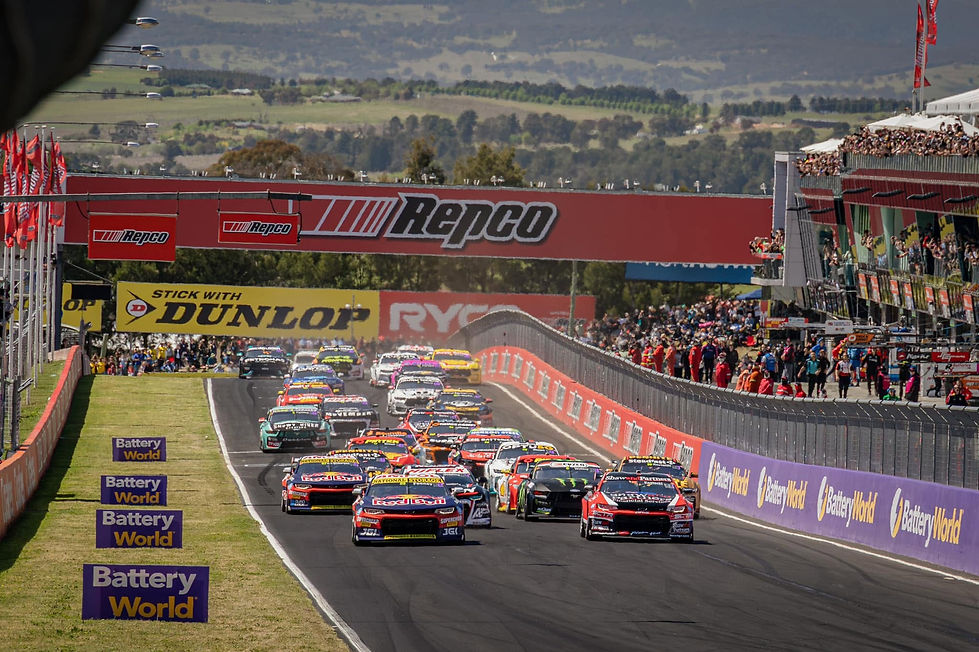
Start of the 2023 Bathurst 1000
Peter Brock
and the Men the Mountain Chose
No story about Bathurst survives without Peter Brock, the closest thing this place has to a patron saint.
They called him:
The King of the Mountain.
He won the Bathurst 1000 nine times, a record that became part of the mythology surrounding both Brock and the circuit. But it wasn't simply a story of dominance. It was understanding.
He seemed to know the mountain the way old farmers know the weather — instinctively, as though he'd made peace with it.
Fans still talk about him in hushed tones decades after his death in 2006 in a rally accident far from Bathurst.
He'd cracked the code so many others couldn't.
For every Brock, there have been dozens of brilliant drivers who arrived supremely confident and left with their cars in pieces and their dreams in the gutter.
Bathurst doesn't always respect reputation. The mountain doesn't hold grudges.
It just doesn't forgive.
Forrest's Elbow
and the Long List of Broken Hearts
If Skyline is where the mountain shows off its beauty, Forrest's Elbow is where it shows its teeth.
It's a tight, demanding left-hander near the bottom of the descent, a place where a driver who's been perfect for lap after lap can lose it all in a heartbeat because concentration slipped for half a second.
That's the brutal genius of this place. It's not one terrifying moment. It's death by a thousand tiny decisions, corner after corner, lap after lap.
Drivers aren't just racing each other. They're racing fatigue, concentration, and the temptation to relax for just one lap because surely the mountain will let them have this one.
It rarely does.

Peter Brock, the King of the mountain with his Holden Commodore. 1980

Forrest's Elbow

12 hour morning start
The 12 Hour
a Different Kind of Punishment
If the Bathurst 1000 is the mountain's most famous fight, the Bathurst 12 Hour is its longest interrogation.
Run earlier in the year, this endurance classic throws some of the world's most formidable GT machinery — Ferrari, Porsche, Audi, Mercedes-AMG, Lamborghini and more — at the same unforgiving tarmac for twelve relentless hours.
And it starts in darkness. Racing Mount Panorama before sunrise sounds almost cruel.
In places, headlights carve narrow tunnels of vision through Skyline and The Esses, the blind crests and sudden drops made more treacherous by the fact that drivers can't always see where the road goes until they're already committed.
Then daylight arrives, and the mountain changes again.
The event attracts some of the world's best GT drivers, including factory aces who arrive having conquered many of the world's great circuits. But no amount of pedigree makes Mount Panorama ordinary.
The physical and mental toll is enormous.
Multiple drivers share each car, but twelve hours against a track that punishes a single lapse is exhausting.
Cars that have been flawless for hours can end up in the wall in the dying minutes, undone not by lack of speed but by fatigue creeping in when it shouldn't.
The mountain, as always, waits patiently for that one moment of weakness.
But there's something television can never completely explain. Watching Bathurst and driving Bathurst are two completely different experiences.
To understand that difference, you need the driver's perspective.

Daniel Bilski before the action at Mount Panorama
Tame or Be Tamed
A Driver's Perspective
Daniel Bilski
For me, and for every other Aussie, Bathurst isn't just another race. It's a rite of passage.
Whether you're glued to the television or, better still, making the pilgrimage to Mount Panorama itself, watching the Bathurst 1000 or the 12 Hour is practically written into the national DNA.
However, watching it and driving it are two completely different experiences.
I recently sat down with a great friend, Daniel Bilski, Australian-born, now residing overseas, and an experienced racing driver who has raced all over Asia and Europe and built a career around motorsport.
An extremely experienced and seasoned driver, especially in the endurance racing format, he has the trophies — oh, and a dislodged wheel stud on the mantlepiece — to prove it.
Why is Mount Panorama feared?
Why is it so well respected?
And why do they all want to feel the thrill of the risk?
This is the real story of what this mountain does to even the most seasoned of drivers.
Smaller than it looks, a hell of a lot scarier and, oh yes, it's physical.
"It's basically a street circuit on steroids," Dan tells me.
What looks like a wide, sweeping ribbon of tarmac from the television cameras is, up close, barely two lanes of public road with a wall on either side and nowhere to breathe.
Dan still remembers his first proper flying lap, cresting the rise near Skyline, catching a glimpse of nothing but open sky ahead and experiencing a split second of pure panic before the track dropped away beneath him.
"You drop off the end of the world."
"The first time, you genuinely don't know what's coming."
One moment you're looking straight ahead at blue sky, as though you've run out of road entirely. The next you're staring down into an entire valley, and then the car just falls away down the other side.
What doesn't come across on television is that almost every corner up there is blind.
You can't see what's waiting on the other side of a crest, whether it's clear track, a spinning car or even some of the great Australian wildlife: a kangaroo that's ventured out onto the track.
At Bathurst, you're committing blind, every single time, trusting a line you can barely see and hoping it's still clear when gravity brings you back down to earth.
The whole lap is one long exercise in restraint, patience and a little bit of luck, or, perhaps, good fortune.
There's a few seconds coming down through Conrod Straight where you can almost exhale and relax, albeit doing just shy of 300 km/h.
But even then, it's only a breather before the next commitment, because the braking zone into The Chase comes up fast. Sometimes too fast.
Everywhere else, it's concrete on both sides and no room to think about anything except the next apex. You don't get to relax. You don't get to admire the view. You just react, corner after corner, for as long as your stint lasts — successfully or otherwise.
Then there's the traffic.
In a 12-hour race you're sharing the mountain with thirty or forty other cars, ranging from factory-paid professionals to weekend amateurs. You genuinely don't know what any of them are about to do.
Faster GT3 cars come hunting across the top of the mountain, looking for any gap you leave them, and if you don't hold your line and put your elbows out, you'll get bullied straight into the fence.
There's no politeness up there. You defend your position or you lose it. And losing it can mean a visit to the wall.
Then there's the physical side.
Brake pressures nudge close to a hundred kilos of force through your leg into the pedal, corner after corner, for hours at a time.
The car turns into an oven under the Australian sun, sometimes pushing well past 60°C inside the cockpit.
Your neck and shoulders are being wrenched around by G-forces with barely a moment's let-up.
Add in the fact that the Bathurst 12 Hour starts before dawn. You've barely slept the night before, and a single lapse in concentration doesn't mean a spin into gravel somewhere safe.
It means a very expensive, very public shunt into unforgiving concrete.
That combination of blind corners, walls everywhere, nowhere to hide, thirty-odd other cars all wanting the same piece of road as you, is what makes Mount Panorama feel like nothing else.
You can be quick anywhere else in the world and still find Mount Panorama humbling.
It doesn't care how good you were last weekend.
It's in control here.
Daniel Bilski entering in his AMG

A Brutally Expensive Dream
And sometimes that dream can end before it even starts.
Racing a GT3 car at Bathurst properly, Dan says, can run you close to $350,000–$450,000, and that's just for the event: car costs, crew, freight, fuel, tyres and everything else required, and that doesn't include buying the car.
Dan has had seats fall through at the worst possible moments: deals collapsing a week out, flights and hotels cancelled, entire campaigns unravelling because one driver pulled out or the insurance couldn't be sorted in time.
It's the kind of sport where you can do everything right for months and still watch it fall apart in an afternoon.
And it's not a hobby, either. Not in his eyes.
"This stopped being a hobby the first day I got in a race car."
"It became so much more."
Surviving is One Thing.
Finishing is Another.
Dan has raced the Bathurst 12 Hour six times now, plus one crack at the 6 Hour in a Holden.
And the mountain hasn't made it easy on him.
There were years when he never even got to sit in the car.
Co-drivers had wiped out in practice before the race had properly begun.
Twice.
The first two 12 Hour races at Bathurst that Dan attended as a driver, he didn't complete a single race lap. Not one.
There was a crash in the dark in the first 15 minutes of the race one year that turned into a fight simply to finish at all.
Another year, while running P1 in class, the car was already damaged and the gearbox eventually let go. Dan was also nailed from behind by the overall leader, bringing another Bathurst campaign to an unsuccessful end.
There was a pit stop that claimed two wheel studs entirely — stripped and missing.
Dan still keeps one of those studs sitting on his trophy shelf as a reminder of how close it all came to going horribly wrong.
But with heartache and torment comes the ultimate dream.

Daniel Bilski In his Mercedes-AMG GT4

Dawn driving at Mount Panorama
2024
Driving for the Team 19 Prestige Iveco Mercedes-AMG GT4 team.
Dan came into the pits a lap down. New, cold slick tyres were fitted.A full tank of fuel.
He left pit lane. And the rain came down. The worst-case scenario. A decision that could easily have ended in disaster.
Instead, Dan found himself out there for three laps, in the wet, on cold slick tyres, barely able to see and with almost no grip.
The fear was very real.
Drawing on every single bit of his driving knowledge, skill and a little luck, Dan managed not only to keep it straight, but came out at the end of his 70-minute stint with a 45-second clear lead over the next GT4 rival.
"That got us back in the race."
P1. A dream not just for Dan's racing career, but a childhood dream: to stand on the podium at the greatest racetrack in Australia and one of the greatest in the world.
Winning here, whatever the category, is a major accolade for any racing driver.

Daniel Bilski in action
Success
Why does he return year after year? Ask Dan and it's not really about the trophy.
A win is the cherry on top.
"It's about how good can I be in the car, as a driver, and as a team-mate."
For Dan, Bathurst is where that question gets answered more honestly than anywhere else.
No shortcuts. No easy laps. Nowhere to hide if you're not switched on for all twelve hours.
The mountain has history.
A lot of history.
It's equal parts glory, tradition and personal challenge.
It's our Australian race circuit.
But it also has an almost mythical status on the international stage.
"Every driver I speak to, no matter where they're from, no matter if they are a factory Pro or an AM, when you mention racing at Bathurst... their eyes light up."
"And it's either total excitement and respect, or complete and utter fear."
"There's nothing in between."
For a racing driver, conquering Bathurst isn't just a result.
It's a statement.
"Every time I leave that track, the first thing I think as I'm driving out the gates is — I've got to come back."
See you in 2027, my good friend.

Daniel Bilski (left) celebrating victory. 2024 GT4
Why Drivers Keep Coming Back
And perhaps that's the strange thing about Mount Panorama.
For all the carnage, every driver worth their racing licence wants to conquer this place.
There's a mystique to Bathurst that no purpose-built circuit can manufacture.
Winning elsewhere is an achievement.
Winning at Mount Panorama is something different, it's a proof that you looked at a genuinely unforgiving piece of terrain and found a way through it, lap after lap, without allowing it to swallow you whole. That's what the legend comes down to.
Some drivers arrive thinking they can bully the mountain, muscle their way to victory. It humbles them.
Others arrive with something closer to reverence, patience, an understanding that this is a track earned through rhythm and restraint, not force. Those are the names that become part of Bathurst folklore.
Every year, a fresh grid lines up believing they're about to drive that mountain.
Hours later, the ones still standing know the truth.
They didn't drive it at all.
They survived it.
Corner by brutal corner.
And if they were good enough, and perhaps humble enough, the mountain lets them leave with an experience that can't be replicated. Maybe even a trophy. Instead of a wrecked car and a long walk down the mountain.
That's the deal it's always offered. And will continue to offer.
You tame the mountain. Or the mountain tames you.
There has never been a third option.

Tame or be tamed.

