THE SHIFT Stories from Car Culture
Most people remember Paul Newman for his eyes.
The blue gaze that filled cinema screens for decades.
The smile that helped define an era of Hollywood.
The Academy Award-winning performances.
The legendary films.
The fame.
But those who stood beside him in the paddock remember something else.
They remember a competitor.
A man who arrived before sunrise.
Who studied data.
Who listened more than he spoke.
Who chased tenths of a second with the same discipline that made him one of the most respected actors of his generation.
Because beneath the fame, beneath the awards, beneath the image that the world knew, Paul Newman carried a secret.
He did not want to play racing drivers.
He wanted to be one.

Paul Newman
The Spark of an Obsession
The story began relatively late.
Newman was already in his forties when filming Winning in 1968.
The movie told the story of a racing driver chasing victory at Indianapolis.
To prepare for the role, Newman immersed himself in the world of motorsport.
He trained.
He learned racecraft.
He spent time around professional drivers.
What started as research quickly became something else.
An obsession.
When filming ended, the fascination remained.
For many actors, motorsport is a temporary passion.
A weekend diversion.
A glamorous hobby.
For Newman, it became a second life.

Paul Newman filming Winning 1968
Earning Respect
Throughout the 1970s, he steadily climbed through the ranks of American racing.
Not through celebrity invitations.
Not through publicity.
Through commitment.
He entered club races.
Learned the craft.
Made mistakes.
Improved.
And earned the respect of drivers who cared little about movie stars.
The paddock can be brutally honest.
A stopwatch does not care how famous you are.
Newman understood that.
And perhaps that was precisely what attracted him.
On track, nobody cared about box office numbers.
Only lap times.

Paul Newman racing in his Ferrari 365 GTB/4 Daytona, 1977
The Le Mans Statement
By the late 1970s, Paul Newman had become a genuinely competitive racing driver.
Then came the moment that transformed perception.
The 1979 24 Hours of Le Mans.
Driving a Porsche 935 alongside Dick Barbour and Rolf Stommelen, Newman arrived at the world's greatest endurance race carrying the label of Hollywood celebrity.
He left carrying something entirely different.
Second overall.
At Le Mans.

Paul Newman and Rolf Stommelen, Le Mans, 1979
The Actor Had Become a Racer
One of the greatest achievements ever recorded by an amateur driver.
It was not a publicity stunt.
It was not luck.
It was the result of years spent learning, improving, and refusing to be treated differently.
The actor had become a racer.
Yet perhaps the most remarkable chapter of Newman's motorsport story came later.
Most drivers slow down with age.
Paul Newman accelerated.
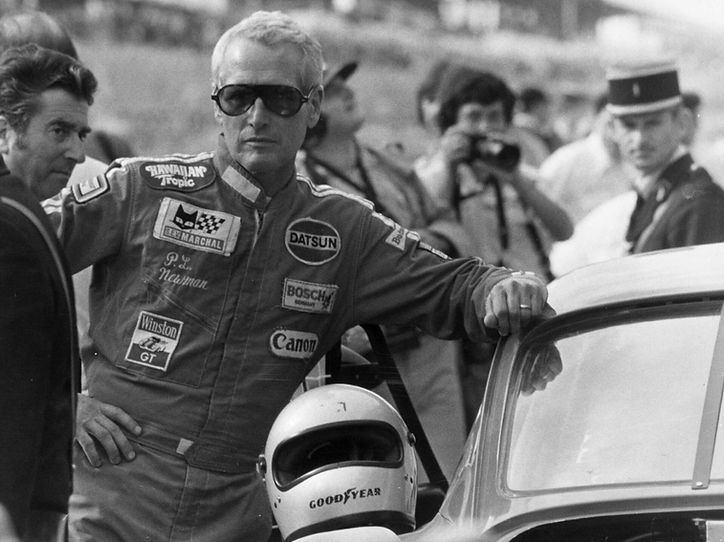
Paul Newman in Le Mans, 1979
Faster With Time
At an age when many professional athletes had long retired, he remained fiercely competitive.
He continued racing into his seventies.
Continued winning.
Continued learning.
Continued showing up.
In 1995, at the age of seventy, he became the oldest driver to win a major sanctioned professional race in America.
An achievement that perfectly captured the philosophy that defined him.
Not fame.
Not ego.
Not recognition.
Improvement.
The pursuit itself.

Paul Newman and the Datsun 280ZX
Building a Legacy
His impact extended far beyond the cockpit.
Together with Carl Haas, Newman co-founded Newman/Haas Racing, one of the most successful teams in American open-wheel racing.
The organisation became a powerhouse in CART, collecting championships, victories, and helping shape an entire generation of drivers.
For Newman, racing was never simply about driving.
It was about contributing.
Building.
Creating opportunities.
Leaving something behind.

Paul Newman and Carl Haas
Why He Was Different
That may explain why his motorsport legacy remains so powerful today.
There have been many celebrities who loved cars.
Many famous names who appeared at races.
Many actors photographed beside exotic machinery.
Few earned genuine respect from professional racers.
Paul Newman did.
Because he approached motorsport the same way he approached life.
With humility.
Curiosity.

Paul Newman, pre-race moments
Authentic
And an understanding that passion is not something you perform.
It is something you practice.
In Hollywood, Paul Newman became a legend.
In motorsport, he became something rarer.
He became authentic.
And in a world where image often matters more than substance, that may be the greatest victory of all.


