The MINI Adventure
Keep Buggering On
Featuring Timothy Bradshaw
By Nuno Di Franco
Founder, KINGSHIFT
There are probably more sensible cars to take across Africa than a 2006 Mini Cooper S.
There are certainly more sensible things to do after breaking your neck in three places during a 150 km/h motorcycle accident.
Timothy Bradshaw is doing both.
And perhaps that is the entire point.
“I’ve always been a fan of human endeavour and have always been captivated by humans and machines pushing themselves to the limit.”
For Bradshaw, the Mini Adventure is not really about choosing the perfect machine for the job. Nor is it about trying to recreate what the factory teams of modern rally raid can achieve with extraordinary technology and enormous budgets.
It is about adventure.
And about getting back to Dakar.

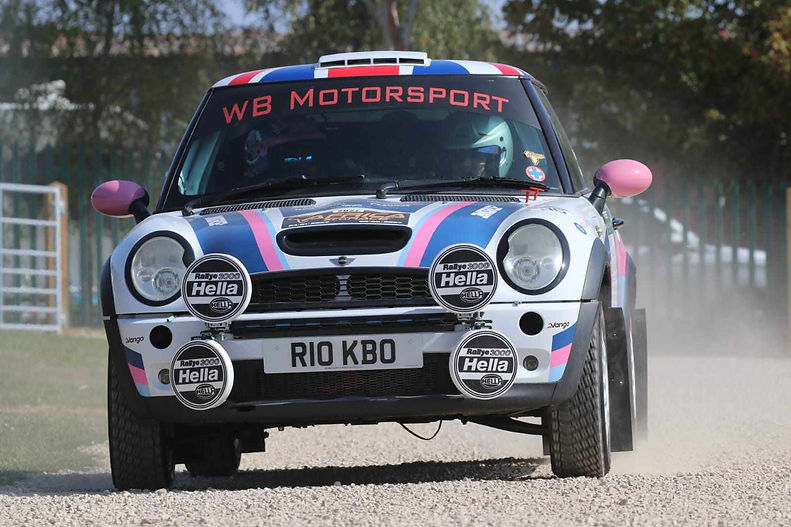
Bradshaw's MINI Cooper S
The Road Back
The story really begins with a motorcycle.
Bradshaw had previously attempted the race on two wheels. Just two days into the event, everything changed.
“I had an accident at 150 km/h. I was knocked unconscious and when I came round I was paralysed.”
He had broken his neck in three places.
“I was 1000th of a mm from not being here today. I had to wear a full neck brace for 3.5 months.”
It would have been an understandable place to stop.
Bradshaw saw it differently.
“Following the accident my mindset hasn’t really changed — after all, we’re going back to the rally — but I have to look at things slightly differently as I have permanent damage in my neck.”
There is no attempt to pretend that risk disappeared after the accident. If anything, it seems to have become something he understands differently.
“I certainly believe we have to make the most of the time we have and for me taking risk is part of that process, but the skill is to prepare properly and have a great team around you.”
After the crash, racing motorcycles was no longer a realistic option. But Bradshaw is, in his own words,
“not one for quitting.”
So he started looking elsewhere.
Cars offered another possibility, and rallying was already deeply woven into his family.
“My wife’s family has been involved in rallying forever. Her late father was Nigel Harris, who co-drove for Malcolm Wilson in Group B rally cars in the ’80s, and her uncle Steve, my co-driver, has also navigated at British and international level.”
There was one obvious problem.
Money.
“The problem was that rallying seemed so prohibitively expensive.”
Then came the Mini Rally Challenge, a national championship for R50 and R53 Minis with relatively controlled regulations.
“Steve said that if I had the courage to get in the car, he would sit next to me.”
That was enough.
“Over the winter my wife and I built a car in our garage to the championship regulations and we went rallying.”
And somewhere along the way, something much bigger began to take shape.
The Stars Begin to Align
The project had started around 18 months earlier with a conversation with Ben Bloor of WB Motorsport, who built the Mini rally car.
“We agreed we should go for it.”
For most people, that might still have been the point at which reality intervened.
But Bradshaw has previous form.
“I put together an Everest expedition in 2015, climbed the Matterhorn in 2018 and, of course, had the previous rally raid adventures, so when I commit to something I tend to find a way to make it happen.”
Then the Africa Eco Race launched its Historic category.
A telephone call with Anthony Schlesser, son of former Formula One driver and Dakar winner Jean-Louis Schlesser, confirmed something unexpected.
The 23-year-old Mini was eligible.
“So, in the spirit of Thierry Sabine, the dream was born. We had the car, a navigator and some previous form. What could possibly go wrong?”
Recently, with the support of a number of sponsors, the final payment for the entry fees was made.
“It’s a lot of money, and suddenly everything felt very real.”
Why a MINI
At first, the answer is wonderfully uncomplicated.
“Initially we already had the Mini because we’d built it for the Mini Rally Challenge.”
But as the project developed, history began attaching itself to the little car in ways nobody had planned.
“As the project grew it was as though the stars were aligning.”
Bradshaw’s late father-in-law, Nigel Harris, was killed in a light aircraft accident while carrying out a reconnaissance for the Ivory Coast Rally.
Also killed in the accident was Henry Liddon, Paddy Hopkirk’s co-driver in the Monte Carlo-winning Mini.
For Bradshaw, a former Army officer, that connection to British motorsport history matters.
“I’ve always been quite patriotic, so being able to race in the desert with some British heritage really appeals.”
The Mini might look like an unlikely desert weapon, particularly when parked beside the machinery usually associated with rally raid.
That only makes it more appropriate.
The Outsiders
Modern rally raid cars are technological masterpieces.
Bradshaw has seen some of them up close.
“The modern-day machinery is truly incredible. I’ve had the opportunity to see the Dacia Sandrider and the Ford Raptor T1+ machines up close and the technology is staggering, but they are million-euro monsters.”
The Mini Adventure exists at almost the opposite end of that philosophy.
“We don’t have anything like that sort of budget, so we were always going to follow a different path and focus on the adventure rather than outright performance.”
And then Bradshaw says something that perhaps explains why this slightly improbable project is so easy to understand.
“It’s the jeopardy that captures people’s imagination and the fact that it feels somehow attainable for a gentleman driver.”
This is not a factory prototype pretending that failure does not exist.
Failure is part of the story.
So is imperfection.
So is the possibility that somewhere, thousands of kilometres from home, the Mini simply decides it has had enough.
“The key word here is adventure. We’ve called the project The Mini Adventure for a good reason.”
Even within the Historic category, Bradshaw and the Mini will be outsiders.
They will line up against cars such as Mitsubishi Pajeros and Porsche 911s.
“That is definitely the point.”
Bradshaw in action

The MINI and the Raptor. Different machines, same attitude
Old School
There is another reason Bradshaw chose the Africa Eco Race Historic rather than pursuing the modern Dakar in Saudi Arabia.
Spirit.
“Of course I’d jump at the chance to compete in the Dakar itself, but the AER is much more in line with the original Dakar spirit.”
The route for 2027 has changed slightly. Competitors will meet in the south of France, with the race itself beginning once they reach the shores of Morocco before continuing towards Dakar.
For Bradshaw, it remains closely connected to what made the original African race extraordinary.
“Slightly crazy people attempting a crazy race across the desert simply because they can.”
And in the Historic class, technology deliberately takes a step backwards.
“We are fully old school with paper roadbooks and analogue navigation.”
No digital cocoon insulating the crew from the landscape. No attempt to remove every uncertainty.
Bradshaw believes that matters far beyond motorsport.
“We live in a very sanitised world currently and I’ve always been captivated by some of the last great motorsport adventures that are still accessible by those with the courage to enter, like the Isle of Man TT, Le Mans, Pikes Peak and, of course, Dakar and the Africa Eco Race.”
Can that kind of adventure still exist in a world of smartphones, GPS and permanent connectivity?
“Not only can it exist, I think it’s really important that it does.”
He is not anti-technology. Quite the opposite.
“I am a fan of modern technology and safety systems, but I believe the day we stop taking risks and pushing ourselves will be a backwards step towards our survival.”
And, at a moment when artificial intelligence increasingly occupies conversations about the future, Bradshaw sees adventure almost as a defence of something fundamental.
“The development of AI is a prominent topic globally at the moment, so I think we must keep practising those things that make us uniquely human.”
Two Men One MINI
If the Mini is one half of this adventure, the other is the relationship inside it.
Beside Bradshaw will be Steve Harris.
Asked what makes Steve the man he wants sitting next to him when they are exhausted, lost and somewhere in the middle of Africa, Bradshaw answers with a single word.
“Trust.”
Rally raid makes that trust essential.
“In stage rallying the co-driver is calling pace notes and managing the car. In a rally raid, particularly in the Historic class, Steve will be navigating from point to point whilst calculating arrival times at checkpoints.”
And Bradshaw is under no illusion about what will happen eventually.
“At some point we will get lost.”
When they do, the relationship built through stage rallying becomes part of the machinery required to get them moving in the right direction again.
“The trust we’ve built between us during stage rallies will be invaluable. Not only is he an amazing co-driver, he’s also family.”
The division of responsibility is simple.
“Whilst, as the driver, I’ll be negotiating the obstacles and keeping us shiny side up, he will be the one adding the competitive advantage.”

Timothy Bradshaw and Steve Harris
Still a MINI
Turning an R53 Cooper S into something capable of crossing Africa inevitably requires modification.
But the Historic regulations mean that underneath everything, it still has to be what it claims to be.
A Mini.
“The regulations in the Historic class require us to keep the car very much a Mini. To that end, the shell and engine are straight out of the road car.”
Safety comes first. A full weld-in FIA safety cage has been fitted, together with Atech seats and six-point harnesses.
But underneath is where WB Motorsport has done some of the clever work required to give the car a fighting chance in Africa.
“The clever bit of the car is its running gear.”
Proflex suspension dramatically increases travel and ride height. To make that possible, Ben Bloor and WB Motorsport lowered the engine by 10mm and installed bespoke driveshafts.
“This will give the little Mini the best possible chance of surviving the rocky tracks and desert conditions.”
But Bradshaw is keen not to turn the Mini into something it isn't.
“It’s still very much a 23-year-old Mini.”
And that is precisely why it matters.
Keep Buggering on
There is one small detail on the car that may explain the entire project better than any engineering specification.
Its number plate.
KBO.
“It was one of Winston Churchill’s favourite expressions — Keep Buggering On. Never quit.”
Bradshaw knows things will go wrong.
His previous life as an intelligence officer, together with years of expeditions, means that the practical business of dealing with setbacks does not particularly frighten him.
Something else does.
“My biggest fear is letting down sponsors and all of those people who’ve helped in making this happen.”
The project is largely self-funded, but partners have become essential to getting the Mini onto the start line.
Bradshaw does not see those relationships as an exercise in covering a rally car with logos.
“I don’t believe there is any real value in putting a sticker on the car. The real value comes through partnership and communication.”
The Mini Adventure is used to share lessons about rallying, leadership, overcoming challenges and teamwork. Partners and their clients are brought into motorsport through events including the Goodwood Festival of Speed and the McRae Rally Challenge.
“We work hard to tell the story of adventure, which in turn helps our partners.”
But for all the commercial realities required to make an adventure like this happen, there is ultimately only one destination that matters.
Dakar.

The MINI ready for the adventure
Lac Rose
What would constitute success?
A competitive result?
A class position?
A trophy?
Bradshaw's answer brings everything back to its simplest form.
“The mission has to be to arrive on the shores of Lac Rose in Dakar at the end of the rally.”
Then the racing driver interrupts the adventurer.
“That said, once the helmet goes on, anything could happen!”
But imagine, for a moment, that it does happen. Imagine the little Mini survives. Imagine Bradshaw and Harris navigate their way across Africa and eventually realise there are only a few kilometres remaining.
For Bradshaw, those final kilometres would carry far more than the weight of one rally.
“I think it will be quite emotional.”
After his first rally raid in Morocco, a qualifying event for the Dakar, Bradshaw lost his father to cancer.
Then came the accident.
The broken neck.
The recovery.
And, more recently, the birth of his daughter.
“My wife, Sammi, has stood by me throughout this whole crazy project, which actually started on the bike over five years ago.”
The journey to Dakar has therefore become inseparable from everything that has happened around it.
“Driving up the beach in Dakar will be a culmination of all of those emotions and moments.”
There is a famous idea associated with Thierry Sabine: Dakar was a challenge for those who went and a dream for those who stayed behind.
For Timothy Bradshaw, the dream survived a motorcycle crash, three fractures to his neck, months in a brace and the knowledge that his body would never quite be the same again.
Now it sits inside a 23-year-old Mini.
So what would happen if Thierry Sabine could stand beside that Mini before the start and look at the man about to attempt something that, on paper, makes very little sense?
Bradshaw doesn't hesitate.
“I think he would look me in the eye and tell me to go chase that dream.”
And then, presumably, the little Mini would head for Africa.
KBO.
Keep Buggering On.


