THE SHIFT Stories from Car Culture
GROUP C
The Last Great Age of Excess
By Adrian Lefévre
Motorsport Heritage Researcher
Contributor, THE SHIFT
There was a time when Le Mans felt almost untamed.
Before hybrid systems.
Before Balance of Performance.
Before simulation dictated every decision.
Group C was an era when engineers chased speed with extraordinary freedom, manufacturers arrived with radically different ideas, and drivers faced the night at nearly 400 km/h.
Many call it the golden age of endurance racing.
Looking back today, it is difficult to argue otherwise.
Between 1982 and 1993, Group C produced some of the fastest, most beautiful and most iconic racing cars ever created.
It also produced legends.
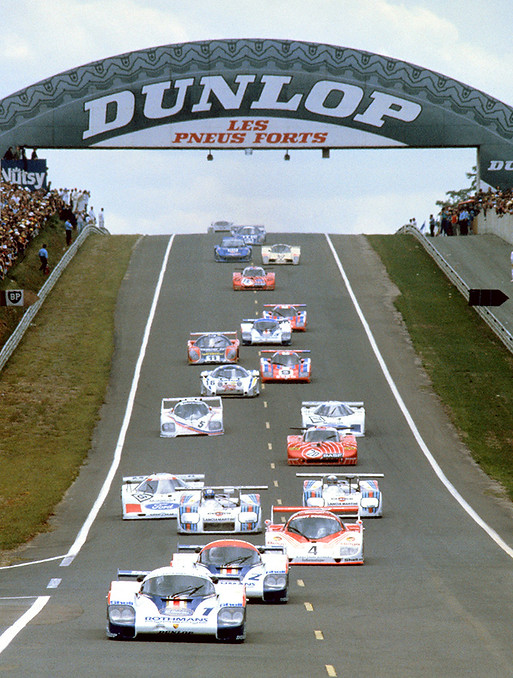
Le Mans, 1982
The Rule That Changed Everything
The genius of Group C was surprisingly simple.
Rather than restricting engine size, cylinder count or configuration, the regulations focused primarily on fuel consumption.
Manufacturers could choose almost any path they wanted.
Turbocharged flat-sixes.
Naturally aspirated V12s.
Twin-turbo V8s.
Rotary engines.
What mattered was finding the perfect balance between speed, reliability and efficiency.
The result was a decade-long engineering arms race unlike anything endurance racing had seen before.
Every manufacturer arrived with a different answer to the same question.
How do you win Le Mans?

Porsche 956
The Porsche Dynasty
The first dominant force came from Stuttgart.
The Porsche 956 arrived in 1982 and immediately changed the sport.
Built around an aluminium monocoque and exploiting ground-effect aerodynamics to devastating effect, the 956 became one of the most successful racing cars in history.
Its successor, the Porsche 962, continued the dynasty.
Together they would win Le Mans seven consecutive times between 1982 and 1987.
For much of the decade, beating Porsche became the objective of everyone else.
Few succeeded.
The Great Manufacturers' War
Yet Group C was never about a single manufacturer.
It was about the battle.
Jaguar returned with the magnificent XJR series.
Mercedes-Benz partnered with Sauber to create the fearsome C9.
Nissan arrived with increasingly sophisticated turbocharged prototypes.
Toyota joined the fight.
Mazda pursued a completely different path through rotary power.
Peugeot would eventually bring Formula 1-style technology to endurance racing.
Each manufacturer represented a different philosophy.
Each believed they had found the answer.
The beauty of Group C was that nobody knew who was right.

Sauber-Mercedes C9
The Mulsanne Straight
Nowhere captured the spirit of the era better than the Mulsanne Straight.
Before the chicanes were introduced in 1990, the legendary stretch of road seemed almost endless.
Cars disappeared into darkness.
Engines screamed at maximum velocity.
Drivers remained flat-out for extraordinary periods of time.
In 1988, the WM Peugeot P88 reached an astonishing 405 km/h.
The record still stands as the highest speed officially recorded during the race week at Le Mans.
Today it feels almost unbelievable.
At the time, it felt normal.
Group C had redefined what was possible.

Group C cars at full throttle, Mulsanne Straight, Le Mans
The Men Behind The Machines
The cars became legends.
The drivers became myths.
Jacky Ickx.
Derek Bell.
Hans-Joachim Stuck.
Jochen Mass.
Stefan Bellof.
Henri Pescarolo.
Klaus Ludwig.
Vern Schuppan.
Martin Brundle.
Johnny Dumfries.
Bob Wollek.
And many others.
Some became Le Mans royalty.
Others became symbols of courage and commitment.
Few embodied the era more completely than Stefan Bellof.
His qualifying lap around the Nürburgring Nordschleife in 1983 remains one of the most extraordinary performances in motorsport history.
Even today, it feels almost impossible.

Hans-Joachim Stuck, Derek Bell, Jochen Mass and Jacky Ickx, Imola, 1985
A Symphony Of Speed
The sounds of Group C were as diverse as the cars themselves.
Porsche's turbocharged flat-six.
Jaguar's thunderous V12.
Mercedes' twin-turbo V8.
Mazda's four-rotor masterpiece.
Every car sounded different.
Every lap felt like a battle between philosophies.
Fans did not need timing screens to know who was approaching.
They could hear it.
Long before they could see it.

Jaguar XJR-9 LM, Le Mans, 1988
The Rotary Legend
Among all the great machines of the era, one occupies a special place in endurance racing history, and in my own memories, as I was fortunate enough to witness it in action.
The Mazda 787B.
In 1991, it became the first Japanese manufacturer to win Le Mans and remains the only rotary-powered car ever to do so.
Its orange-and-green Renown livery became iconic.
Its four-rotor engine became legendary.
For many enthusiasts, the sound alone is enough to transport them back to Group C's final years.
Yet the significance of the victory extended beyond nostalgia.
It proved that innovation could still defeat convention.

Mazda 787B, Le Mans winner in 1991
The Future Arrives
The final years brought new challengers.
Peugeot arrived with the 905.
Powered by a high-revving naturally aspirated V10, it felt almost like a Formula 1 car adapted for endurance racing.
The 905 represented the future.
The Porsche 962 represented the past.
Group C stood at a crossroads.
Technology was changing.
Manufacturers were changing.
Motorsport itself was changing.
The end was approaching.

Peugeot 905, winner of the 24 hours of Le Mans in 1992
The End Of An Era
By 1993, Group C was gone.
Costs had risen dramatically.
Regulations evolved.
Manufacturers shifted focus.
The category that had defined a generation disappeared.
But legends rarely stay confined to history books.
The Porsche 956 and 962.
The Jaguar XJR-9.
The Sauber-Mercedes C9.
The Mazda 787B.
The Peugeot 905.
They continue to appear at historic events, museums and concours gatherings around the world.
Not merely as racing cars.
But as symbols of an era.

The Benchmark
Many forms of racing have produced great champions.
Many eras have produced great cars.
Few have produced both in such abundance.
Group C combined extraordinary engineering freedom, breathtaking speed, unforgettable drivers and some of the most beautiful racing machines ever created.
It was dangerous.
It was excessive.
It was glorious.
And for those fortunate enough to witness it, Group C remains the benchmark against which every generation of endurance racing is measured.
I count myself among the fortunate.
Decades later, the memories remain as vivid as the sound of those machines disappearing into the Mulsanne night.
Some races are remembered. Group C is remembered because it was experienced.