THE SHIFT Stories from Car Culture

A Champion
My all-time favorite Formula 1 driver never won a World Championship.
And yet, he was a champion.
For me, in a way that vibrated like nothing else I’ve ever seen behind the wheel.
And for many who truly love Formula 1, and raw driving, the feeling is the same.
There are drivers who win championships.
And there are drivers like Gilles Villeneuve, who redefine what racing means.
He never became a World Champion.
He never dominated a season.
He never built a legacy on statistics.
And yet, decades later, his name still carries a weight few champions ever reach.
Because Villeneuve didn’t race for titles.
He raced at the limit of what was possible, and sometimes, beyond it.
A Different Kind of Talent
Villeneuve’s path to Formula 1 was anything but conventional.
Born in 1950 in Quebec, Canada, he developed his craft not on the polished circuits of Europe, but on snow and ice.
Racing snowmobiles at high speed, often sideways, often on the edge of control.
It shaped everything.
Where most drivers learned precision first, Villeneuve learned survival.
Where others chased clean lines, he became comfortable with instability.
By the time he arrived in Formula 1 in 1977, briefly with McLaren, it was already clear:
This was not a driver who would adapt to the system.
The system would have to adapt to him.
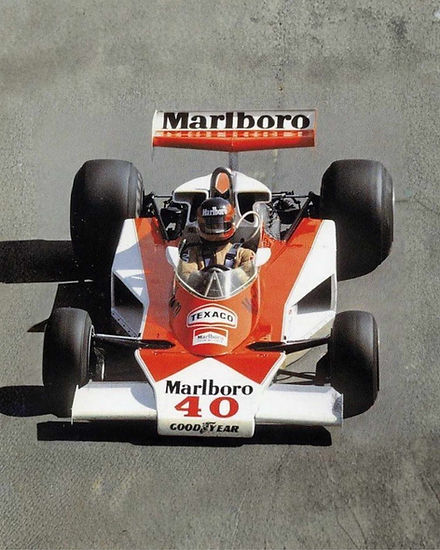
Gilles Villeneuve | Silverstone 1977 | McLaren M-23
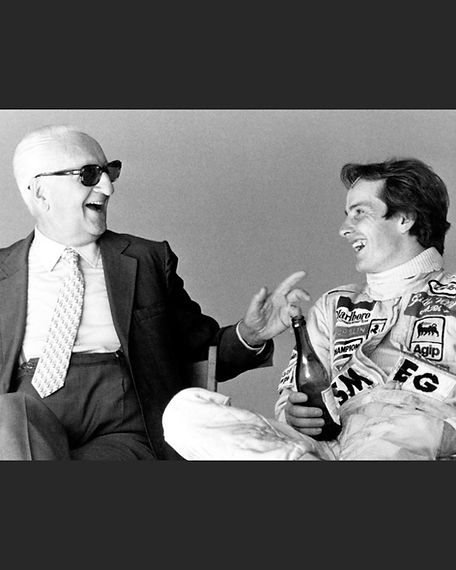
Enzo Ferrari and Gilles Villeneuve
The Ferrari Gamble
When Enzo Ferrari signed Villeneuve for Scuderia Ferrari in late 1977, many questioned the decision.
He was inexperienced. Raw. Unpolished.
But Enzo didn’t see what Villeneuve lacked.
He saw what others didn’t.
Courage. Loyalty. Instinct.
And perhaps most importantly, something Ferrari had always valued above all else:
A driver willing to give everything to the car.
Villeneuve became more than a signing.
He became Enzo’s driver.
Often referred to as “the little Canadian,” he earned Ferrari’s trust not through results, but through commitment.
Total, unquestionable commitment.
Driving Beyond the Limit
To understand Villeneuve, you have to forget conventional definitions of driving.
He did not aim for mechanical perfection.
He did not prioritize tire preservation.
He did not build races around calculated margins.
He drove on instinct.
Technically, his style was built around a constant management of oversteer.
Where most drivers sought stability through smooth inputs, Villeneuve used the throttle as a balancing tool.
He would enter corners aggressively, unsettling the rear of the car, and then control the slide with precise throttle modulation.
Not correcting the instability, but working with it.
It was a technique that demanded extraordinary sensitivity,
and carried constant risk.
Because once you choose to drive that way, there is no safe margin left.
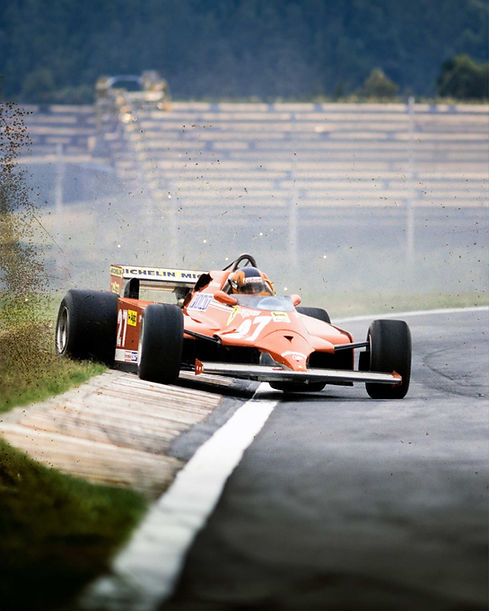
Gilles Villeneuve | Ferrari 126 CX | 1981

Villeneuve and Arnoux | French Grand Prix 1979
Dijon, 1979
There are races that define championships.
And there are races that define eras.
The 1979 French Grand Prix at Dijon belongs to the latter.
In the closing laps, Villeneuve found himself battling René Arnoux, not for victory, but for second place.
What followed remains one of the most extraordinary duels in Formula 1 history.
Wheel to wheel. Corner after corner.
Contact. Recovery. Attack again.
Neither driver yielded.
Not out of recklessness, but out of mutual understanding.
This was racing in its purest form.
No strategy. No management. No calculation.
Just instinct, courage, and absolute commitment.
That battle didn’t just entertain.
It reminded the world what Formula 1 was supposed to feel like.
Alive. Unpredictable. Human.
Monaco, 1981
The Impossible Victory
If Dijon showed Villeneuve’s spirit, Monaco 1981 proved his genius.
Driving the Ferrari 126C, a car powerful but notoriously difficult to handle, Villeneuve delivered one of the most remarkable performances in street circuit history.
The car was unstable. Turbocharged. Demanding.
On a track where precision is everything.
And yet, Villeneuve made it work.
Sliding between barriers, controlling the car with micro-adjustments, he turned an unpredictable machine into a weapon.
He didn’t dominate Monaco. He survived it.
And in doing so, he mastered it.

Gilles Villeneuve victory in Monaco 1981
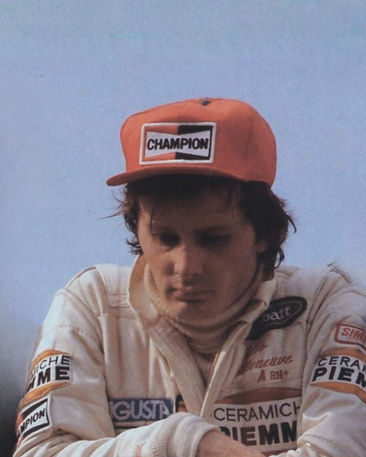
Gilles Villeneuve | San Marino GP Podium | 1982
Loyalty and Conflict
Villeneuve’s relationship with Ferrari was built on trust.
But Formula 1, even then, was not immune to tension.
At the 1982 San Marino Grand Prix, Ferrari instructed its drivers to hold position to secure a safe finish.
Villeneuve believed that agreement would be respected.
But his teammate, Didier Pironi, chose to overtake him in the closing laps and take victory.
For Villeneuve, it wasn’t just a lost win. It was a betrayal.
In a sport where trust is fragile, that moment changed everything.
He left the circuit feeling not defeated, but disillusioned.
Zolder, 1982
wo weeks later, during qualifying at Zolder, Villeneuve pushed once again.
As he always did.
There was no adjustment. No caution. No retreat from the edge.
In a high-speed section of the circuit, a misunderstanding with a slower car ahead led to a catastrophic collision.
The impact was violent.
The consequences, irreversible.
Villeneuve was gone at just 32 years old.
And even today, writing these lines, it doesn’t read like history.
It feels like something unfinished.
Like a sentence that should have continued, a story that deserved more laps.
Perhaps that’s why his legacy endures the way it does.
Because we never saw the end of it.
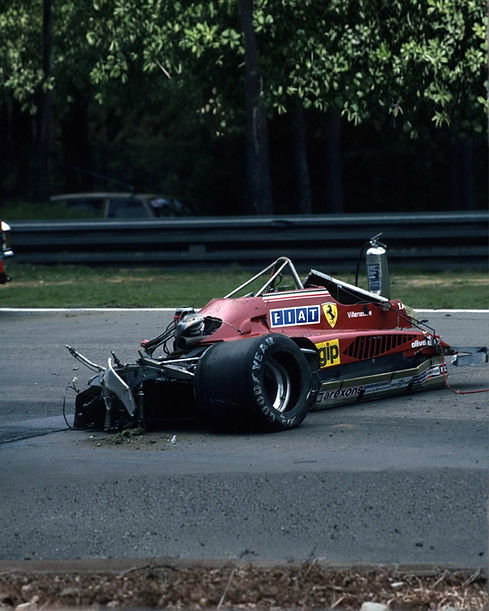
Zolder, Belgium | 8 May 1982

Legacy Without a Crown
Villeneuve’s career statistics will never tell his story.
Six Grand Prix victories. No championships.
On paper, modest.
In reality, immeasurable.
Because Villeneuve changed something deeper than results.
He reminded Formula 1 of its essence.
That racing is not just about winning.
It’s about how you win.
How you drive. How much you give. How far you are willing to go.
To this day, his name lives on, not just in history books,
but in the soul of the sport.
In the drivers who dare to take risks.
In the fans who remember what racing felt like.
And in every moment where instinct triumphs over calculation.
Gilles Villeneuve didn’t need a championship.
He became something rarer.
A benchmark for courage.