THE SHIFT Stories from Car Culture
FOOTBALL ICONS
AND MACHINES
The Cars That Define Them
By Frank Saint-James
Contributor, THE SHIFT
There is a moment, in every era of football, when performance alone stops being enough to explain a player.
Numbers help. Trophies help. Records help.
But they don’t capture presence.
I’ve spent most of my life watching football, not just for what happens on the pitch, but for what lingers after: The feeling certain players leave behind, the sense that they belong to something larger than the game itself.
That’s where the parallels begin.
Because in every decade, there are machines that do the same.
This is not about ownership.
It never was.
It’s about recognition.
Style Before Structure
George Best
Jaguar E-Type
The 1960s still allowed for individuality in its rawest form.
Football was less systematised, less protected, and far more exposed to personality. In that environment, George Best didn’t just thrive, he defined it.
I’ve always thought of Best as someone who played like rules were optional.
The E-Type feels the same.
It doesn’t justify itself. It doesn’t explain.
It simply exists in a way that makes everything around it feel slightly less alive.
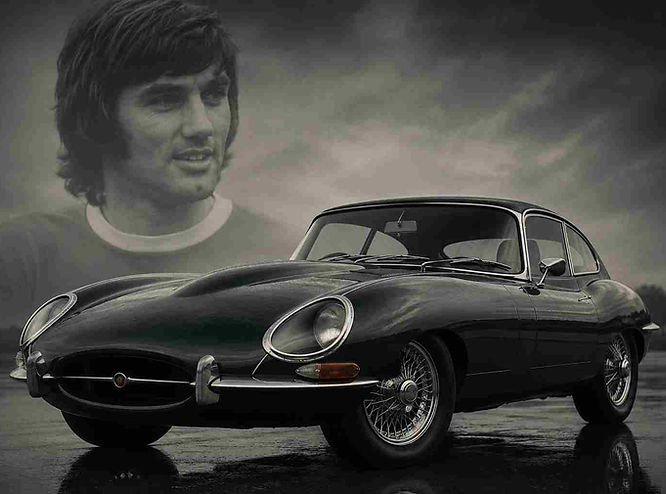
George Best and the Jaguar E-Type Series 1.5
Intelligence in Motion
Johan Cruyff
Citroën SM
By the 1970s, football began to evolve into something more structured, more conceptual.
Johan Cruyff stood at the centre of that shift.
He didn’t just play within a system, he reshaped how space and movement were understood.
I remember the first time I properly understood Cruyff.
It wasn’t a goal.
It was a pause. A decision that seemed simple until you realised no one else had seen it.
The SM operates on that same level.
Developed in collaboration with Maserati, it combined French experimentation with Italian performance, creating something that never quite fit into a category.
You don’t respond to it immediately.
You grow into it.

Johan Cruyff and his Citroën SM from 1972
Theatre and Excess
Diego Maradona
Ferrari Testarossa
The 1980s were not interested in restraint.
They were louder, more visual, more unapologetic in their expression, in sport, in culture, in identity.
Maradona didn’t just belong to that decade.
He defined it.
In Naples, he became something that extended beyond football.
A figure shaped as much by brilliance as by volatility, capable of shifting the emotional weight of an entire city with a single moment.
Everything about him operated at intensity.
The Testarossa reflects that same condition.
Wide, dramatic, impossible to ignore, it wasn’t designed to integrate. It amplified its surroundings, drawing attention without ever asking for it.
With both, control was never absolute.
But presence always was.
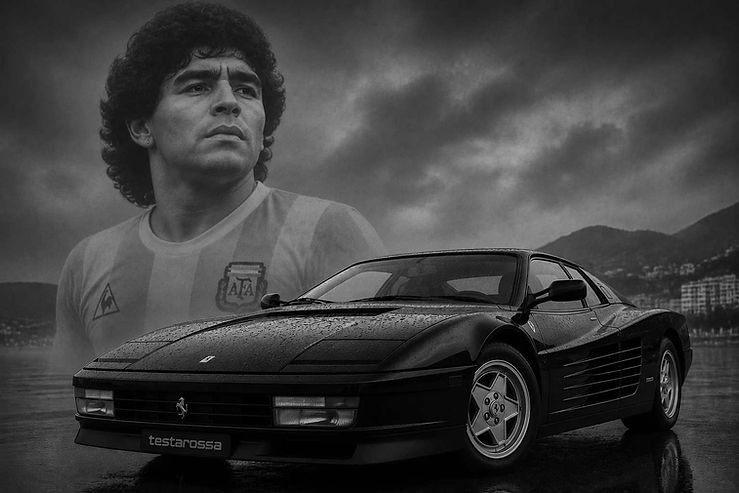
Maradona and the Testarossa
Power and Presence
Ruud Gullit
Mercedes-Benz 560 SEC
If Maradona represented intensity, Gullit represented control.
By the late 1980s, at Milan, he became the centre of a team built on structure, discipline, and physical dominance. Yet within that system, he never felt restricted.
He moved with authority.
Not rushed, not forced, but decisive.
I always found something reassuring about watching him.
Even in chaos, he felt stable.
The 560 SEC carries that same philosophy.
Built in an era where strength came from engineering rather than display, it projected power through solidity, not aggression.
There is a quiet confidence in both.
Nothing needs to be exaggerated.
Because everything is already understood.
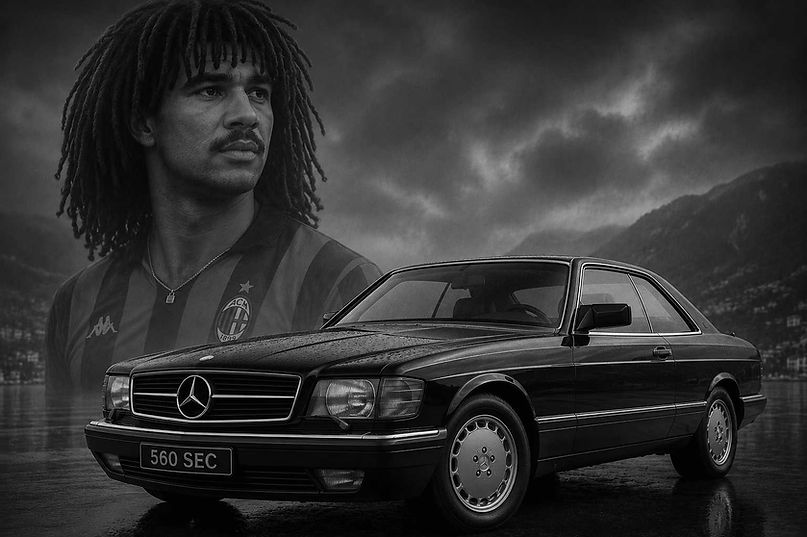
Ruud Gullit and his 1987 Mercedes-Benz 560 SEC
Precision and Fragility
Roberto Baggio
Ferrari F355
The 1990s introduced a different kind of tension.
Faster, more physical, less forgiving.
And within that environment, Baggio felt almost fragile by comparison.
His game was built on timing and intuition, always operating on a fine edge where brilliance and vulnerability coexisted.
There was a sense, watching him, that if you looked away for a moment, you might miss something essential.
The F355 carries that same balance.
Precise, responsive, and deeply engaging, but never entirely forgiving.
With both, the experience is heightened because it never feels completely secure.
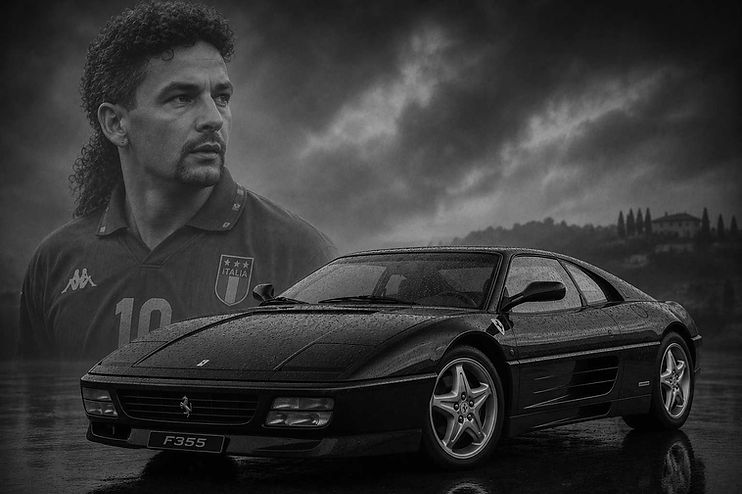
Roberto Baggio and the F355
The Outsider
Eric Cantona
Saab 900 Turbo
Cantona arrived in English football at a moment of transition.
The game was becoming faster, more physical, more structured, and yet he introduced something that didn’t quite fit within that direction.
There was control in how he played, but also unpredictability in how he carried himself. A constant sense that he operated according to his own logic, not the one around him.
He didn’t reject the system.
He simply never fully belonged to it.
The Saab 900 Turbo follows a similar path.
Developed with an engineering mindset shaped by aviation, it approached performance differently, prioritising function, ergonomics, and turbocharged efficiency over convention.
It never tried to compete on the same terms.
And because of that, it created its own.

Eric Cantonaand the SAAB 900 Turbo
Quiet Authority
George Weah
Mercedes-Benz S500
George Weah’s rise carried a different kind of weight.
Coming from Liberia, far removed from the traditional centres of European football, his path into the highest level of the game was not expected, and never fully absorbed into the narratives that defined his era.
And yet, in 1995, he stood at the top of it.
Ballon d’Or winner. A presence built not on noise, but on consistency, intelligence, and control.
There was a directness to his game.
Power, yes, but always applied with purpose.
The S500 reflects that same logic.
It does not rely on spectacle. It defines its position through clarity, through engineering, through an understanding of what it is meant to be.
With both, authority is never announced.
It is established.

George Weah and the Mercedes Benz S-Class
Image as Construction
David Beckham
Porsche 993 Carrera S
By the late 1990s, football had begun to change.
Visibility increased, but not everyone understood what to do with it.
Beckham did.
At Manchester United, his game was built on repetition. The same delivery, executed with a level of consistency that turned precision into identity.
There was very little excess in how he played.
Everything was controlled, measured, repeatable.
The 993 Carrera S reflects that same mindset.
As the final evolution of the air-cooled 911, it refined an existing formula rather than replacing it, relying on proportion, balance, and detail rather than reinvention.
It doesn’t demand attention.
But over time, it becomes impossible to ignore.

David Beckham and the 993 Carrera S
Structure and Intelligence
Frank Lampard
Aston Martin DBS
Lampard’s game was built on understanding.
Not just of space, but of timing, of repetition, of how patterns evolve over the course of a match.
At Chelsea, his influence was rarely immediate.
It accumulated.
Late runs, second balls, positioning that seemed simple until you realised how consistently it produced the same outcome.
There was discipline in everything he did.
Not restrictive, but deliberate.
The DBS reflects that same approach.
It combines performance with structure, delivering power through balance rather than excess, relying on proportion, weight, and control to shape its character.
Nothing is improvised.
Everything is constructed.

Frank Lampard and the Aston Martin DBS
Raw Force
Ronaldo
Ferrari 360 Modena
Ronaldo arrived at a moment when football still struggled to understand players like him.
He was too fast for defenders, too technical for a traditional striker, and too physically dominant to fit the image of the elegant Brazilian number nine that had come before him.
What made him extraordinary was not just acceleration.
It was the violence of transition.
One second the game felt under control.
The next, it was already gone.
At Barcelona, Inter and with Brazil, Ronaldo played with an explosiveness that changed the rhythm of entire matches. Defenders didn’t react to him, they anticipated damage.
The Ferrari 360 Modena carried a similar energy into the early 2000s.
Compared to the more delicate Ferraris that preceded it, the 360 felt sharper, more aggressive and more immediate, introducing a new level of speed and responsiveness without abandoning the emotion that defined the brand.
Like Ronaldo, it didn’t arrive quietly.
It arrived redefining expectations.

Ronaldo and the 360 Modena
Scale and Obsession
Cristiano Ronaldo
Bugatti Chiron
Cristiano Ronaldo’s career is built on repetition.
On refinement.
On a level of discipline that extends beyond talent.
That kind of mindset doesn’t emerge by chance.
The Chiron reflects that same philosophy.
It is engineered to exceed, repeatedly, across every measurable parameter.
Both are defined by scale.
And by the refusal to accept limitation.

Cristiano Ronaldo and the Bugatti Chiron
Individuality Without Concession
Zlatan Ibrahimović
Ferrari Monza SP2
Zlatan has always existed outside standard frameworks.
His career, his personality, even his communication resist simplification.
He doesn’t adapt to environments.
He reshapes them.
There’s a freedom in that.
But also a risk.
Players like Zlatan understand something others don’t.
That identity is more powerful than acceptance.
The Monza SP2 is built on that same belief.

Zlatan and the Monza SP2
Afterword
Over time, the details begin to blur.
The matches, the scores, even the seasons start to merge into something less precise.
What remains is something else entirely.
A gesture. A silhouette. A way of moving that felt distinct enough to resist time.
The same happens with certain cars.
They outlive their specifications.
They move beyond performance figures and technical comparisons, and settle into memory as objects that represented a moment, a mindset, a way of seeing the world.
That is where the connection exists.
Not in ownership. Not in fact.
But in recognition.
Because when identity is strong enough, it doesn’t stay confined to one place.
It finds other forms.
And sometimes, those forms happen to have four wheels.
Visuals in this article are editorial reconstructions created using AI to express conceptual alignment between subject and machine.