THE SHIFT Stories from Car Culture
GUMBALL 3000
THE MOVEMENT
In conversation with Maximillion Cooper
By Nuno Di Franco
Founder, KINGSHIFT
Before Gumball 3000, if you owned a supercar, the script was fairly well established.
You took it to a track day. You entered a concours. You drove it to a meeting of other people who owned similar machines, and you talked about the machines.
The car was the point.
Everything else was peripheral.
That model had clarity, but it also had limits. It defined what a supercar was supposed to be, and how it was supposed to be used.
There wasn’t much room for interpretation.

Maximillion Cooper AKA Mr. Gumball (Photo Gumball 3000)
The Missing Piece
Maximillion Cooper looked at that world in the late 1990s and felt something was missing.
Not performance. Not engineering.
Something else.
The kind of energy he had grown up around in fashion, music, and art.
Identity. Expression.
The sense that what you drove said something about who you actually were.
“What I felt was missing was something that reflected the energy I was seeing in youth culture… something that blended cars with creativity, music, fashion, and personality.”
In conversation with THE SHIFT, Maximillion Cooper spoke about something that wasn’t a refinement of anything that already existed.
It was something else entirely.
It wasn’t about improving what was already there. It was about introducing a different way of thinking around the car itself, one that placed equal importance on context, people, and experience.

First edition of Gumball 3000 | 1999 (Photo Gumball 3000)
A Different Beginning
A loosely structured convoy of friends driving across countries.
No podiums.
No stopwatch.
No real rules.
And yet, it did something the established formats never had.
It made supercar culture interesting to people who didn’t particularly care about supercars.
That crossover remains one of Gumball 3000’s most underappreciated achievements.
Because once that barrier was broken, the audience expanded.
The car stopped being the only entry point.
Culture became one too.
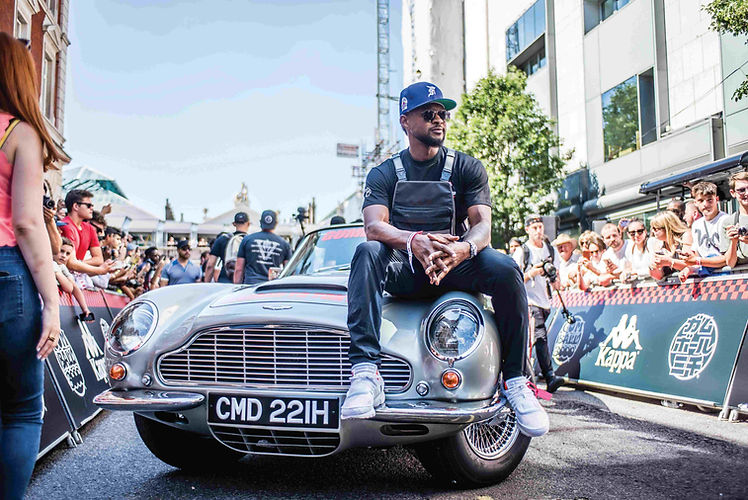
Usher on the Gumball 3000 Grid (Photo Gumball 3000)
The Crossover
The cars on the grid have always been extraordinary.
But the grid itself became something else.
Artists. Musicians. Entrepreneurs. Collectors.
People who saw the car not just as a machine, but as a statement, an extension of identity.
“Car culture isn’t just about mechanics or performance anymore. It’s about identity.”
“People see cars as extensions of themselves… whether they’re artists, entrepreneurs, or collectors.”
That shift didn’t happen overnight, but once it started, it redefined the expectations around what it meant to be part of the supercar world.

Mr. and Mrs. Gumball3000 (Photo Gumball 3000)
Not Engineered
This wasn’t something imposed from above.
It evolved the same way the event itself did: organically.
“The fusion was partly intentional and partly organic.”
“I came from a fashion, music, and art background, so it felt natural to bring those worlds together with cars.”
And over time, something else shaped it.
“What really shaped it was the people.”

Flag drop in Toronto with David Hasselhoff (Photo Gumball 3000)
Expansion and Culture
As Gumball 3000 grew, it extended beyond the rally itself.
Apparel. Media. Collaborations.
“The expansion evolved naturally… it was more about responding to what the audience connected with.”
That responsiveness is precisely what most automotive brands, for all their resources, have struggled to replicate.
Culture doesn’t respond well to being managed.
Gumball 3000 understood this early.
It allowed things to evolve without forcing direction, something that is far harder to execute than it appears.
Most brands try to control culture.
Gumball let it form.
“It’s both a reflection and a catalyst.”
“Gumball mirrors what’s happening in culture, but it also pushes it forward.”
“When you put those elements in one space, new ideas and collaborations naturally emerge.”

Patrice Evra in Bangkok (Photo Gumball 3000)
A Shift in Meaning
For most of the 20th century, the supercar meant one thing: speed.
And the wealth required to access it.
The machine was dominant.
The person behind the wheel was almost incidental.
Gumball 3000 helped dismantle that hierarchy.
It didn’t remove the importance of the machine.
It reframed it.
The car became part of a wider narrative rather than the entire story.

IShowSpeed (Photo Gumball 3000)
Rebalancing
On the Gumball 3000 grid, the car and the person carry equal weight.
The question is no longer just what you’re driving.
It’s who you are when you drive it, where you take it, what you do when you get there.
The car is still central.
But it no longer defines the entire experience.
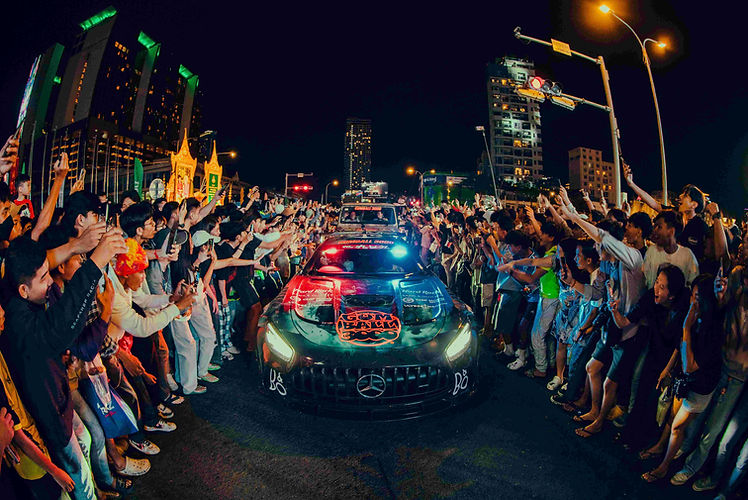
Mercedes Madness in Bangkok (Photo Gumball 3000)
“Racing is about winning.
Gumball 3000 is about experiencing.”

Bucharest crowds (Photo Gumball 3000)
A New Perspective
A generation of collectors and enthusiasts now thinks about cars in terms of narrative and community as much as specification.
Ownership is no longer the end of a story.
It’s the beginning of one.
A starting point for experiences, for movement, for connection.
The value shifts from possession to participation.

David Hasselhoff and Maximillion Cooper on the grid in Dublin (Photo Gumball 3000)
The Early Years
None of this came easily.
There were funding problems, logistical challenges, and a public that didn’t always know what to make of it.
“There were definitely moments where it could have gone another way or not happened at all.”
“The challenges… are what teach you how to adapt, improve, and stay grounded.”

Gumball 3000 in Cambodia (Photo Gumball 3000)
The Future
The automotive world is evolving in multiple directions at once.
Electrification pulling one way. Analogue revival pulling another.
Gumball 3000 isn’t fixed to either.
That flexibility is what allows it to remain relevant. It isn’t tied to a specific technology or era, but to a way of experiencing the world.
“We’re open to change… but the focus will always remain on experience and culture.”
“It’s not about the type of car, it’s about what the journey represents.”

Afrojack performing in Bucharest (Photo Gumball 3000)
The Journey Continues
This June, the journey runs from Miami to Mexico City.
A route that moves not just across distance, but across cultures, from one energy to another, from one rhythm to the next.
Cities change.
People change.
The atmosphere shifts.
But the essence remains.
Whatever unfolds along the way becomes part of a story that has been evolving since 1999.

Rolling through Thailand (Photo Gumball 3000)
Legacy
In the end, what matters is not what was built, but what remains.
Not the event itself, but the impact it leaves behind.
“I’d hope people say it changed how events can bring cultures together.”
“That it broke down boundaries between industries and created a new kind of global community.”
For supercar culture, that legacy is already visible.

Mr. Gumball says hello to the crowd (Photo Gumball 3000)
A World in Motion
Gumball 3000 is often described through what can be seen.
The cars.
The routes.
The spectacle.
But what defines it isn’t what’s visible.
It’s what happens around it.
Where identity, culture, and movement intersect.
Where the journey becomes something more than distance.
Not a rally.
But a world in motion.

GMA T.50 Sets Off in Istambul (Photo Gumball 3000)