Sauro Torreggiani has drawn every Formula 1 car. Even the ones that never won.
More than 5,000 illustrations.
Thirteen years of work.
From World Championship icons to forgotten cars that barely made the grid, Sauro Torreggiani is building a visual history of Formula 1 unlike any other.

Sauro Torreggiani
A Picture is Worth a Thousand Words
“A picture is worth a thousand words,”
journalist Arthur Brisbane wrote in 1911, describing the power of images to reach the mind and the eye without the need for explanation.
It is a philosophy that perfectly describes the work of Sauro Torreggiani.
The Italian illustrator has undertaken a monumental task: tracing the history of Formula 1 through approximately 5,000 drawings representing the cars built for the World Championship from 1950 to the present day.
From the legendary machines of World Champions to the forgotten projects of small teams, his illustrations tell the evolution of motorsport’s highest category through the immediate power of art.
But perhaps what makes Torreggiani’s work truly remarkable is that, in his world, every car matters. Not only the winners.
A Boy from Mantua
Torreggiani was born in 1957 in the countryside of the province of Mantua, Italy.
His attraction to cars and model cars appeared early, together with a natural talent for drawing. He applied it to different subjects: aircraft, human figures, the front ends of rally cars, prototypes.
Then came the spark that would change everything.
By chance, he watched a Formula 1 race on television. A Ferrari and a BRM were locked in a close battle. It was not so much the fight for victory that fascinated him, but the shapes of the cars themselves.
They were, as Torreggiani remembers them, “streamlined like aeroplanes with wheels.”
After finishing compulsory education, and with little enthusiasm for further study, Torreggiani entered the working world early. At seventeen, he began working in a body shop, dealing with competition and historic cars. It gave him the opportunity to physically encounter the machines he had previously admired from a distance, from rally cars to Formula 1 cars.
He describes that period as unforgettable, even if it was short, because life, he says, eventually demands fewer dreams and more pragmatism.
He was forced to move into another field, but he never forgot those hours spent beside racing cars.
Decades later, they would return in every detail of his drawings.

March 721G, Ronnie Peterson, 1972
From Paper to Pixels
The first time Torreggiani remembers seeing a reproduction of a racing car was while leafing through Autosprint, the cult Italian weekly dedicated to motorsport.
His desire to draw led him to begin reproducing single-seater profiles on paper. Eventually, he produced around 640 drawings at 1:25 scale.
The pastime continued until 1992. Then the drawer closed, but twenty years later, in 2012, it opened again.
Sauro decided to return to drawing. This time digitally, despite not knowing how to use any illustration software.
After roughly a year of experimentation and self-taught study, he learned to reproduce racing cars on a computer in a style inspired by the work of illustrator Paolo Betti, whom Torreggiani considers his master.
The objective was not to create technical drawings. The proportions and dimensions had to remain faithful to reality, but the images also had to communicate emotion and make each machine instantly recognisable.
His drawings began appearing on a website for motorsport enthusiasts and quickly gained appreciation. A small group of collaborators began forming around the project. Then Torreggiani met journalist Massimo Piciotti, an expert in the history of drivers and teams and a cataloguer of the Formula 1 chassis that raced until the 1990s.
With Piciotti’s research and notes, Torreggiani’s illustrations gained another dimension: historical precision.
The drawings were becoming an archive.
MILLEe1CORSA
In 2020, during the Covid lockdown, Bologna-based graphic designer Matteo Lumia contacted Torreggiani and showed him an almanac containing Formula 1 results from 1950 to 2012. The three became a team.
Because Sauro had an idea. An idea that, in reality, had been with him since childhood.
He wanted to make Formula 1 grids visible again.
Not merely lists of names and results, but the actual cars positioned in their real starting formations, allowing someone to see, Grand Prix after Grand Prix, how an entire season unfolded.
That idea became MILLEe1CORSA. The history of Formula 1 told through drawings of the cars designed and built for the World Championship.
One season, one volume. One race, one grid. One car, one drawing.
Championship after Championship.
An initial self-funded “issue zero” was printed.
Traditional publishers declined the project. In a publishing market already under pressure, none were prepared to make the necessary investment. So the team chose another route: self-publishing through Amazon.
In May 2023, the first volume appeared, dedicated to the 1970 Formula 1 World Championship.
Today, 52 season volumes have been published, covering the years from 1950 to 1999, together with the 2024 and 2025 seasons. They are available in both Italian and English.
Work on the seasons from 2000 onwards is already underway.

Sauro Torreggiani at work

McLaren MP4-5B, Ayrton Senna, 1990 Season

Jordan EJ15, Tiago Monteiro, 2005 Season

Maserati 250F, Juan Manuel Fangio, 1957 Season
Every F1 Car Deserves a Portrait
The heart of Torreggiani’s work is philosophical before it is artistic.
Every single car that has taken part in Formula 1 deserves to be drawn.
Not only the car belonging to that season’s World Champion.
The result is an immense collection which, according to the latest estimates, exceeds 5,000 illustrations when the different chassis variations and special liveries used throughout individual seasons are included.
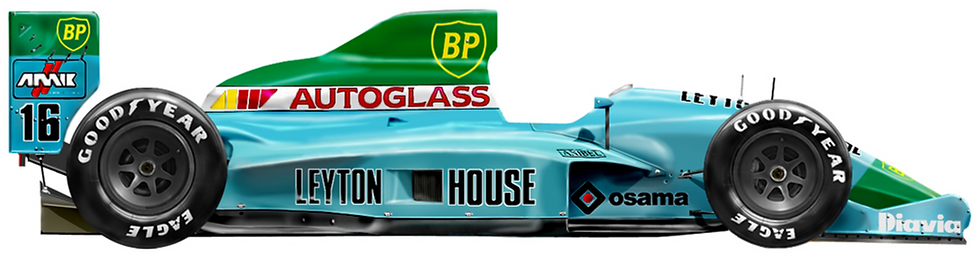
Leyton House CG901, Maurício Gugelmin, 1990 Season
The Numbers Behind the Obsession
5,000+ Car profiles drawn
2,600+ Pages published
52 Season volumes published — 1950–1999, plus 2024 and 2025
656 Grands Prix from 1950 to 1999 documented in the volumes
3,596 Car profiles published across the first 50 volumes
13 YEARS Spent drawing more than 5,000 profiles
15–20 HOURS Required to create a single car from scratch
But numbers tell only part of the story.

With extraordinary precision, Sauro’s work documents every Formula 1 car to have taken its place on the grid.
Drawing the Forgotten
Reproducing a single vehicle can require between fifteen and twenty hours of work.
Torreggiani begins with photographic research, using websites specialised in archiving historic motorsport material.
The photographs can come from every possible angle. Some are in colour, others in black and white. Some are blurred. Others show the car from awkward perspectives.
Then comes the historical research.
For Torreggiani, a drawing can only succeed once you truly know the story of the vehicle, its engineers and its driver.
That means reading contemporary race reports and searching for details that might otherwise disappear.
Sometimes something as apparently simple as establishing the colour of a particular car requires detective work because the only surviving photographs are in black and white.
And the most difficult cars to recreate are often the forgotten ones. Obscure machines. Cars for which only a handful of photographs remain.
Helping Torreggiani in this search is a small international community of enthusiasts and experts that has gradually formed around his work. They send photographs, identify errors, suggest corrections and add details.
Piece by piece, the archive becomes more complete.
No Hierarchy
What makes Torreggiani’s work unique is its complete absence of hierarchy.
There are cars from Formula 1’s most celebrated teams, But beside them are the single-seaters created by teams armed with little more than courage.
There are audacious projects from tiny constructors. Cars driven by almost unknown drivers who attempted to qualify for perhaps only one Formula 1 Grand Prix.
For Torreggiani, the history of this extraordinary sport is built above all by tenacious, determined and stubborn people.
Drivers. Mechanics. Engineers. People with whom he shares the same fever, the same love for engines and speed.
Because it is easy to fall in love with the Champion and it is easy to remember the fastest car, but Formula 1 history is not only made by those who won.
Behind every Champion are all those who never won a Grand Prix.
Teams that survived for a single season.
Chassis constructed with almost impossible budgets.
Dreams that reached a Formula 1 paddock but never reached a podium.
In Torreggiani’s archive, they are not forgotten. They receive the same portrait.

Sauro doing detective work and making sure every single detail of each car is not missed

Williams FW21, Alex Zanardi, 1999 season

Lotus 33, Jim Clark, 1965 season
More Than Illustration
Sauro Torreggiani’s work goes far beyond a collection of drawings. It is historical, bibliographical and documentary.
Precise and extraordinarily rich in technical detail.
Yet alongside that accuracy is an artistic eye. His compositions remain balanced, transforming the cars into images that can sometimes appear almost more beautiful on paper than they did in reality, and although the images themselves are static, they possess an extraordinary vitality.
Every profile communicates movement. Volume. Life.
The result is an unmistakable style that makes Torreggiani’s illustrations immediately recognisable.
Together, they form a celebration of Formula 1 machinery as icons of speed, design and innovation, but they also do something more important. They teach the history of the racing car to those who look at them — and preserve that history for the generations that will follow.
Sauro Torreggiani’s undertaking is almost cyclopean in scale, yet completely artisanal in execution.
It is the work of one man who transformed the passion of a child into a project unlike anything else in the world.
A project that perhaps only his own stubbornness could ever have carried this far, and thousands of cars later, he is still drawing.
To discover more of Sauro Torreggiani’s extraordinary work and to acquire his pieces, please visit:
Sauro Torreggiani website

Much more than illustrations. History perserved.

