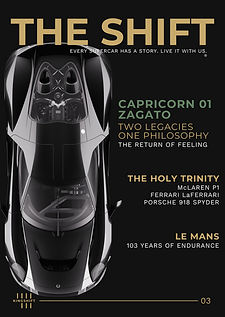
A Different Kind of Hypercar
Some cars are built to define the future.
Others are built to question it.
The capricorn 01 Zagato belongs firmly to the second kind.
Not a machine created to follow the direction of the industry, but one that steps back, and asks a more fundamental question:
What should driving feel like?
A Feeling We Were Losing
For years, the direction was clear.
More power.
More technology.
More layers between driver and machine.
Progress, measured in numbers.
And yet, somewhere along the way, something began to fade.
Not performance.
But sensation.

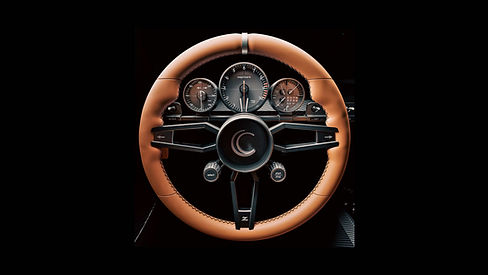
capricorn 01 Zagato steering wheel with analog instruments
A Different Starting Point
This story does not begin with an engine.
Or a design sketch.
It begins with a question:
What should a car feel like today?
Not in theory.
But in the hands of the person driving it.
Two Paths, Quietly Converging
Long before this car existed, two very different disciplines were evolving in parallel.
In Germany, since 1933, a company focused on precision at a level most would never see, developing components for machines that operate at the limit.
In Milan, since 1919, a small design house shaped by aviation thinking, where lightness and form were inseparable from performance.
Different origins.
Different languages.
But, at their core, the same obsession:
To remove what is unnecessary, and elevate what remains.
When 93 years spent shaping championship-winning machines meet 107 years devoted to designing some of the most beautiful cars ever created, the result can only be a modern masterpiece.


capricorn Nürburgring manufacturing facility
The Unseen Side of Performance
capricorn is not a name most people would recognize immediately.
And yet, its work is everywhere.
Not on the surface, but beneath it.
Inside the cars that define performance at the highest level, from Formula 1 to Le Mans.
Across decades of competition, that presence has translated into results:
186 championships.
18 Formula 1 titles.
14 Le Mans victories.
A track record built not through visibility, but through contribution.
A kind of engineering that does not seek attention,
but repeatedly proves itself where it matters most.
Form, Without Excess
Zagato has always approached the automobile differently.
Not as a canvas.
But as a structure.
Its origins in aviation are not a detail, they are a foundation.
Lightness was never a trend.
It was a requirement.
And over time, that requirement became a language.
One defined not by decoration, but by proportion, efficiency, and restraint.
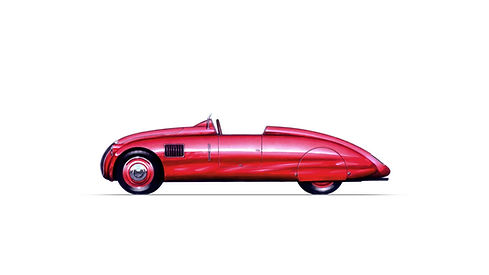
Lancia Aprilia Sport Zagato, 1938
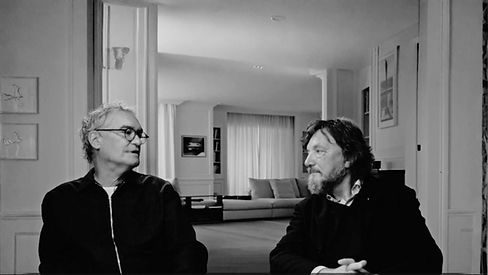
Robertino Wild (left) and Andrea Zagato (right)
When Ideas Align
Projects like this are often described as collaborations.
This one feels different.
A long-standing relationship between Robertino Wild and Andrea Zagato created the conditions for something more natural.
Not a brief.
Not a market opportunity.
But a shared understanding of what a car should be.
A Quiet Shift
For capricorn, this is a departure.
After decades of building for others, this is the first time the company presents a car as a complete vision.
Not a component of performance.
But its interpretation.

capricorn 01 Zagato gullwing doors

Redefining the Objective
There was never an intention to build the fastest car.
Or the most powerful.
Or the most technologically advanced.
Those battles are already being fought.
This was about something else entirely:
To build a car that feels right.
Removing the Layers
Modern performance is often filtered.
Software refines it.
Electrification enhances it.
Systems manage it.
The capricorn 01 Zagato takes a different path.
It removes.
Not to simplify the car, but to clarify the experience.
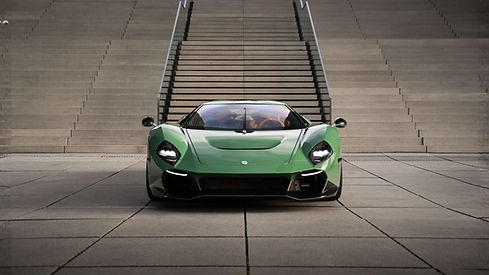

The Core
At its center, a 5.2-liter supercharged V8.
Over 900 horsepower.
1,000 Nm of torque.
A redline at 9,000 rpm.
0–100 km/h in under 3 seconds.
A top speed of 360 km/h.
These numbers matter.
But they are not the reason this car exists.
The Decision
that Changes Everything
The gearbox tells you everything you need to know.
A five-speed manual.
Not because it is efficient.
But because it is engaging.
Because it requires timing.
Attention.
Involvement.
Because it gives something back.


The Role of the Driver
This is not a car that adapts to you.
It expects you to rise to it.
Rear-wheel drive.
Minimal interference.
The balance is yours to manage.
And that is precisely the point.
Weight, or the Absence of It
Before power, there is mass.
Or, in this case, the reduction of it.
A carbon fiber monocoque derived from LMP1 thinking.
A structure built around lightness as a principle, not a target.
Under 1200 kg.
The kind of number that changes everything that follows.


Air as a Tool
There are no exaggerated wings.
No visual declarations.
The work happens elsewhere.
Under the car.
Through the surfaces.
In the way air is guided, not forced.
Performance, without the need to announce it.
A Shape Outside of Time
The design does not try to look futuristic.
Nor does it rely on nostalgia.
It exists somewhere in between.
Confident enough to stand on its own, without reference.
Under the direction of Norihiko Harada, Zagato’s design language is pushed further, without losing the discipline that has always defined it.
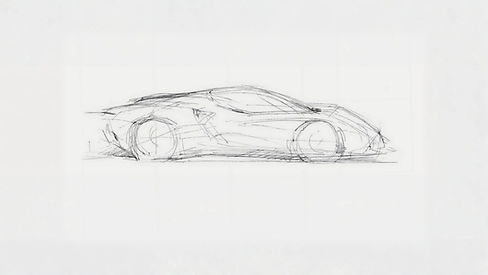
Nori Harada’s sketch of the capricorn 01 Zagato.
Inside the Machine
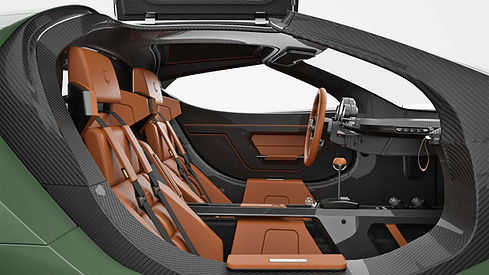
Step inside, and the approach becomes even clearer.
No screens. No infotainment system.
No unnecessary complexity.
Only what serves the act of driving.
Nothing more.
Scale and Intention
Only 19 cars will be built.
A number that speaks quietly to Zagato’s origins.
But more importantly, to the idea that this was never meant to be scaled.
Some things are more meaningful when they remain rare.

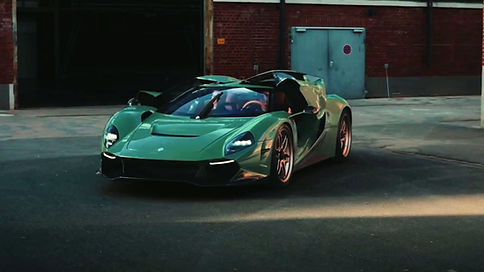
Not an End, But a Beginning
For capricorn, this is not a one-off.
It is the beginning of something.
A first expression of what the company believes a car should be, when it is no longer building for others.
What Remains
In the end, the capricorn 01 Zagato does not try to define the future.
It does something far more interesting.
It asks a question.
And leaves the answer in the hands of the driver:
What should a car feel like?